





In football, there is a truth that fans know well but rarely acknowledge out loud: goalscorers dominate the headlines, but defenders win championships. The history of the beautiful game is filled with teams built upon the solidity of their defensive lines, on the coolness of a sweeper capable of reading the game before it unfolds, and on the bravery of a full-back joining the attack when everyone expects them to stay put.
Choosing the ten greatest defenders in the entire history of football is, inevitably, a subjective exercise. The criteria we have used are clear: influence on their era, impact on the tactical evolution of their position, titles conquered, sustained level of play over the years, and their footprint on the teams they defended. We are not just looking for famous names, but for players who truly changed the way defending is understood.
Here is the countdown of the ten greatest.
📋 Table of Contents
- 🛡️ The 10 Best Defenders in History
- ❓ Why Are Other Great Defenders Not Included?
- 🧠 Frequently Asked Questions
- 📝 Conclusion
🛡️ The 10 Best Defenders in History
1. Franz Beckenbauer (Germany)
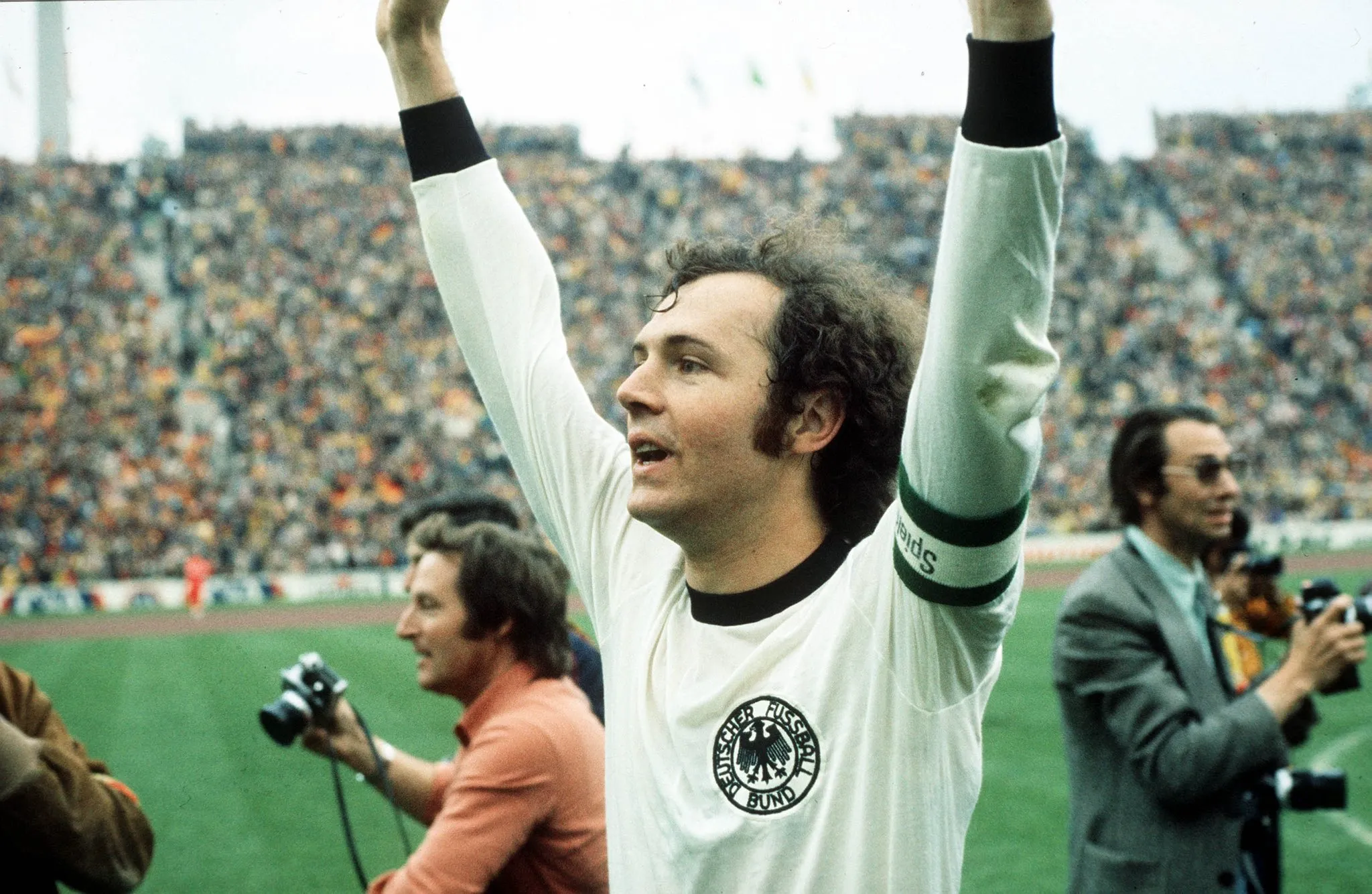
If there is a consensus in football regarding who was the greatest defender of all time, that name is Franz Beckenbauer, the Kaiser. Not because he was the fastest, the strongest, or the most forceful in one-on-one situations, but because he radically transformed what it meant to play as a defender. Before Beckenbauer, the sweeper was a player whose primary function was to destroy. With him, it became the first playmaker from the backline.
During his time at Bayern Munich, Beckenbauer won three consecutive European Cups (1974, 1975, and 1976) and captained the German national team to the 1974 World Cup title. His vision allowed him to read the game several moves ahead, and his ability to bring the ball out of defense under control was the envy of many midfielders. Capping off an unparalleled career, he repeated that success years later as a manager, leading Germany to win the 1990 World Cup in Italy. Two World Cups, two different roles, the same result: champion.
Clubs: Bayern Munich, New York Cosmos, Hamburger SV Honors: 1974 World Cup, Euro 1972, 3 European Cups, Ballon d’Or 1972 and 1976
2. Paolo Maldini (Italy)
There are long careers, and then there is the career of Paolo Maldini. For 25 seasons, the Milan native played for a single club—AC Milan—without his level dropping significantly. He started as a fast-overlapping left-back in the eighties and finished as an authoritative and experienced center-back in the 2000s, adapting with unusual tactical intelligence.
What distinguishes Maldini from other great defenders is the combination of his elite longevity with the elegance of his play. He was never the most aggressive or intimidating: his main tool was anticipation. He rarely needed to make a strong tackle because he almost always arrived first. His presence in the dressing room was that of a natural leader who didn’t need to shout: his example was enough.
He conquered four Champions Leagues with Milan (1989, 1990, 1994, and 2003) and was a fundamental piece in one of the greatest teams in European football history. He reached the 1994 World Cup final with Italy, where the Azzurri fell on penalties to Brazil. Milan’s number 3 jersey was retired forever in his honor.
Club: AC Milan Honors: 4 Champions Leagues, 7 Serie A titles, 1994 World Cup finalist
3. Franco Baresi (Italy)
If Maldini was elegance personified, Franco Baresi was the coldest tactical brain in the dressing room. Milan’s captain for over a decade, Baresi embodied the Italian catenaccio in its most sophisticated version: not the primitive defensive bolt, but the high line, the offside trap as a weapon, and the direction of the entire defense with a commanding voice his teammates obeyed instinctively.
One of the most memorable images of his career ironically comes from a defeat: the 1994 World Cup, when Baresi reached the final after recovering from a meniscus injury in record time and was one of the best players of the tournament. The Azzurri lost on penalties to Brazil; Baresi missed the first one. For any other player, that moment would have overshadowed an entire career. For him, he simply couldn’t.
Club: AC Milan Honors: 3 Champions Leagues, 6 Serie A titles, 1982 World Cup
4. Elías Figueroa (Chile)
To talk about Elías Figueroa is to talk about one of world football’s great injustices: a defender who was chosen as the best player in the Americas for three consecutive years (1974, 1975, and 1976) and yet barely appears on global lists of history’s greatest defenders simply because he played in an era without the media coverage Europe enjoyed.
Figueroa was an elegant, technical, and dominant center-back who shone in three different countries. At Peñarol (Uruguay), he won national championships; at Internacional de Porto Alegre (Brazil), he became an idol and a three-time champion; for Chile, he was eternally the national team captain. His anticipation, aerial game, and clean passing from the back made him the paradigm of the modern South American defender. Pelé considered him the best defender he ever faced in his entire career.
Clubs: Santiago Wanderers, Peñarol, Internacional de Porto Alegre, Palestino Honors: Three-time champion with Inter de Porto Alegre, multiple titles in Uruguay and Chile, 3-time Best Player in the Americas
5. Bobby Moore (England)
Bobby Moore is a figure who transcends the sport. Captain of the English national team during the 1966 World Cup, Moore lifted the Jules Rimet Trophy from the hands of Queen Elizabeth II and became the symbol of an entire nation. But beyond the title, what makes Moore great is how he played: with a serenity and leadership that seemed out of place for someone who was 25 at the time.
Moore was never the fastest or the most physical. He was a center-back who relied almost exclusively on his reading of the game, his positioning, and his ability to anticipate the opponent. Pelé, who played an epic match against him in the 1970 World Cup in Mexico, described him as the most difficult defender he had ever faced. Their embrace at the end of that match became one of the most iconic photographs in sports history.
Clubs: West Ham United, Fulham Honors: 1966 World Cup, 1965 European Cup Winners’ Cup
6. Cafú (Brazil)
The debate over the greatest right-back in football history has many candidates, but few arguments as solid as those for Cafú. The Brazilian was called up for four consecutive World Cups (1990, 1994, 1998, and 2002) and participated in three finals, winning two of them. No other player in history has reached three consecutive World Cup finals.
What made Cafú special wasn’t just his speed or individual technique, though both were extraordinary. It was his ability to maintain that level for over a decade, remaining one of the most decisive full-backs in both attack and defense. With AC Milan, he also won the Champions League in 2003, concluding a career making him the most decorated right-back in football history.
Clubs: São Paulo, Roma, AC Milan Honors: 1994 and 2002 World Cups, 2003 Champions League, Copa Libertadores, multiple Serie A and Brasileirão titles
7. Sergio Ramos (Spain)
Sergio Ramos is probably the most polarizing defender on this list. No one who has followed football closely over the last twenty years has a neutral opinion about him: you either love him or hate him, almost always depending on the team you support. But beyond the controversies and red cards—he holds the all-time record for sendings-off in the Champions League—the numbers are undeniable.
With Real Madrid, he won four Champions Leagues, five LaLiga titles, and multiple domestic honors. For the Spanish national team, he was captain during the most successful period in Iberian football history: the 2010 World Cup and the 2008 and 2012 European Championships. His 93rd-minute equalizing header in the 2014 Champions League final in Lisbon, which forced extra time against Atlético Madrid, is one of the most decisive moments in the tournament’s history. Ramos didn’t just defend; he showed up in the biggest moments.
Clubs: Sevilla, Real Madrid, PSG Honors: 4 Champions Leagues, 2010 World Cup, 2 European Championships, multiple Spanish LaLiga titles
8. Nilton Santos (Brazil)
Before full-backs were what they are today—offensive players with the freedom to join the attack, cross, and even shoot—there was Nilton Santos. The Botafogo Brazilian was the first to demonstrate that a full-back could be an offensive weapon, not just a shield. At the 1958 World Cup, when Brazil conquered its first world title in Sweden, Nilton Santos was already joining the attack with a naturalness his contemporaries observed with astonishment.
His influence on the modern game is enormous, although difficult to quantify precisely due to historical distance. Every time a full-back today joins the attack and crosses to the far post, there is a bit of the Enciclopédia—his nickname in Brazil—in that play.
Club: Botafogo Honors: 1958 and 1962 World Cups
9. Ronald Koeman (Netherlands)
The most repeated question when discussing Ronald Koeman is always the same: can a defender be the top scorer in the history of his position? The answer is yes, and Koeman proved it throughout his career with over 200 goals as a defender. His specialty was direct free kicks, executed with a power and precision making the best goalkeepers of the era sweat.
At Johan Cruyff’s FC Barcelona Dream Team, he was a fundamental piece, and his free-kick goal in the 1992 European Cup final against Sampdoria at Wembley—the only goal of the match—is one of the Catalan club’s most iconic images. Koeman wasn’t the most elegant or sober defender, but his contribution to collective play and his ability to unbalance matches from the sweeper position make him a unique case in football history.
Clubs: Ajax, PSV, FC Barcelona Honors: Euro 1988, 1992 European Cup, multiple Dutch Eredivisie and Spanish LaLiga titles
10. Virgil van Dijk (Netherlands)
He is the only active player on this list, and his presence is justified because very few defenders in football history have had the transformative impact that Virgil van Dijk had on Liverpool since his arrival in January 2018. Before him, Jürgen Klopp’s team was brilliant in attack but suffered from obvious defensive fragility. After him, Liverpool won the 2019 Champions League, the 2020 Premier League, the League Cup, and the FA Cup in a historic cycle.
Van Dijk combines impressive physical superiority—he is 1.93 meters tall and wins practically all aerial duels—with technical quality allowing him to actively participate in building play. In the 2018-19 season, he was a Ballon d’Or finalist, becoming the first defender to reach that position since Fabio Cannavaro in 2006. His influence on 21st-century football makes him a legitimate candidate to be remembered as one of the greats of his era.
Clubs: Groningen, Celtic, Southampton, Liverpool Honors: 2019 Champions League, 2020 Premier League, UEFA Super Cup, FIFA Club World Cup
❓ Why Are Other Great Defenders Not Included?
A list of ten is always an incomplete list, and this one is no exception. There are names deserving to appear in any serious debate about the greatest defenders in history:
Fabio Cannavaro was the only defender to win the Ballon d’Or (2006) and led Italy to the World Cup title that same year with a memorable performance. His absence from this list is debatable and many would rightly question it.
Roberto Carlos redefined the left-back position with his speed and shooting power. His free kick against France in 1997 remains a subject of physical and mathematical debate. Alongside Cafú, he formed the most unbalancing pair of full-backs in football history.
Carles Puyol was the captain of one of the most successful teams in history, Guardiola’s Barcelona, and of the Spanish national team during its golden era. His commitment and leadership make him a generational benchmark.
Fernando Hierro dominated the Spanish defense and Real Madrid for over a decade with an authority few defenders have matched. He also holds the distinction of being one of the highest-scoring defenders in Spanish LaLiga history.
Football has the virtue of generating eternal debates. If your candidate is not on this list, the discussion is exactly what this sport deserves.
🧠 Frequently Asked Questions About the Greatest Defenders in History
Who is considered the greatest defender in the history of football? The majority consensus among football historians and analysts points to Franz Beckenbauer as the greatest defender of all time, due to his tactical influence, his titles, and for having revolutionized the sweeper position.
How many Champions Leagues did Paolo Maldini win? Paolo Maldini won four Champions Leagues with AC Milan: in 1989, 1990, 1994, and 2003.
Who is the highest-scoring defender in football history? Ronald Koeman is considered the highest-scoring defender in professional football history, with over 200 goals throughout his career, many of them from free kicks.
Which defender has won the most World Cup titles? Cafú (Brazil) is the only player to have played in three consecutive World Cup finals (1994, 1998, and 2002), winning two of them. It is the most extraordinary record in tournament history for a defender.
Who was the best defender of the 21st century? The debate includes Sergio Ramos, Virgil van Dijk, and several others, but Ramos has amassed the most titles with four Champions Leagues and three major international tournaments with the Spanish national team.
Which defender won the Ballon d’Or? Only Fabio Cannavaro (2006) and Franz Beckenbauer (1972 and 1976) have won the Ballon d’Or while being defenders. This reflects how rare it is for individual awards to recognize defensive work.
📝 Conclusion
The ten players on this list share something extending far beyond trophies and records: they all somehow transformed the way their position is understood. Beckenbauer invented the modern sweeper. Nilton Santos and Cafú redefined the full-back. Maldini proved that elite longevity is possible. Van Dijk reminded the modern world that a dominant center-back can single-handedly alter a team’s destiny.
Defending in football is an art not always receiving the recognition it deserves. The most heated debates usually revolve around strikers and creative midfielders. But when looking back at the greatest teams in history—Sacchi’s Milan, the Bayern of the seventies, the Spain of 2008-2012, the Liverpool of 2019—they all share a defensive spine built upon figures of this magnitude.
Defending well is knowing when not to intervene. It’s reading the attacker before they even know what they’re going to do. It’s shouting positions to teammates, holding the line, and showing up at precisely the right moment. That, at the highest level, for years, is what these ten did.