





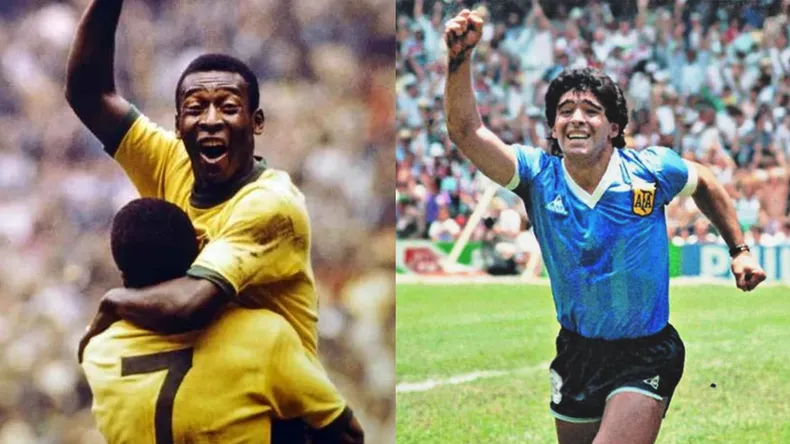
There are debates in football that will never end because they have no objective answer. That of Diego Armando Maradona and Pelé is the oldest, the most passionate, and the most divided of them all. Two players who never coincided in the timeline of their best versions, who grew up in completely different contexts, and who left such different marks that comparing them directly requires assuming, from the beginning, that any conclusion will be partially subjective.
Maradona was born in Buenos Aires in 1960, in the city’s slums, and arrived in professional football carrying the weight of a country that expected from him something more than goals. Pelé was born in 1940 in the interior of Brazil, the son of a footballer who never managed to succeed, and became the symbol of a country that found its most recognizable identity in the world in football. Two humble origins, two continents, two eras: and yet, for decades, the world has continued to ask who was the best.
In this article, we do not intend to give a definitive answer—because one does not exist—but to offer the most complete comparison possible: statistics, titles, historical context, playing style, and the legacy that each has left in football and popular culture.
📋 Table of Contents
- Honors and Statistics Compared
- Diego Maradona: The Rebel Genius
- Pelé: The King of Football
- Legacy and Influence in Football
- The Eternal Debate: Who Was Better?
- Conclusion
Honors and Statistics Compared
Below are the most important data for each in official matches and competitions:
| Category | Diego Maradona 🇦🇷 | Pelé 🇧🇷 |
|---|---|---|
| Official titles | 9 | 26 |
| Club matches | 491 | 831 |
| Club goals | 259 | 757 (official) |
| Estimated assists | 150+ | 300+ (estimated) |
| National team matches | 91 | 92 |
| National team goals | 34 | 77 |
| World Cups | 1 (1986) | 3 (1958, 1962, 1970) |
| Ballon d'Or | 1 honorary (1995) | 1 honorary (2014) |
The difference in titles—26 for Pelé compared to 9 for Maradona—partly reflects the different conditions in which each competed: Pelé played with a Santos team that dominated Brazilian football for an entire era, while Maradona arrived at a Napoli team that had never won Serie A before and led them to the title from scratch. A direct comparison of honors, as in all intergenerational debates, requires context to be fair.
Diego Maradona: The Rebel Genius
Diego Maradona arrived in professional football at the age of 15 at Argentinos Juniors in Buenos Aires, and from the very first moment, it was clear that the world was facing something it had never seen before. He wasn’t the tallest, he wasn’t the fastest in a straight line, he wasn’t the strongest. But he had a combination of ball control, game vision, and the ability to beat opponents in minimal spaces that no manager had found a way to consistently neutralize.
His first major spell came at FC Barcelona, where he played between 1982 and 1984. They were two difficult seasons: injuries, institutional conflicts, and the feeling that his environment didn’t always provide the conditions he needed to perform at his best. But in Naples, he found his home. He arrived in 1984 at a southern Italian club that had never won Serie A, that lived in the shadow of the northern teams, and in seven years transformed them into the best team in Italy. Two leagues (1987 and 1990), one UEFA Cup (1989), and multiple Coppa Italias: titles the club had not won before and has not won consecutively since.
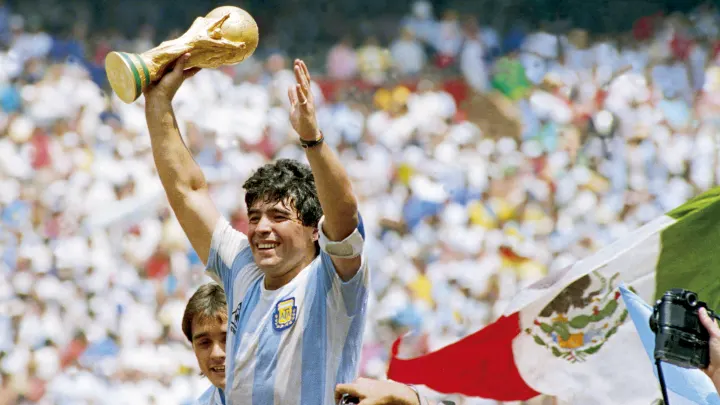
But the moment defining Maradona above all others is the 1986 World Cup in Mexico. In that tournament, Maradona was simply the greatest player in World Cup history in terms of individual impact on the result: he carried Argentina on his shoulders from the group stage to the final, where they beat West Germany. The match against England in the quarterfinals concentrated everything Maradona was: the goal with his hand—which he described as “the hand of God” with a smile saying more than any explanation—and the Goal of the Century, an 11-second play in which he picked up the ball in his own half of the pitch, beat five opponents and the goalkeeper, and scored the goal most voted as the best in football history.
His final years were marked by addictions, public conflicts, and progressively deteriorating health. Maradona died in November 2020, at the age of 60, and his passing generated one of the most massive periods of mourning that Argentina and the footballing world have ever experienced for an athlete.
Pelé: The King of Football
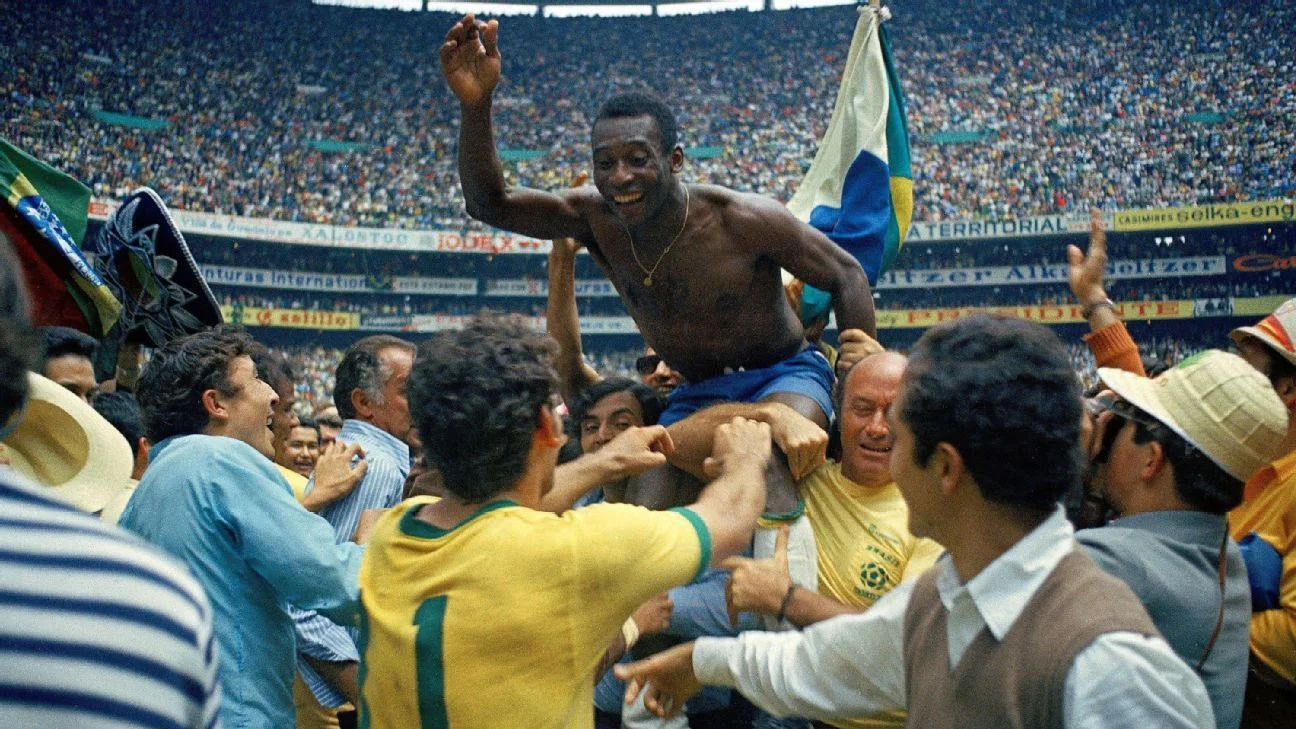
Edson Arantes do Nascimento, “Pelé,” won his first World Cup at 17 years old in Sweden 1958. He is the youngest player to score in a World Cup final—with two goals against the host nation—and also the only one in football history to have won three World Cups (1958, 1962, and 1970). The third title, in Mexico 1970, he won with what many consider the greatest team that has ever existed in national team football history: that Brazil side of Jairzinho, Tostão, Rivellino, and Pelé that won all their matches with football the world had not seen before.
With Santos, the club where he played between 1956 and 1974, he won multiple Brazilian leagues and became the figure who led the club to two consecutive Copa Libertadores titles (1962 and 1963), making them the first Brazilian team to win the continental title. The Santos of the sixties went on extensive international tours that took Pelé to play against teams from Europe, Africa, and Asia, making his name recognizable worldwide long before global television made that commonplace.
His playing style was the opposite of Maradona’s in terms of public profile: where Maradona was unpredictable and visceral, Pelé was elegant and precise. Technically complete—he could play as a center forward, attacking midfielder, or winger—physically powerful, and capable of scoring in any way and from any position. His personal record spoke of over 1,200 goals throughout his career, although the 767 officially recognized by statistical bodies are enough to place him among the top three highest goalscorers in history.
Pelé passed away in December 2022, at the age of 82, after several years of health issues. Brazil underwent national mourning, and the footballing world united in tribute to the man who for decades had been the most recognizable symbol of the planet’s most popular sport.
Legacy and Influence in Football
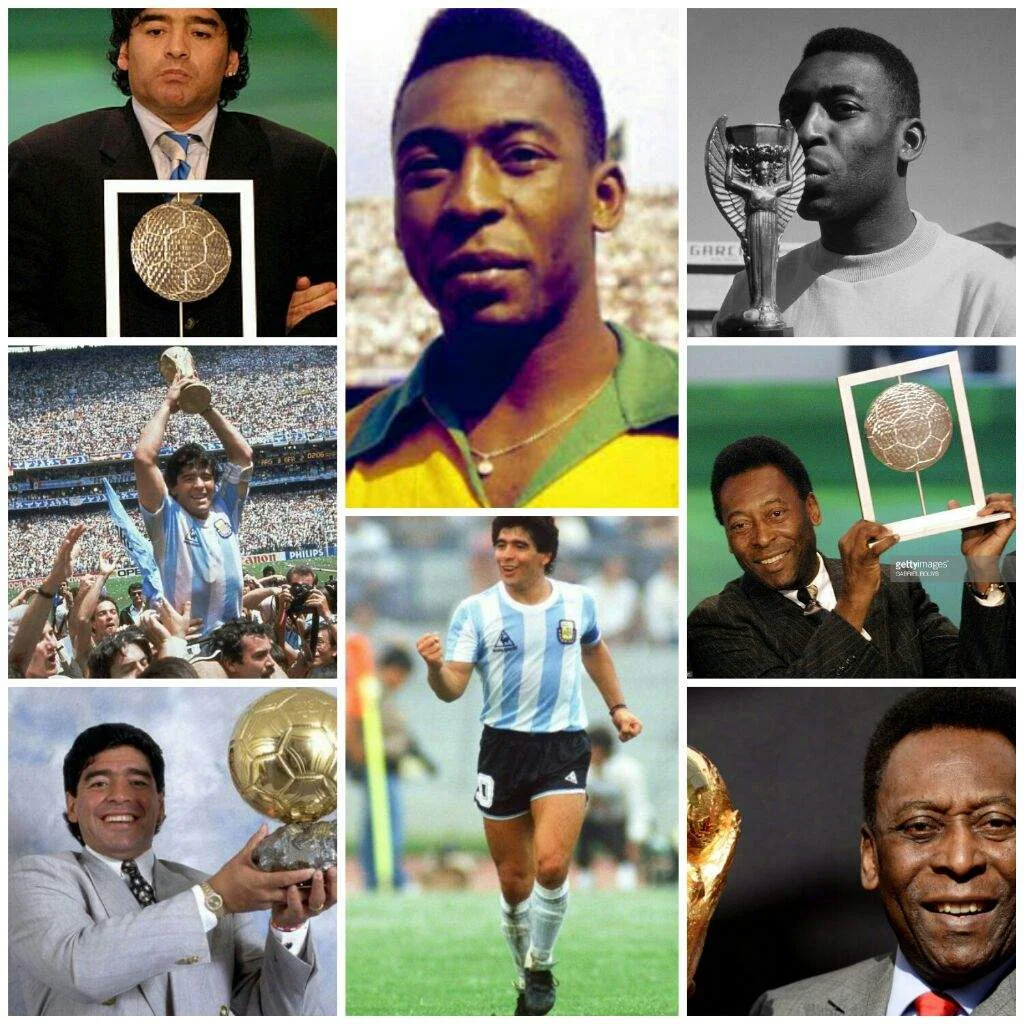
The legacies of Maradona and Pelé are different in their nature, though comparable in their magnitude.
Pelé was the first to demonstrate to the world that football could be a global spectacle. His tours with Santos in the sixties took the game to corners of the world where it had never reached, and his image—the number 10, Brazil’s yellow shirt—became the symbol of Brazilian football and, by extension, world football. He was also an institutional ambassador for the sport: his presence at FIFA events, his role as Brazil’s minister of sports in the nineties, and his participation in global football promotion campaigns made him something more than a former player: the living representative of the sport.
Maradona had a more complex and, in many ways, more human legacy. His origin story—the poor neighborhood of Buenos Aires, the years of struggle, the triumph against everyone’s expectations—resonated with millions of people who saw in him not just a great footballer but someone who beat the system from the bottom up. In Argentina, Maradona was never just a sporting idol: he was an almost religious figure for many. There is a church in Argentina called “La Iglesia Maradoniana” that has tens of thousands of followers and holds masses in his honor. That kind of cultural devotion has no equivalent in any other athlete in history.
Tactically, both influenced the game of their era in different ways. Pelé popularized the image of the complete forward: not just a finisher, but a player capable of creating and linking up play. Maradona redefined the role of the number 10 as the absolute conductor of a team, the player who can decide a match by himself at the most important moment.
The Eternal Debate: Who Was Better?
Comparing Maradona and Pelé objectively is an exercise that has clear limits. They played in different eras, in leagues of different levels, with incomparable medical and physical resources, and against rivals that cannot be directly equated.
What can be said with certainty is the following:
In favor of Pelé: Three World Cups is the most extraordinary record any player has achieved in the history of football’s most important competition. No other outfield player has equaled it. His more than 750 official goals for club and country, his consistency over nearly two decades, and his global impact as an ambassador for the sport make him the player with the most recognized institutional legacy in history.
In favor of Maradona: The 1986 World Cup is the greatest individual tournament a player has had in World Cup history. He did it with Argentina, without the stars that Brazil had in its best eras, and practically made the decisions leading to the title alone. Furthermore, transforming Napoli—a club with no history in Europe, from a peripheral city of Italian football—into the best team in Italy is an achievement of individual leadership that Pelé, with an already dominant Santos when he arrived, did not have to accomplish.
The debate has no end. And that, perhaps, is the best proof that both were exactly as great as the legend says.
Conclusion
Decades after the glory years of both players, the debate between Maradona and Pelé remains the reference point in any conversation about the greatest footballers in history. Not because new candidates haven’t appeared—Messi and Ronaldo have entered that conversation with compelling arguments—but because the duel between the “King” and the “God,” between perfect elegance and rebellious magic, between three World Cups and the Goal of the Century, captures something essential about football that goes beyond numbers.
Pelé was more prolific in statistical terms. Maradona was more decisive in the biggest moments. Pelé was the global ambassador of the sport. Maradona was the hero for those who never had one. Both were geniuses of their era, both transformed football into something more than a sport, and both died knowing they had left a mark time will not erase.
The answer to the question “who was better?” ultimately depends on what you value most in a footballer. And that is, precisely, the reason why the debate will remain alive as long as there is someone who loves football.