





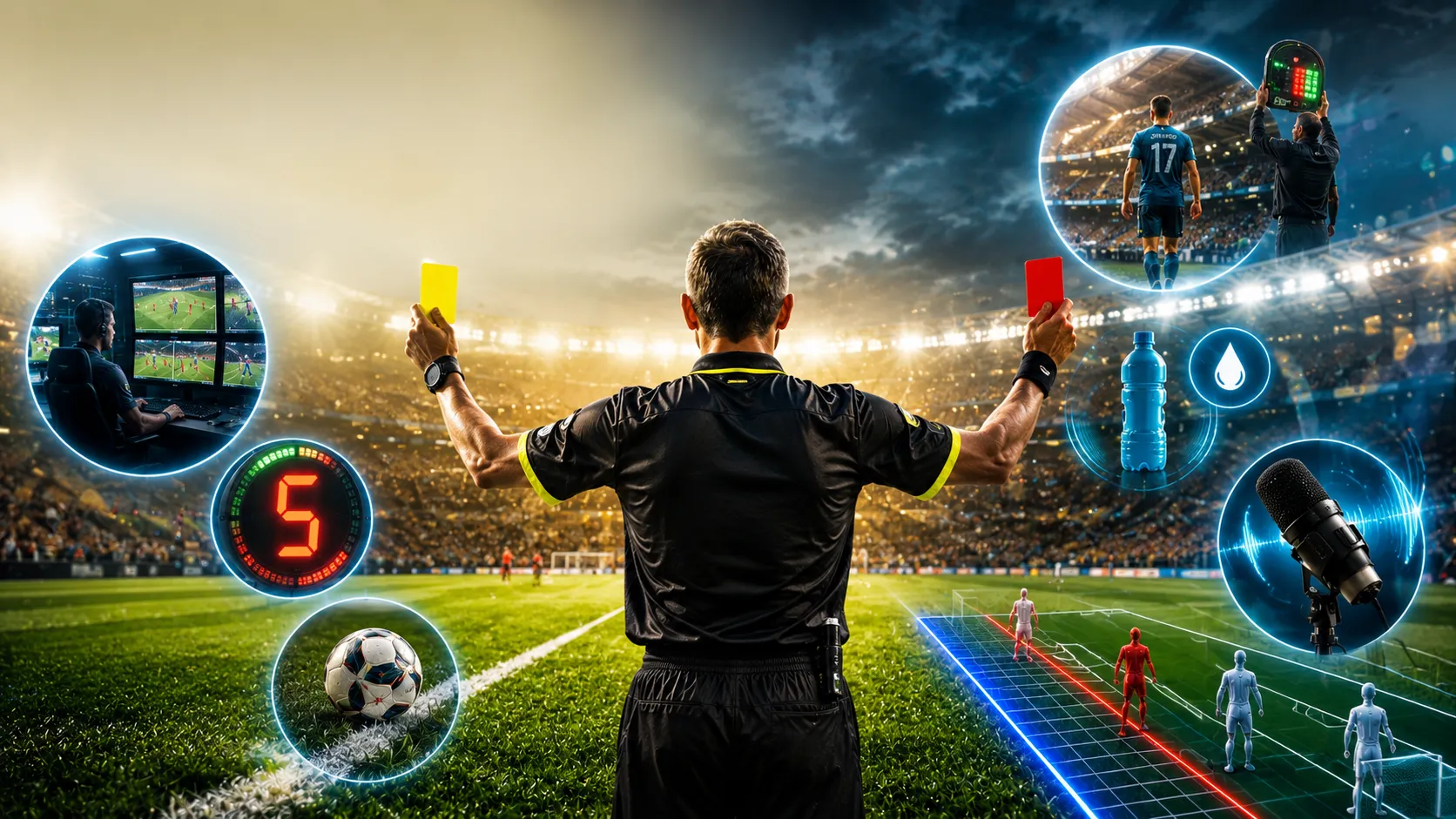
The 2026 World Cup is not only historic because of the number of participating national teams. On the pitch, the football played in Mexico, the United States, and Canada features rules that didn’t exist three months ago. The IFAB—the International Football Association Board, the body that legislates football worldwide—approved at its 140th Annual General Meeting, held in Hensol (Wales) in February 2026, the most extensive package of regulatory modifications in recent decades. FIFA backed and expanded them in April in Vancouver.
The result is a tournament debuting ten specific changes in the game. Some are technical adjustments; others transform gestures as basic as taking off a shirt or covering one’s mouth into grounds for a direct red card.
This guide explains each change, why it was introduced, how it affects players, referees, and coaches, and what future awaits it when the tournament ends.
📋 Table of Contents
- The Context: Why These Changes Arrived Now
- The Ten Regulatory Changes of the 2026 World Cup
- 1. The Five-Second Countdown on Restarts
- 2. The Penalty for Slow Substitutions
- 3. The Mandatory Cooling Break
- 4. The «Vinícius Law»: Red Card for Covering the Mouth
- 5. Dismissal for Leaving the Pitch in Protest
- 6. VAR Can Review Second Yellow Cards
- 7. VAR Can Correct Wrongly Awarded Corner Kicks
- 8. VAR and Offenses Prior to the Ball Being in Play
- 9. The Public Explanation of Refereeing Decisions
- 10. Medical Attention Requires a One-Minute Exit
- Refereeing Technology: SAOT and On-Pitch AI
- Which Rules are Permanent and Which are Still on Trial
- What Will Happen to These Rules After the 2026 World Cup
- Conclusion
- Frequently Asked Questions
The Context: Why These Changes Arrived Now
Football has a problem that governing bodies have been trying to solve for years: out of the standard 90 minutes, actual playing time barely exceeds 48 to 52 minutes on average, according to studies cited by the IFAB. The rest are interruptions: tactical injuries, slow substitutions, endless restarts, collective protests, and all sorts of strategies designed to run down the clock.
Added to this was an image problem. In February 2026, Pierluigi Collina, chairman of the FIFA Referees Committee, summarized the philosophy behind the changes in a few words: the goal is to “clean up football and increase the pace of matches.”
The timing was no coincidence. The 2025 Club World Cup served as a laboratory. Several measures were tested there under the extreme heat conditions of the American summer. The conclusions from that experience accelerated decisions that, in any other context, would have taken more years to arrive.
The Ten Regulatory Changes of the 2026 World Cup
1. The Five-Second Countdown on Restarts
What it is: When the referee considers that a team is deliberately delaying the restart of play on a throw-in or a goal kick, they will initiate a visual five-second countdown with their hand.
The consequences differ depending on the type of restart:
- On a throw-in, if the player does not execute it within that timeframe, the ball goes to the opposing team.
- On a goal kick, if the goalkeeper delays for more than five seconds, the opponent receives a corner kick.
The asymmetry between both sanctions is deliberate: the goal kick is historically the most used mechanism for time-wasting, especially when a team is winning. Conceding a corner kick as a consequence significantly raises the cost of that tactic.
Who applied it first in practice: In a preparation match between Japan and Iceland in May 2026, the referee applied the penalty for a slow substitution—a related rule—for the first time, and Japan scored with the opponent at a numerical disadvantage. The image traveled the world before the start of the tournament.
2. The Penalty for Slow Substitutions
What it is: The player being substituted has ten seconds to leave the field of play by the nearest boundary line. The assistant referee will count those ten seconds from the moment the change is announced.
If they do not leave in time:
- The substitute cannot enter immediately.
- They must wait on the sideline until the next stoppage in play that occurs at least one minute later.
- During that time, the team making the substitution plays with a numerical disadvantage.
This rule attacks one of the most visible forms of time-wasting: the player slowly walking towards the bench, stopping to receive instructions, and hugging the coaching staff. With ten seconds counted from the assistant’s announcement, this habit now has a direct sporting consequence.
3. The Mandatory Cooling Break
What it is: All 104 matches of the 2026 World Cup include two mandatory breaks of exactly three minutes, one in each half, around the 22nd minute.
The IFAB already permitted these types of breaks when the temperature required it. FIFA made them universal for this tournament, regardless of the weather, venue, or time. They are applied equally at night, in air-conditioned stadiums, and in mild temperatures.
The official argument: Gianni Infantino, FIFA President, justified it based on the experience of the 2025 Club World Cup, where several players complained about the extreme heat in US stadiums with temperatures exceeding 38°C (100°F). The measure guarantees equal conditions for all teams in all matches.
The real controversy: The break generates a structured two-minute and ten-second advertising window for television networks, once the 20-second courtesy at the start and the 30 seconds prior to the restart are deducted. Fox Sports arrived late for the opening minute of the tournament by using the break for advertising in the Mexico-South Africa match.
US coach Mauricio Pochettino was direct: “I don’t like them, I only like them if conditions are extreme.” Former manager Jürgen Klopp was harsher: “Football is being hijacked by executives entrenched in air-conditioned offices.”
The total six minutes of both breaks are added entirely to the stoppage time of each period. Consequently, added times in the 2026 World Cup will be structurally longer than in previous editions.
4. The «Vinícius Law»: Red Card for Covering the Mouth
What it is: Players who cover their mouths with their hand, arm, or shirt during a confrontation with an opponent may receive a direct red card if the referee considers it an attempt to conceal discriminatory behavior.
The origin: This rule has a first and last name. In a Champions League match between Benfica and Real Madrid in the 2024/25 season, player Gianluca Prestianni was accused of directing racist insults at Vinícius Júnior with his mouth covered by his shirt to avoid being caught on camera. The IFAB initiated a formal consultation in February 2026, and FIFA implemented the sanction two months later, in April, with the Council’s approval.
How it is applied: The red card for covering the mouth is not automatic. The referee must interpret that the gesture is accompanied by an intent to confront. Distinguishing between an automatic reflex—many footballers have been covering their mouths out of habit for years—and a deliberate attempt to hide something will be one of the most delicate points of application.
FIFA also clarified that disciplinary proceedings can be initiated retrospectively, using referee reports and video footage as evidence, even when the referee does not sanction it at the time.
5. Dismissal for Leaving the Pitch in Protest
What it is: Players who leave the field of play in protest of a refereeing decision, and coaching staff members who incite or urge them to do so, will be dismissed with a direct red card. If a team causes a match to be suspended for this reason, they may forfeit the game.
The precedent that motivated this rule: In the final of the 2025/26 Africa Cup of Nations, Senegal left the pitch in protest over a penalty awarded in favor of host Morocco in the final minutes. The match was interrupted for over a quarter of an hour. The IFAB identified that episode as the definitive trigger to codify an explicit sanction.
6. VAR Can Review Second Yellow Cards
What it is: The Video Assistant Referee (VAR) system can now intervene in situations involving second yellow cards that result in a dismissal, whenever there is a clear and obvious error—such as mistaken identity or a clearly incorrect first yellow card—and the review can be conducted quickly.
Until this tournament, VAR could not revisit a player’s disciplinary history in the same match. This expansion closes a loophole that had led to manifestly unjust sending-offs with no possibility of technological correction.
7. VAR Can Correct Wrongly Awarded Corner Kicks
What it is: VAR can intervene to rectify corner kicks awarded incorrectly, provided the review is quick and takes place before the corner is taken.
This modification responds to frequent situations: the ball grazes an attacking player and goes out over the goal line, the referee incorrectly awards a corner, and the team scores from that very corner. With the new rule, VAR can intervene before the ball comes into play to correct the error.
8. VAR and Offenses Prior to the Ball Being in Play
What it is: This is, according to the IFAB, the most significant technical modification of the package. VAR can now intervene when an offense committed by the attacking team before the ball is in play—before a corner or a free kick is taken—has a direct impact on a goal, a penalty, or a disciplinary sanction.
A concrete example: Before a corner is taken, an attacker knocks down or holds a defender inside the penalty area. The referee doesn’t see it. The corner is taken, there’s a rebound, and a goal is scored. Until now, the goal stood because the offense prior to the ball being in play was not reviewable. With the new clarification, VAR can recommend an on-field review. If the referee confirms the foul, they will disallow the goal and order the restart to be retaken.
Status: The IFAB has made it clear that this clarification “will be reviewed after the World Cup before any decision is made regarding its possible broader application.” For now, it is an operational trial.
9. The Public Explanation of Refereeing Decisions
What it is: Following a VAR review and the subsequent on-field decision (OFR), the referee can briefly explain the adopted decision using the stadium’s audio and video systems, informing the fans of the reasons.
First recorded use: On June 11, 2026, in the opening match between Mexico and South Africa at the Estadio Azteca, Brazilian referee Wilton Sampaio used this mechanism after reviewing on the monitor the dismissal of South African Themba Zwane. The measure, already used in some domestic leagues, debuted at a World Cup for the first time.
The stated objective: To reduce public mistrust in refereeing decisions and make the review process more understandable.
10. Medical Attention Requires a One-Minute Exit
What it is: When a player receives medical attention on the pitch during a stoppage in play for that reason, they must remain off the field of play for a full minute before being allowed to re-enter.
The important exception: If the injury was caused by a foul that resulted in the opponent being carded, the player can return immediately. Punishing the team that was the victim of an aggression would be counterproductive.
This rule targets so-called “tactical injuries”: the player who falls to the ground to waste time, receives treatment, gets up without any issues, and continues playing. With the penalty of a mandatory minute off the pitch, the cost of faking an injury to waste time becomes real.
Refereeing Technology: SAOT and On-Pitch AI
Beyond the written rules, the 2026 World Cup introduces technological advancements that change the way decisions are detected and communicated.
The SAOT (Semi-Automated Offside Technology) system tracks the 1,248 players in the tournament using 16 cameras per stadium that collect 29 data points per player 50 times per second. Players underwent prior scanning that generated a digital replica of their bodies, integrated with the real-time tracking system. The result: 3D reconstructions of controversial plays—especially offsides—that are broadcast live on television.
The system also alerts assistant referees of possible illegal positions via headsets, repeating “offside” when it is certain and “delay” when the play is doubtful.
Referees also wear a camera on the side of their headset that allows them to show their perspective in real-time. Starting with this tournament, that image is stabilized with artificial intelligence to eliminate the tremors inherent to movement.
Which Rules are Permanent and Which are Still on Trial
Not all changes have the same regulatory status. It is important to distinguish between what is already an official Law of the Game and what is being evaluated:
Rules Already Officially Incorporated into the 2026/27 Laws of the Game
The following modifications are part of the Laws of the Game approved by the IFAB, effective from July 1, 2026 (with the possibility of early application in competitions that started beforehand):
- Five-second countdown on throw-ins and goal kicks
- Penalty for slow substitutions (ten seconds to leave)
- Medical attention requires staying off the pitch for one minute
- VAR expansion to second yellow cards
- VAR expansion to incorrectly awarded corner kicks
- Red card for covering the mouth in confrontations
- Red card for leaving the pitch in protest
Measures on Trial or Evaluation
- The universal mandatory cooling break is a specific measure for this tournament. UEFA has already confirmed that it will not implement it on a mandatory basis for Euro 2028. The IFAB permits these breaks but does not impose them globally.
- The expansion of VAR to offenses prior to the ball being in play (rule 8) is under operational trial. The IFAB will review its results after the tournament before deciding whether to apply it more broadly.
- The public communication of refereeing decisions is available as an option for referees, but it is not mandatory in all competitions.
What Will Happen to These Rules After the 2026 World Cup
Some conclusions are clearer than others.
Rules aimed at reducing time-wasting—the five-second countdown, the slow substitution penalty, medical attention with a mandatory minute off—are already official Laws of the Game as of July 2026. They will be introduced progressively in all leagues and competitions worldwide.
Disciplinary measures—the red card for covering the mouth and for leaving the pitch—are also part of the official regulatory framework, although their application will depend on the refereeing criteria in each competition.
The cooling break is the most uncertain case. FIFA’s decision to make it universal—regardless of temperature—has met resistance from coaches and sectors of sports journalism. UEFA has indicated that it will not adopt it on a mandatory basis for its competitions. It is likely that in European leagues it will remain an optional measure linked to weather conditions, in line with what already existed before.
The expansion of VAR to offenses prior to the ball being in play will need to pass the IFAB’s post-tournament review. If the data from the World Cup shows that the measure brought justice without disproportionately lengthening matches, it is a candidate to become a permanent rule.
Conclusion
The 2026 World Cup is not just the 48-team tournament. It is the tournament that has transformed football’s regulations the most in a single go since the introduction of VAR in Russia 2018.
Most of the changes point in the same direction: fewer dead seconds, more individual responsibility, and more tools to correct manifest errors. The logic behind them is coherent and responds to real demands from the football community.
What generates the most debate is the cooling break—the only measure that has received open criticism from top-level coaches—precisely because its climatic justification clashes with its universal application, including night matches in air-conditioned stadiums. Its future outside of this tournament remains undecided.
The rest of the regulatory package has all the conditions to be installed permanently. The football played in this World Cup is the same as always—eleven against eleven, two halves, one ball—but with less margin for those who have always found in the regulations a tool for not playing.
Frequently Asked Questions
When were the new football rules for the 2026 World Cup approved? The IFAB approved them at its 140th Annual General Meeting held in Hensol (Wales) on February 28, 2026. FIFA expanded the disciplinary package on April 28, 2026, in Vancouver. They came into effect on June 11 with the opening match between Mexico and South Africa.
Is the five-second countdown on restarts already applicable in all leagues? Yes. It is an official Law of the Game as of July 1, 2026. Leagues may adopt it before that date if they so choose.
Will the mandatory cooling break reach the Champions League or Premier League? It is not expected. UEFA has confirmed that it will not implement it on a mandatory basis in its competitions. In European domestic leagues, it will remain an optional measure linked to extreme weather conditions.
Will any player who covers their mouth be sent off? No. The referee must interpret that the gesture occurs during a confrontation with the intent to conceal inappropriate or discriminatory behavior. Automatic gestures or those without a confrontational context should not be sanctioned, although the line between the two scenarios generates debate.
What happens if an injured player was the victim of a foul? If the injury was caused by an offense that resulted in the opponent receiving a card, the player can re-enter immediately without waiting the mandatory minute off the pitch.
Can VAR now review any yellow card? No. It can only intervene in cases of a second yellow card leading to a dismissal when there is a clear and obvious error—such as mistaken identity—and the review can be conducted quickly. Individual yellow cards are not reviewable by VAR.
Do the new rules also affect the knockout stages and final rounds of the tournament? Yes. All approved modifications apply to all 104 matches of the tournament, including the Round of 32, Round of 16, quarter-finals, semi-finals, and the final.