





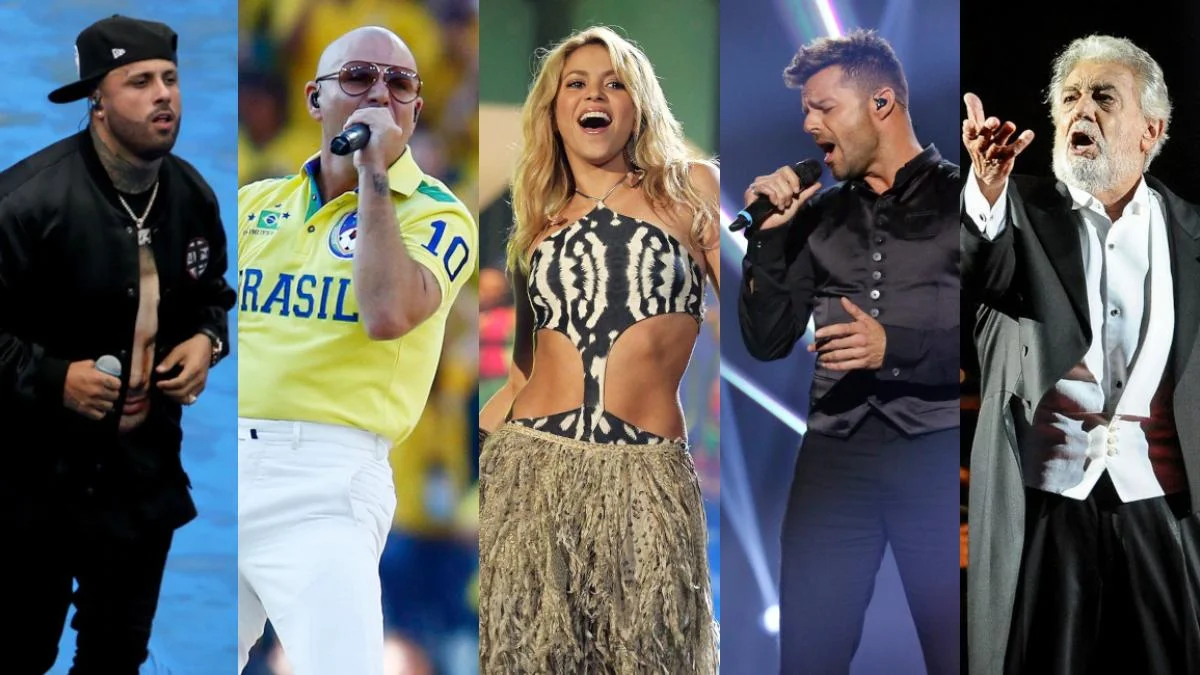
The FIFA World Cup isn’t just a sporting event; it’s a global celebration that connects us all through shared emotions, national jerseys, and, of course, music. Every four years, a new anthem joins humanity’s collective soundtrack, but only a select few manage to transcend their time and become true classics.
Before we journey through history, let’s take a look at the present:
📋 Table of Contents
- 🎶 The Anthem of the 2026 World Cup (Canada, Mexico, and USA)
- Part I: 🏆 The Official FIFA Classics
- 1. The Seed of Rock and Roll (Chile 1962)
- 2. A Taste of Ranchera (Mexico 1970)
- 3. The Voice of Opera (Spain 1982)
- 4. The Greatest of All Time (Italy 1990)
- 5. The Global Boom (France 1998)
- 6. The Power of Voice (South Korea-Japan 2002)
- 7. The Social Phenomenon (South Africa 2010)
- 8. The Party in Brazil (Brazil 2014)
- 9. A Spectacle in Russia (Russia 2018)
- 10. Cultural Fusion (Qatar 2022)
- Part II: 🚀 Unofficial but Unforgettable Classics
- Conclusion
🎶 The Anthem of the 2026 World Cup (Canada, Mexico, and USA)
With the tournament already underway, the most recognizable anthem of the Spanish-language coverage of the 2026 World Cup is “Somos Más,” introduced by Telemundo:
- Song: “Somos Más”
- Artists: Carlos Vives, Wisin, Emilia, and Xavi
- Context: The official anthem for Telemundo’s 2026 World Cup coverage, the leading Spanish-language network in the US market
- Message and Style: A track that celebrates Latin American diversity and unity through football, blending tropical and urban beats with a broad generational crossover: Carlos Vives (Colombia) and Wisin (Puerto Rico) represent established global stars, while Emilia (Argentina) and Xavi (Mexico) bring in the new wave of pop and regional urban music
Part I: 🏆 The Official FIFA Classics
These are the anthems that carried the official FIFA seal, setting musical and cultural milestones in the tournament’s history:
1. The Seed of Rock and Roll (Chile 1962)
- Song: “El Rock del Mundial”
- Artist: Los Ramblers (Chile)
- Context: Widely considered the very first song associated with a World Cup to achieve massive success. It was a genuine Chilean rock and roll hit, even though it wasn’t a direct commission from FIFA, but rather a spontaneous publishing phenomenon
- Additional Info: Its lyrics included references to the local national team with the famous shout “Gol de Chile!” and it became the best-selling single in Chile’s history up to that point, sparking a musical tradition that FIFA would institutionalize in later editions
2. A Taste of Ranchera (Mexico 1970)
- Song: “Fútbol México 70”
- Artists: Los Hermanos Zavala (Mexico)
- Context: This melody incorporated elements of Mexican musical culture, such as the ranchera, and served as a joyful welcome to the tournament during the first World Cup to be broadcast in color on television
- Additional Info: Los Hermanos Zavala were a family with a deep musical tradition in Mexico, which brought authenticity to the anthem. This was also the first World Cup to feature an associated song with such distinct local rhythms
3. The Voice of Opera (Spain 1982)
- Song: “El Mundial”
- Artist: Plácido Domingo (Spain)
- Context: This anthem combined the orchestral backing of a pasodoble—the traditional rhythm associated with bullfighting—with the voice of the most renowned tenor of the era
- Additional Info: Plácido Domingo is a passionate football fan who also performed the official anthem for Real Madrid, making him a culturally significant choice in Spain. The song maintained a classic, ceremonial tone that remained far removed from the pop music that would dominate later editions
4. The Greatest of All Time (Italy 1990)
- Song: “Un’estate italiana” (An Italian Summer)
- Artists: Gianna Nannini and Edoardo Bennato (Italy)
- Context: Originally composed by Giorgio Moroder with English lyrics (“To Be Number One”), it was Nannini and Bennato who wrote the Italian lyrics that achieved global fame. It is a version that many consider the greatest World Cup song in history due to its atmosphere and timeless emotion
- Additional Info: The song is also popularly known as “Notti Magiche.” Its melody has been repeatedly used in World Cup television broadcasts and commercials around the world since 1990. In Argentina, in particular, it became permanently etched in the collective memory as the soundtrack to one of their national team’s most dramatic campaigns
5. The Global Boom (France 1998)
- Song: “La Copa de la Vida”
- Artist: Ricky Martin (Puerto Rico)
- Context: This track marked a turning point: it was the first World Cup anthem to achieve massive pop success on a transatlantic scale, catapulting Ricky Martin’s international career and establishing the Latin-pop formula that would dominate the tournament’s anthems for the next decade
- Additional Info: His performance at the 1999 Grammy Awards is considered by many to be the trigger for the “Latin explosion” in US pop music. The song has both a Spanish and an English version (“The Cup of Life”) and was included on his album Vuelve before being designated as the tournament’s official anthem
6. The Power of Voice (South Korea-Japan 2002)
- Song: “Boom!”
- Artist: Anastacia (United States)
- Context: The American singer performed the official anthem for the first World Cup co-hosted by two countries, delivering a powerful electropop style that stood in sharp contrast to the more Latin tone of previous anthems
- Additional Info: Anastacia stated in interviews at the time that she practically didn’t know the rules of football when she recorded the song, which generated some controversy. Nevertheless, the track was well-received for its energy and versatility during the tournament’s broadcasts
7. The Social Phenomenon (South Africa 2010)
- Song: “Waka Waka (This Time for Africa)”
- Artist: Shakira (Colombia) featuring Freshlyground
- Context: Arguably the most popular and widely played World Cup anthem in history. Its choreography and the use of South African rhythms turned it into a global cultural phenomenon that far outlived the tournament itself
- Additional Info: The song adapts a melody from the traditional African track “Zangaléwa,” popularized by the Cameroonian group Golden Sounds. The music video was, for a time, the most-watched video on YouTube, and it was precisely during its filming that Shakira met then-FC Barcelona player Gerard Piqué
8. The Party in Brazil (Brazil 2014)
- Song: “We Are One (Ole Ola)”
- Artists: Pitbull ft. Jennifer Lopez & Claudia Leitte
- Context: A blend of pop, electronica, and samba that, despite initial criticism, became a global hit thanks to its danceable and catchy rhythm
- Additional Info: The song was co-written by Australian songwriter Sia Furler, and its official version features verses in Spanish, English, and Portuguese, representing the diversity of the Americas. The involvement of Claudia Leitte, a star of Brazilian axé music, was FIFA’s local attempt to give the track an authentic flavor of the host nation
9. A Spectacle in Russia (Russia 2018)
- Song: “Live It Up”
- Artists: Nicky Jam feat. Will Smith & Era Istrefi
- Context: Chosen as the official anthem, this song fuses pop, reggaeton, and dance sounds. Although it received mixed reviews for not being as memorable as other World Cup anthems, Will Smith’s presence gave it a considerable media boost
- Additional Info: It was produced by the renowned American DJ and producer Diplo. The participation of Will Smith, who was in the midst of the second phase of his musical career at the time, was the key element that guaranteed its global visibility well beyond the strict footballing audience
10. Cultural Fusion (Qatar 2022)
- Song: “Hayya Hayya (Better Together)”
- Artists: Trinidad Cardona, Davido, and Aisha
- Context: Qatar 2022 adopted a different strategy: instead of a single anthem, it released an album featuring several official songs. “Hayya Hayya” was the first single and the most representative of the bunch, aiming for a fusion of rhythms from the Americas, Africa, and the Middle East
- Additional Info: It was produced by Moroccan songwriter RedOne, well known for his work with Lady Gaga and Jennifer Lopez, which gave it a top-tier production polish. The shift toward a multi-track album marked a new strategy from FIFA aimed at diversifying the cultural and geographic reach of the tournament’s official music
Part II: 🚀 Unofficial but Unforgettable Classics
Sometimes, the public chooses its own anthems. These songs, even though they weren’t the Official FIFA Song, became entirely synonymous with their respective World Cups:
1. The Underrated Anthem (South Africa 2010)
- Song: “Wavin’ Flag”
- Artists: K’naan (Somalia-Canada) & David Bisbal (Spain)
- Context: Selected by Coca-Cola as the theme for their promotional campaign for the tournament. Its inspiring message of struggle and celebration resonated so deeply with audiences that many people, even today, still confuse it with the official song
- Additional Info: K’naan’s original track was a song about hope and resilience in Somalia. It was rewritten with a message of global celebration for the World Cup, and the Spanglish version featuring David Bisbal became massively popular across the Spanish-speaking world, securing its place as one of the most fondly remembered songs associated with that summer in recent history
2. Shakira’s Alternative (Brazil 2014)
- Song: “Dare (La La La)”
- Artist: Shakira (Colombia)
- Context: Even though “We Are One” was the official track, Shakira managed to sneak in a second massive hit that, for many, ended up being the true emotional anthem of Brazil 2014
- Additional Info: The World Cup version was an adaptation of an original track from her album. The music video featured appearances by Neymar, Lionel Messi, and Gerard Piqué, giving it immense visibility among football fans. The fact that Shakira had two massive hits during the same World Cup—one official and one unofficial—is completely unprecedented in the history of World Cup anthems
3. A Global Dream (Qatar 2022)
- Song: “Dreamers”
- Artists: Jungkook (South Korea) & Fahad Al Kubaisi (Qatar)
- Context: Performed at the opening ceremony of the 2022 Qatar World Cup, “Dreamers” became a symbol of cultural unity, fusing South Korean pop with Arabic sounds in a flawless production that electrified the Ahmad Bin Ali Stadium
- Additional Info: Jungkook is a member of BTS, the most influential K-Pop group in the world, which guaranteed an instant global audience. The song quickly soared up the international charts following its performance and turned the tournament’s opening into one of the most-watched moments of that edition
4. The Rhythm of the Rainbow (Russia 2018)
- Song: “Colors”
- Artists: Jason Derulo & Maluma
- Context: Created as Coca-Cola’s official anthem for the 2018 World Cup in Russia, this song celebrates diversity and passion for football with a message of inclusion and a rhythm that blends English-language pop with Latin pop
- Additional Info: Maluma recorded the Spanish version, which was the one most heavily promoted throughout Latin America. The original English version is by Jason Derulo. This marked the third time Coca-Cola released its own anthem for the tournament: in 2010 they had done it with “Wavin’ Flag” and in 2014 with David Correy’s “The World Is Ours”
5. The African Party (Brazil 2014)
- Song: “Magic in the Air”
- Artists: Magic System ft. Chawki
- Context: Although it was not an official World Cup song, its contagious energy and festive spirit made it one of the most heavily played tracks during Brazil 2014, especially within African and French-speaking communities
- Additional Info: Magic System is a group originally from Ivory Coast. The song managed to climb the charts in several European countries, notably in France and Belgium, cementing its status as an unofficial anthem of the football celebration well beyond the borders of the tournament itself
Conclusion
The history of World Cup anthems reflects how music has evolved right alongside global trends and changing generations. In the years before the digital era, the World Cup was a more emotional and less commercial event, and that is perfectly reflected in “Un’estate italiana” (Italy 1990). Composed by Giorgio Moroder and performed and sung in Italian by Gianna Nannini and Edoardo Bennato, it is an epic ballad that symbolizes the romance and nostalgia of classic football. For many fans of that generation, this song represents the artistic and sentimental peak of World Cup anthems—an era where raw emotion carried more weight than virality.
With the arrival of Ricky Martin’s “La Copa de la Vida” in France 1998, World Cup anthems definitively transformed into global products geared toward mass entertainment. That song didn’t just conquer stadiums; it ignited the explosion of Latin music within the Anglo-Saxon market. Since then, Shakira with “Waka Waka” (2010), Pitbull in Brazil (2014), and the choral experiments of Qatar 2022 featuring Jungkook have fully consolidated this digital era, where what matters isn’t just the tournament, but the cultural and emotional impact these anthems generate on a global scale. Furthermore, songs like “Wavin’ Flag” and “Colors” prove that sometimes, the most memorable anthem doesn’t bear an official seal: it’s chosen by the fans.