





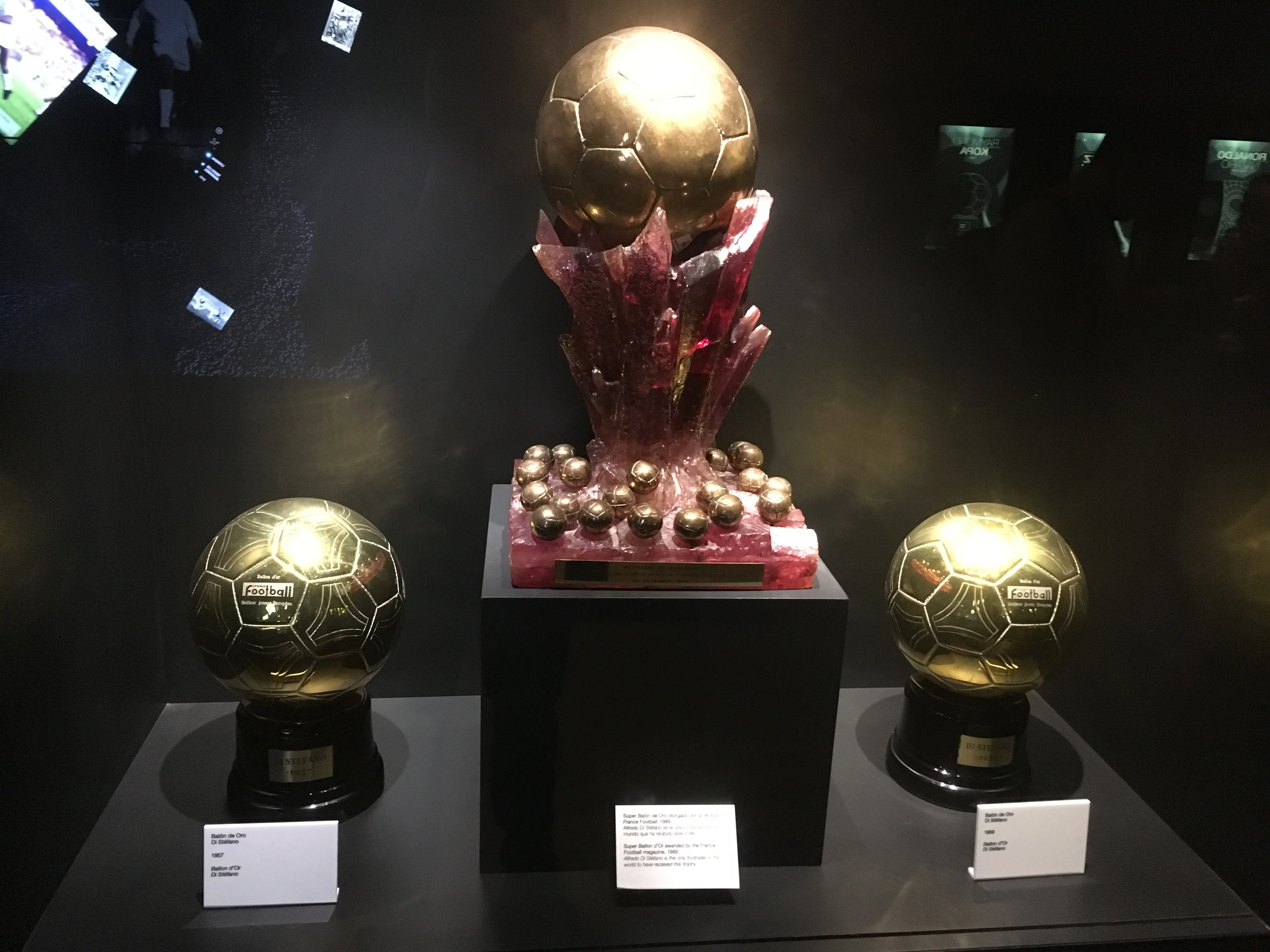
In a sport that hands out trophies every season, every month, and sometimes every week, there is an award so rare that it has only been given once in more than sixty years of history. It’s not the World Cup, nor the Champions League, nor the annual Ballon d’Or. It is the Super Ballon d’Or — a mythical accolade that only one footballer on the entire planet can say he has won.
Conceived by the prestigious French magazine France Football, creator of the traditional Ballon d’Or, this extraordinary trophy was not designed to reward the best player of a specific year. Its ambition was much greater: to crown the best European footballer of three complete decades of football. The result was an award of such historical weight that, to this day, it has only been handed out once. Its only winner? An Argentine by birth and Spaniard at heart, whose name is inseparable from Real Madrid’s identity.
📋 Table of Contents
- The Origin: France Football’s 30th Anniversary
- The Only Winner: Alfredo Di Stéfano
- The Nominees and the Voting Process
- The Trophy: What Is It Like and Where Is It Today?
- Differences with the Traditional Ballon d’Or
- Could Messi or Cristiano Win It in the Future?
- Conclusion
The Origin: France Football’s 30th Anniversary
To understand the Super Ballon d’Or, it is essential to travel to 1989. That year, the magazine France Football was celebrating a significant milestone: its 30th anniversary as an editorial publication. The management team decided that a conventional commemorative edition was insufficient for an anniversary of that magnitude.
The idea that emerged was as bold as it was original: to create a unique, unrepeatable award to answer one of the most debated questions in European football — who had been the best player of the last three decades? Instead of rewarding a single season, this accolade would evaluate an entire career, measuring sustained excellence, the ability to define an era, and the titles conquered over the years.
There was, however, a crucial restriction inherited from the rules of the time. Until 1995, the traditional Ballon d’Or was exclusively limited to players of European nationality competing in Europe. That meant absolute legends like Pelé or Diego Maradona were not eligible under the rules in force. The Super Ballon d’Or, operating under those same historical rules, was the search for the best European footballer of the period between the late 1950s and the late 1980s.
The Only Winner: Alfredo Di Stéfano
On December 24, 1989, France Football announced the winner of the first — and to this day only — Super Ballon d’Or: Alfredo Di Stéfano. The Blond Arrow, born in Buenos Aires but naturalized Spanish — which allowed him to win the Ballon d’Or in 1957 and 1959 under the rules of the time — was crowned the best European player of the previous thirty years.
Di Stéfano’s career was simply unlike any other of his time, or possibly of any time. When he arrived at Real Madrid in 1953, the club was not the global institution it is today. What came next was one of the most extraordinary cases of sustained individual dominance in team sports history. Under his leadership, Real Madrid won the first five consecutive European Cups (1956, 1957, 1958, 1959, and 1960) — an achievement no club has ever repeated.
What truly separated Di Stéfano from all his contemporaries was not just his goalscoring — although he scored with prolific regularity — but his absolute control of a match from start to finish. He was a total footballer before the term existed: he organized the defense from the back, directed the play in midfield, and finished with precision when the time came. In 8 league titles with Real Madrid, he scored 216 goals.
Di Stéfano’s Honors
- 5 consecutive European Cups with Real Madrid (1956–1960), scoring in each of the five finals, including a hat-trick in the 7-3 win over Eintracht Frankfurt in 1960
- 8 Spanish LaLiga titles with Real Madrid
- 2 Ballon d’Or awards (1957 and 1959)
- 2 Generalísimo Cups (Copa del Rey)
- Over 500 goals throughout his professional career
The Nominees and the Voting Process
The process used to choose the winner of the Super Ballon d’Or was exhaustive and deliberately constructed to guarantee maximum legitimacy. The voting was divided into three distinct juries: France Football readers, a panel of specialized journalists from the magazine itself, and a group composed of former Ballon d’Or winners — the living legends of the sport themselves.
The final list of nominees was a catalog of the greatest names in 20th-century European football:
| Nominee | Country | Main Clubs |
|---|---|---|
| Alfredo Di Stéfano | Spain (b. Argentina) | Real Madrid |
| Johan Cruyff | Netherlands | Ajax, Barcelona |
| Michel Platini | France | Juventus |
| Franz Beckenbauer | West Germany | Bayern Munich |
| Kevin Keegan | England | Liverpool, Hamburg |
| Karl-Heinz Rummenigge | West Germany | Bayern Munich |
The readers’ vote favored Michel Platini — winner of three consecutive Ballon d’Or awards in the 1980s and a genuine idol in France. However, both the magazine’s panel of experts and the former Ballon d’Or winners voted overwhelmingly for Di Stéfano. The final podium placed Cruyff in second place and Platini in third, but the gap to first place was decisive. Di Stéfano’s five European Cups gave him an argument no other candidate could match.
The Trophy: What Is It Like and Where Is It Today?
The physical Super Ballon d’Or is as unique as the award itself. Although it retains the iconic central golden sphere of the standard Ballon d’Or, the base is completely different and much more spectacular: the golden sphere rests on an ornate, carved base from which smaller golden spheres emerge — a constellation of gold representing three decades of football history. The trophy is notably heavier and bulkier than the annual award.
For years, the trophy was on display at the Santiago Bernabéu Museum in Madrid, where Di Stéfano had donated it during his lifetime. However, following his passing in 2014, his heirs decided to auction a significant part of his memorabilia collection through Julien’s Auctions in London. The Super Ballon d’Or was put up for auction in September 2021 with an initial estimate of between 35,000 and 58,000 euros, but the hammer price was much higher: 187,500 euros, sold to an anonymous private buyer. Today, its exact whereabouts remain unknown to the general public — adding another layer of mystery to an already legendary object.
Differences with the Traditional Ballon d’Or
Understanding what makes the Super Ballon d’Or genuinely unique requires a direct comparison with its annual counterpart:
| Characteristic | Traditional Ballon d’Or | Super Ballon d’Or |
|---|---|---|
| Frequency | Awarded every year | Awarded only once in history |
| Period evaluated | A calendar year | Three full decades of a career |
| Eligibility (in its time) | European players in Europe | Same rules as the 1956–1989 period |
| Winner | Changes every year | Only Alfredo Di Stéfano (1989) |
| Current whereabouts of trophy | Kept by that year’s winner | Sold at auction in 2021; location unknown |
The key philosophical difference is that the Ballon d’Or rewards a peak season, while the Super Ballon d’Or attempted to recognize an entire life in football. That distinction is what makes it genuinely incomparable to any other individual award in the sport.
Could Messi or Cristiano Win It in the Future?
Since the early 2000s, and with increasing intensity during the era of absolute dominance by Lionel Messi and Cristiano Ronaldo, the possibility of a second Super Ballon d’Or has become a recurring theme in football’s most passionate debates. France Football itself has suggested that a new edition could be awarded in 2029, exactly 40 years after the award to Di Stéfano.
The fundamental difference from 1989 is that since 1995 any player competing in Europe can be eligible for the award — and since 2007, any player in the world. This means Messi’s Argentine nationality, which would have excluded him in 1989, is completely irrelevant today.
Lionel Messi – The Candidacy
Messi’s statistical case for a hypothetical modern Super Ballon d’Or is arguably the strongest in sports history. He has accumulated 8 Ballon d’Or awards — more than double any other player — and has ticked all the boxes historically defining the absolute champion of football:
- 8 Ballon d’Or awards (2009, 2010, 2011, 2012, 2015, 2019, 2021, and 2023)
- World Champion with Argentina (Qatar 2022)
- Copa América Champion (2021 and 2024)
- All-time top scorer in LaLiga and for FC Barcelona
- Over 800 official goals in his entire career
Beyond the numbers, Messi’s longevity at the elite level — maintaining top-tier performance well into his thirties and winning a World Cup at 35 — reflects exactly the criterion of sustained excellence over decades that the Super Ballon d’Or was designed to recognize.
Cristiano Ronaldo – The Candidacy
Cristiano Ronaldo’s argument centers on pure volume and unprecedented physical durability. He has continued scoring at an elite rate well into his second professional decade, building a statistical legacy that sits at the absolute summit of football in terms of goals:
- 5 Ballon d’Or awards (2008, 2013, 2014, 2016, and 2017)
- European Champion with Portugal (Euro 2016)
- All-time top scorer in the Champions League (over 140 goals)
- Over 900 official goals — the highest total in professional football history
- 5 Champions League titles: 1 with Manchester United (2008) and 4 with Real Madrid (2014, 2016, 2017, and 2018)
- The only player to score in 5 different World Cups and 5 different European Championships
Cristiano’s goalscoring records are simply unrivaled in sports history. For a hypothetical award rewarding an entire career, that figure — over 900 goals — carries a weight that is almost impossible to ignore.
Conclusion
The Super Ballon d’Or occupies a unique place in football history — not as part of the regular awards calendar, but as a monument. An unrepeatable recognition that attempted to stop time at a specific moment in the sport’s evolution to declare its greatest figure.
Alfredo Di Stéfano remains the sole owner of that title, and his candidacy is indisputable. The man who built the Real Madrid dynasty, who won five consecutive European Cups scoring in every single final, and who played every position on the pitch with the naturalness of an innate genius, was the logical and deserved choice. His Super Ballon d’Or is not just a personal achievement: it is a tribute to the birth of European club football as we know it.
If France Football were to one day reopen the trophy’s drawer for a 2029 edition recognizing the extraordinary legacies of Messi and Cristiano, it would be one of the most debated verdicts in all of sports history. If they do not, Di Stéfano will forever remain the only possessor of the rarest honor in the world’s most beautiful game.
📚 Recommended reading: