





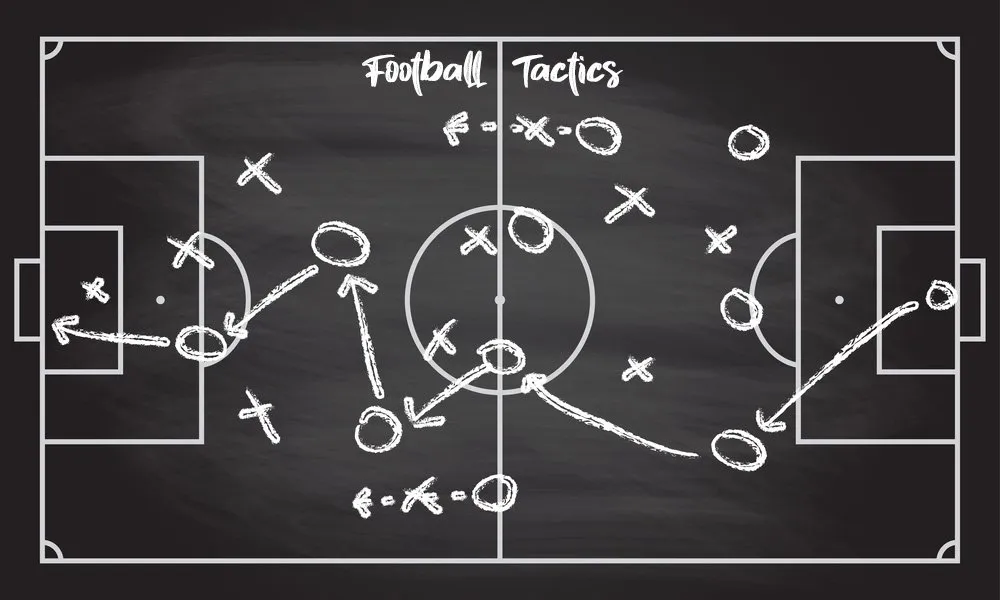
Tactics and Formations That Changed Football: History and Evolution
When we see a team pressing as a block after losing the ball, or a forward dropping into midfield to disorganize the opponent’s defense, we are witnessing the result of over a century of tactical evolution. Modern football is not just built with individual talent: it is designed. It is thought out before the match begins, adjusted at half-time, and reinvented season after season.
Formations aren’t just numbers on a blackboard. They are playing philosophies, answers to the challenges of the rules, legacies of visionary managers who saw football differently. This article reviews the ten most influential tactics and formations in football history, from the wild attacking systems of the 19th century to the hybrid and dynamic systems of contemporary football.
Table of Contents
- The Origin of Tactics in Football
- The 10 Most Influential Formations in History
- The Managers Who Changed the Game
- Tactical Trivia
- Tactical Football Today
- Conclusion
The Origin of Tactics in Football
Late 19th-century football barely had any structure. Teams fielded up to eight or nine players in offensive positions, convinced that whoever attacked more would win more. The result was chaotic matches, with double-digit scorelines and very little defensive organization.
The first major revolution arrived when managers began to ask themselves a seemingly simple question: what if we defend better? The balance between attack and defense became the central axis of all subsequent tactical evolution. Every rule change—and football has had several throughout its history—triggered a new wave of innovations that the best managers knew how to capitalize on before their rivals.
What follows is the history of those innovations.
The 10 Most Influential Formations in History
1. The 2-3-5, the Pyramid (Late 19th Century — Early 20th Century)
The first organized system in modern football was almost a statement of intent: five forwards, three midfielders, and only two defenders. The “Pyramid,” as it was known, dominated English-speaking football for decades and perfectly reflected the mentality of the era: football was meant for attacking.
The national teams of England and Scotland were its main exponents, and their matches produced results that would seem surreal today. With so little attention to defense, scorelines of seven or eight goals per team were not exceptional. The system worked because all rivals played the same way: when more defensive schemes began to appear, the Pyramid began to show its limitations.
2. The WM (3-2-2-3), the First Great Defensive Revolution (1920s)
In 1925, FIFA modified the offside rule: instead of needing three defenders between the attacker and the goal, two were enough. The change was immediate and devastating for teams that didn’t know how to adapt: goals skyrocketed and defenses were left exposed.
Herbert Chapman, manager of Arsenal, was the first to provide a coherent tactical response. His WM system—named for the shape the players drew on the pitch, reminiscent of the letters W and M superimposed—pulled a center forward back to become a defensive inside forward, creating a new balance between the lines.
The impact was enormous. Chapman’s Arsenal won four league titles and two FA Cups in less than a decade, and the WM became the dominant system in European football for the next thirty years. It is, probably, the first great tactical innovation in modern football history.
3. The 4-2-4, Football Becomes a Spectacle (1950s and 1960s)
If the WM was the defensive response to a crisis, the 4-2-4 was the offensive reaction of a generation wanting to see a different game. The Hungary of the fifties—the team that humiliated England 6-3 at Wembley in 1953 with a brand of football the world had never seen before—pioneered this system, which sought attacking power without sacrificing defensive solidity.
But the one who took it to its maximum expression was Brazil. The Brazilian national team of 1958 and 1970 built some of the most admired teams in history on this system: the 1958 side introduced the world to a 17-year-old teenager named Pelé, and the 1970 side is still considered by many today to be the greatest team that has ever existed. The 4-2-4 naturally evolved into the 4-3-3, which remains one of the base systems of contemporary football.
4. Catenaccio, the Art of Not Conceding (1950s and 1960s)
While Brazil fascinated the world with its offensive football, Italy developed a completely opposite philosophy in parallel. Catenaccio—“door-bolt” in Italian—placed the emphasis on defensive solidity: a line of four defenders, a free sweeper behind them to cover spaces, and a swift counterattack when the ball was recovered.
Helenio Herrera took it to its most effective version with the Inter Milan of the sixties, winning two consecutive European Cups (1964 and 1965) with a team against which it was practically impossible to score goals. Catenaccio was harshly criticized as supposedly anti-spectacle, but its principles—defensive organization as the foundation of success, the counterattack as a lethal weapon—remain present in football today.
5. Total Football, When Positions Ceased to Exist (1970s)
The greatest philosophical revolution in football history came from the Netherlands. Rinus Michels, manager of Ajax Amsterdam, developed a system in which players interchanged positions fluidly and constantly: a defender could push up to attack, a forward drop down to defend, and the team always maintained its shape without any player having a fixed role on the pitch.
The requirement was demanding: all players had to be technically complete, physically capable of covering large spaces, and cognitively quick to read the game in real time. Johan Cruyff, the greatest interpreter this system had, explained it like this: “Playing football is very simple, but playing simple football is the hardest thing there is.”
Ajax won three consecutive European Cups (1971, 1972, and 1973), and the Netherlands national team reached the World Cup finals in 1974 and 1978 with a brand of football that left the world speechless. The legacy of Total Football is so profound that it can be traced directly to the play of Guardiola, Klopp, and practically any modern manager prioritizing pressing and possession.
6. The 4-4-2, the System of Balance (1980s and 1990s)
If Total Football was philosophically ambitious, the 4-4-2 was pragmatically effective. Four defenders, four midfielders, and two forwards: a compact, balanced block difficult to overcome. The English national team of 1966 had already used variants of this scheme on their way to the world title, but it was in the eighties and nineties that the 4-4-2 became the default system of European football.
Sir Alex Ferguson’s Manchester United, Diego Simeone’s Atlético Madrid in their more defensive versions, and dozens of national teams built their success on this scheme. Its greatest virtue is its readability: players know exactly what is expected of them, facilitating collective organization even with squads of heterogeneous levels.
7. Tiki-Taka, Control as the Ultimate Weapon (2008–2014)
In 2008, the Spanish national team won the European Championship with football seeming from another planet. Two years later they won the World Cup in South Africa. Two years after that, the European Championship again. In that period, Pep Guardiola’s FC Barcelona won two Champions Leagues and four league titles. The common element was the same: Tiki-Taka.
The philosophy was as simple to state as it was difficult to execute: keep the ball, circulate it with short and precise passes, exhaust the opponent physically and mentally, attack when spaces appear. Tiki-Taka required players with exceptional technique and an extraordinary ability to read the game. It wasn’t a system for just any team, but in the hands of the best—Xavi, Iniesta, Busquets, Messi—it was almost impossible to counter.
The limitation of Tiki-Taka arrived when opponents learned to defend themselves with very deep blocks taking away spaces between the lines. From 2014 onwards, Guardiola himself began to evolve the system towards something more vertical and direct.
8. The False 9, the Forward Who Isn’t Where He Should Be (Since 2009)
In the 2008-2009 season, Pep Guardiola made a decision baffling the football world: he deployed Lionel Messi—a 21-year-old right winger—as a center forward. But Messi didn’t act like a conventional center forward: instead of waiting for passes in the box, he constantly dropped into midfield, dragging rival center-backs out of position and creating spaces his teammates exploited.
The “False 9” wasn’t a new name—Nándor Hidegkuti had practiced it with Hungary in the fifties—but Messi popularized it on a global scale nobody had ever seen before. Barcelona won the first treble in its history that year, and the False 9 became one of the most studied concepts in modern football.
9. Gegenpressing, Intensity as a System (Since 2010)
While Guardiola built his game on possession and patience, Jürgen Klopp developed an almost opposite philosophy in its aesthetics at Borussia Dortmund, though equally coherent in its logic: Gegenpressing.
The idea is deceptively simple: when you lose the ball, you don’t reorganize or retreat. You immediately attack the ball carrier with several players, because in the seconds following a turnover, the opponent has not yet organized their attack and the ball is closer to being recovered than at any other time. Klopp called it “the best playmaker in the world” in reference to immediate pressing: you don’t need a brilliant player to initiate play if you manage to recover the ball in advanced positions.
Borussia Dortmund won two consecutive Bundesligas (2011 and 2012) playing electric and vertical football, and Klopp took this system to Liverpool, where he ended up winning the 2019 Champions League and the 2020 Premier League.
10. The Modern 3-5-2, the Return of the Three Center-Backs (Since 2010)
The last great tactical reinvention of recent decades has been the recovery of the three-center-back system, updated by Antonio Conte in his spells at Juventus, Chelsea, and Inter Milan. Conte’s 3-5-2 is not the defensive system of the eighties: his three center-backs are secure on the ball, his wing-backs have the freedom to reach the byline, and his two forwards work in constant combination.
The Inter Milan team that won Serie A in 2021 under Conte is probably the most complete example of this system, combining defensive solidity with width of play and attacking capacity. Today, the 3-5-2 or its 3-4-3 variant are common systems in the major European leagues.
The Managers Who Changed the Game
The tactical history of football cannot be understood without the men who imagined these systems before they existed and put them into practice against the skepticism of their time.
| Manager | Main Innovation | Team and Era |
|---|---|---|
| Herbert Chapman | WM (3-2-2-3) | Arsenal, 1920s |
| Helenio Herrera | Perfected Catenaccio | Inter Milan, 1960s |
| Rinus Michels | Total Football | Ajax and Netherlands, 1970s |
| Johan Cruyff | Positional play, False 9 | Barcelona, 1990s |
| Arrigo Sacchi | Zonal defending and high pressing | Milan, 1980s-90s |
| Pep Guardiola | Tiki-Taka and modern False 9 | Barcelona, 2008–2012 |
| Jürgen Klopp | Gegenpressing | Dortmund and Liverpool, 2010s |
| Antonio Conte | Adaptable 3-5-2 | Juventus, Chelsea, Inter, 2010s |
What unites all of them is something going beyond systems: the ability to convince their players that a system nobody had seen work was, in fact, the right path.
Tactical Trivia
Catenaccio had a little-known offensive version, developed by the journalist and football thinker Gianni Brera, who argued that the counterattack could be as spectacular as possession play. Michels’ Total Football directly influenced the basketball systems that began to develop in Europe during the seventies and eighties. Guardiola has acknowledged in several interviews that the 1970 Brazilian 4-2-4 was his first tactical reference, long before he started managing.
And perhaps the most revealing trivia: Herbert Chapman, the inventor of the WM, died in 1934 of pneumonia while still managing Arsenal. The club won the league title that same year in his honor.
Tactical Football Today
Contemporary football has moved beyond the idea of fixed systems. The best teams in the world today use what analysts call “fluid tactical identities”: schemes changing depending on the stage of the match, the players’ physical condition, the opponent’s characteristics, or even the scoreline.
Technology has accelerated this process. The analytics departments of top clubs process thousands of variables per match—pressing zones, passing patterns, space coverage, distances between lines—and produce reports managers use both to prepare for matches and to make real-time decisions from the bench.
But deep down, what separates great tactical teams from mediocre ones hasn’t changed since Herbert Chapman’s era: a manager’s ability to communicate an idea clearly and players’ ability to execute it under pressure.
Conclusion
Each of the formations in this review is, in reality, an answer to a question someone asked themselves at a specific moment. How do I defend better? How do I recover the ball sooner? How do I create spaces where there are none? The tactical history of football is the history of those questions and of the managers who had the courage and intelligence to seek their own answers.
From the Pyramid to Gegenpressing there is more than a century of distance, but there is also the same underlying question: what is the best way to play football? The answer, luckily, keeps changing.