





The Most Legendary Stadiums in World Football
There are places that go beyond sports. Spaces where time seems to stand still every time the starting whistle blows, where eighty thousand people breathe in unison, and where goals don’t just change the scoreboard, but also the collective memory of entire generations. The great football stadiums are exactly that: much more than concrete, steel, and stands.
In this article, we take a tour of the 20 most iconic venues in world football, ten in Europe and ten in the Americas, analyzing their history, the moments that turned them into legends, and what makes them unique to this day.
Table of Contents
- The 10 Most Legendary Stadiums in Europe
- The 10 Most Legendary Stadiums in the Americas
- What Makes a Stadium Great?
- Conclusion
The 10 Most Legendary Stadiums in Europe
1. Camp Nou — Barcelona, Spain
Opened: 1957 | Capacity: 99,354 spectators (before the current renovation)
For over six decades, Camp Nou has been the stage where FC Barcelona has built its footballing identity. From Johan Cruyff’s “Dream Team” in the nineties to the Champions League nights that brought the world to its feet, this stadium is, for many fans, the greatest temple of European football.
What makes it special isn’t just its size—it was for a long time the stadium with the largest capacity in Europe—but the atmosphere it generates when it’s full: a constant, deafening roar that accompanies every play by its team. The rivalry with Real Madrid has produced some of the most-watched matches in football history here.
Currently, the stadium is undergoing a full renovation under the “Espai Barça” project, which seeks to modernize its facilities without sacrificing its historic character.
2. Santiago Bernabéu — Madrid, Spain
Opened: 1947 | Capacity: 84,744 spectators
Few stadiums in the world can boast of having witnessed as many European Cups as the Santiago Bernabéu. Five finals of the continent’s most important tournament have been played within its walls, and Real Madrid has turned the venue into its fortress for decades.
Beyond football, the Bernabéu has hosted concerts by international artists, NFL games, and events of all kinds, becoming one of the most highly valued multidisciplinary arenas in the world. The recent renovation, completed in 2023, has endowed it with a retractable roof and a luminous exterior facade that has transformed its aesthetics without renouncing its history.
3. Wembley — London, England
First opened: 1923 | Rebuilt: 2007 | Capacity: 90,000 spectators
“The Cathedral of Football.” This is how England’s national stadium is known, and the moniker is more than justified. In the 1966 World Cup edition, with England as hosts, it was here that Geoff Hurst scored the legendary third goal in the final against West Germany. That match, and that goal, remain part of the most debated footballing folklore in history.
The modern Wembley, opened in 2007 after years of construction, is instantly recognizable by its metal arch towering over North London. Its ninety thousand seats and the iconic staircase of the original Twin Towers (now gone) have given way to a stadium combining tradition and modernity.
4. San Siro / Giuseppe Meazza — Milan, Italy
Opened: 1926 | Capacity: 75,817 spectators
Sharing a stadium between two of the most successful clubs in the world—AC Milan and Inter Milan—is a rarity that very few venues can boast. San Siro, whose official name is Giuseppe Meazza in honor of the Italian striker of the thirties, has been the scene of derbies that have paralyzed an entire city.
Its four concrete towers on the exterior and the peculiar distribution of its stands, with columns partially obstructing the view from some seats, make it a stadium with an unmistakable visual personality. Although there are plans to build a new stadium in Milan, San Siro remains active and continues to provoke debate over whether it should be preserved as historical heritage.
5. Signal Iduna Park — Dortmund, Germany
Opened: 1974 | Capacity: 81,365 spectators
Borussia Dortmund’s stadium holds the record for the highest average attendance of any European club stadium. What distinguishes it, however, is not that statistical fact but something felt before even entering: the Südtribüne, known worldwide as the “Yellow Wall,” is the largest standing terrace in Europe, with space for over 25,000 fans.
When Dortmund supporters unfold their yellow and black scarves and sing the team’s anthems before the match, the visual and acoustic spectacle has no rival in continental football. The stadium was also a host venue for the 2006 World Cup in Germany, where it hosted quarterfinal matches.
6. Old Trafford — Manchester, England
Opened: 1910 | Capacity: 74,310 spectators
“The Theatre of Dreams.” The phrase, coined by Sir Bobby Charlton himself, accurately summarizes what Old Trafford represents for Manchester United and for English football. Since its opening in 1910, this stadium has survived bombings during the Second World War, decades of successes and failures, and the retirement of the most important managers in its history.
The era of Sir Alex Ferguson—26 years in charge of the team, thirteen league titles, two Champions Leagues—turned Old Trafford into a symbol of the most winning football. Today, while the club undergoes a profound sporting and structural renovation, the stadium maintains its magnetism among fans worldwide.
7. Parc des Princes — Paris, France
Opened (modern version): 1972 | Capacity: 48,712 spectators
Paris Saint-Germain’s stadium has a shorter history than others on this list, but it is no less interesting for that. Before becoming the home of PSG, the Parc des Princes was a venue for cycling and rugby, and was the regular host of the French Cup final for decades.
The arrival of massive investments at PSG in the 2010s turned this venue into the epicenter of French football. Its nearly 49,000 seats fill up match night after match night with a fanbase that has seen some of the best footballers in the world pass through, from Ronaldo Nazário to Neymar and Mbappé.
8. Anfield — Liverpool, England
Opened: 1884 | Capacity: 61,000 spectators (after the 2024 expansion)
Few footballing anthems are as recognizable as the “You’ll Never Walk Alone” that sounds every match night at Anfield. The song, popularized by the band Gerry and the Pacemakers in 1963 and immediately adopted by Liverpool fans, has become the symbol of a bond between club and city that hardly has a parallel in world football.
In 2019, the stadium experienced one of the most surreal nights in Champions League history: with Liverpool practically eliminated after losing 3-0 in the first leg against FC Barcelona, Anfield transformed into a cauldron that pushed its team to come back with a historic 4-0 win.
9. Allianz Arena — Munich, Germany
Opened: 2005 | Capacity: 75,000 spectators
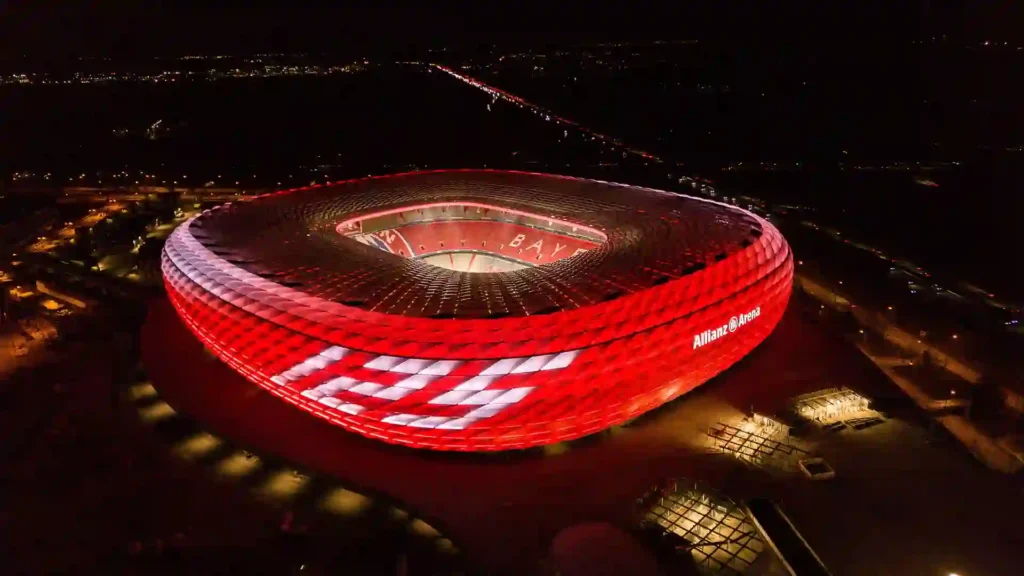
The Allianz Arena is probably the most architecturally recognizable stadium of the last twenty years. Its exterior facade, made of ETFE panels that can be illuminated in different colors—red when Bayern plays, blue when 1860 Munich plays, white for the German national team’s matches—makes it a benchmark for modern design applied to sports venues.
Opened with barely two decades of history, it has already hosted a Champions League final (2012) and is regularly considered one of the best stadiums in the world in terms of spectator experience.
10. Stadio Olimpico — Rome, Italy
Opened: 1953 | Capacity: 70,634 spectators
The Stadio Olimpico in Rome has a collection of major events under its belt that few European venues can match: the 1960 Olympic Games, the 1968 European Championship final, and the 1990 World Cup, where the tournament experienced some of the most memorable nights in the recent history of international football.
As a stadium shared by Roma and Lazio—two clubs with a fierce rivalry within the same city—the Olimpico is also the protagonist of one of the tensest derbies in European football: the Derby della Capitale.
The 10 Most Legendary Stadiums in the Americas
1. Maracanã — Rio de Janeiro, Brazil
Opened: 1950 | Current Capacity: 78,838 spectators
If there is a stadium that condenses all the epic and all the tragedy of football in a single place, it is the Maracanã. Built to host the 1950 World Cup, its inauguration witnessed the “Maracanazo”: Brazil’s defeat to Uruguay in the final, an event that marked an entire generation of Brazilian fans.
Paradoxically, the same stadium was the scene of redemption in the 2014 World Cup, although in that case the wound was different: Germany’s 7-1 thrashing of Brazil in the semifinals. In between, the Maracanã also hosted the 2019 and 2021 Copa América, and the Rio 2016 Olympic Games. A piece of trivia illustrating its historical dimension: in 1950, it is estimated that nearly 200,000 people entered the venue for the final, a figure never equaled in football history.
2. La Bombonera — Buenos Aires, Argentina
Opened: 1940 | Capacity: 54,000 spectators
Boca Juniors’ stadium is neither the largest in Argentina nor the most modern, but it is, without discussion, the one generating the greatest emotional impact among those visiting it for the first time. Its peculiar shape—three vertical stands and one slanted one to adapt to the urban space of the La Boca neighborhood—creates a unique acoustics that literally makes the building’s structures vibrate when the fans sing.
It is said that La Bombonera “beats,” and those who have been in it during a high-tension match perfectly understand the expression. The passion of the Xeneize fanbase, known worldwide for its intensity, turns every match into an experience going far beyond football.
3. Estadio Monumental — Buenos Aires, Argentina
Opened: 1938 | Capacity: 83,000 spectators (the largest in South America)
River Plate’s stadium is the largest on the South American continent and one of the most important historical stages in Argentine football. It was the venue for the 1978 World Cup, which Argentina won at home with the controversy that has always accompanied that tournament, and it also hosted the 2018 Copa Libertadores final between Boca Juniors and River Plate, although incidents with the visiting fans forced the match to be moved to Madrid.
Recently renovated, the Monumental has improved its facilities without losing the big-stadium spirit defining it.
4. Estadio Azteca — Mexico City, Mexico
Opened: 1966 | Capacity: 87,523 spectators
The Estadio Azteca is the only venue in the world to have hosted two men’s FIFA World Cup finals: in 1970, won by Brazil, and in 1986, won by Argentina. But if there is one moment summarizing its historical dimension, it is the 1986 World Cup quarterfinal between Argentina and England, where Diego Maradona scored first with his hand—the famous “Hand of God” goal—and then with a 60-meter run that was named the “Goal of the Century” by popular vote.
The Azteca will also host matches for the 2026 World Cup, making it the first stadium to host matches in three different editions of the tournament.
5. Estádio do Morumbi — São Paulo, Brazil
Opened: 1960 | Capacity: 66,795 spectators
The stadium owned by São Paulo FC is one of the largest in Brazil and one of the most important venues in the history of South American football. It has been the scene of Copa Libertadores finals, Paulista derbies, and Brazilian national team matches, and in its stands, entire generations of fans have cheered on the most passionate football on the continent.
Its architecture, characteristic of the era in which it was built, remains a benchmark for stadium design in Latin America.
6. Arena do Grêmio — Porto Alegre, Brazil
Opened: 2012 | Capacity: 60,540 spectators
Grêmio’s stadium is one of the most modern on the continent and an example of how sports venues can be integrated into the urban landscape with contemporary design. Opened for the 2014 World Cup, its top-level facilities—from the spectator experience to the amenities for the press and teams—position it as a reference for 21st-century Latin American football.
7. Estadio Nacional de Lima — Lima, Peru
Opened: 1952 (renovated several times) | Capacity: 50,000 spectators
The Estadio Nacional is the quintessential stage of Peruvian football. It has hosted Copa Libertadores finals and the 2004 Copa América, and it represents a space of meeting and national identity for the Peruvian national team’s fanbase. The national team’s qualifying nights have generated moments in this venue of an intensity difficult to describe for those who haven’t experienced them.
8. Estadio Centenario — Montevideo, Uruguay
Opened: 1930 | Capacity: 60,235 spectators
The Estadio Centenario in Montevideo holds a unique place in the history of world football: it was the venue for the first FIFA World Cup, held in 1930 and won by Uruguay as hosts. FIFA recognizes it as a Historical Monument of World Football, a title very few stadiums in the world hold.
Its architecture, characteristic of the thirties, has been carefully preserved, and the stadium remains the main stage for Uruguayan football nearly a century after its opening.
9. Estadio Monumental Banco Pichincha — Guayaquil, Ecuador
Opened: 1987 | Capacity: 59,283 spectators
Barcelona SC’s stadium is the largest in Ecuador and the only venue in the country to have hosted top-level international finals. Three Copa Libertadores finals—in 1990, 1998, and 2022—and a Copa América final in 1993 place it among the stadiums with the most historical weight in South America, a notable achievement for a country that historically has had less visibility in continental football.
Popularly known as “El Monumental,” “El Coloso de América,” or “El Templo,” the venue has a devoted fanbase making Barcelona SC matches a memorable experience for any visitor.
10. Estadio Defensores del Chaco — Asunción, Paraguay
Opened: 1917 | Capacity: 42,000 spectators
Paraguay’s national stadium is one of the oldest venues in continuous use in the entire Americas. With over a century of history, its stands have seen football evolve from its most primitive forms to the global, multi-billion-dollar sport it is today. Its name honors the Paraguayan soldiers who fought in the Chaco War, giving it an additional historical dimension going beyond sports.
What Makes a Stadium Great?
Reviewing this list allows us to identify some common elements elevating a simple sports venue to the category of a legendary stadium. Capacity matters, but it isn’t everything: Signal Iduna Park or La Bombonera generate atmospheres surpassing larger stadiums. Accumulated history carries enormous weight: stadiums that have hosted World Cups, Champions League finals, or Copa Libertadores finals possess a patina of greatness that is difficult to replicate.
But perhaps the hardest element to quantify is the relationship between a stadium and its community. The best stadiums in the world aren’t just infrastructures; they are spaces laden with emotional meaning for the people inhabiting them week after week. When Anfield sings “You’ll Never Walk Alone” or when Dortmund’s south stand waves in yellow, what happens transcends football and enters the realm of collective identity.
Conclusion
The twenty stadiums in this review share something in common: they have all generated, at some point in their history, that collective silence preceding a goal, that explosion of emotion making no distinction of languages or borders. They are spaces where football has demonstrated its ability to connect people who would otherwise never share anything.
Visiting them—whether as a tourist, a fan, or a journalist—is always an experience leaving a mark. Not because they are big or beautiful, but because behind every seat there are decades of stories, victories, and defeats forming part of something bigger than any match: the living memory of the world’s most popular sport.