





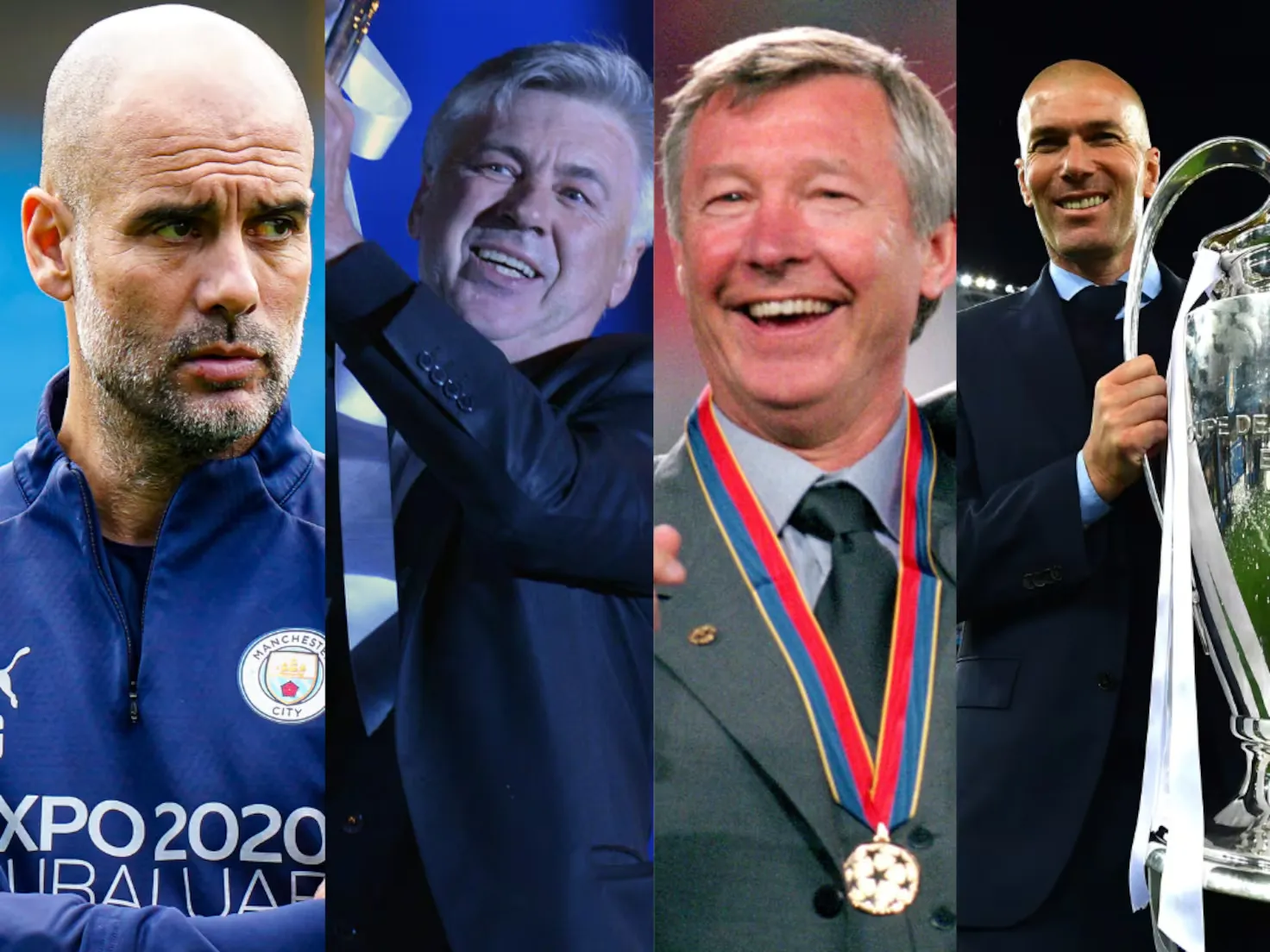
In football, players are the ones who touch the ball, but managers are the ones who build the stage. A great team is rarely an accident: it is almost always the result of a mind capable of seeing a match before it is played, of a leader who convinces twenty-five egos to pull in the same direction, and of a tactician who understands that the pitch is a chessboard where pieces move at thirty kilometers per hour.
Choosing the ten greatest managers in the entire history of football involves answering an impossible question: What matters more, the titles you won or how you changed the sport? A manager who wins everything with an unlimited budget is great, but is he greater than the one who invents a tactical system that all his rivals end up copying?
In this list, we have tried to balance both criteria. These are not just the managers who filled their display cabinets with trophies: they are the men who redefined what is possible on a football pitch.
📋 Table of Contents
The 10 Best Managers in History
1. Sir Alex Ferguson (Scotland)
Clubs managed: East Stirlingshire, St Mirren, Aberdeen, Manchester United, Scotland national team. Notable honors: 13 Premier Leagues, 2 Champions Leagues, 5 FA Cups, 2 European Cup Winners’ Cups.
If greatness is measured in longevity, dominance, and the ability to rebuild winning teams generation after generation, no one surpasses Sir Alex Ferguson. Over 26 years at Manchester United, Ferguson didn’t just manage a club: he built an empire.
When he arrived in Manchester in 1986, the club hadn’t won the league in almost twenty years and lived in the shadow of Liverpool. When he retired in 2013, United was the most successful team in English football history and a global powerhouse. Ferguson wasn’t a tactical revolutionary like Cruyff or Sacchi, but he was the ultimate manager: a master of psychology, a ruthless competitor who knew exactly when to dismantle a winning team to build the next one, and a leader who always placed the institution above any player, no matter how big their name.
His achievement of the Treble (Premier League, FA Cup, and Champions League) in 1999 remains one of the greatest milestones in English football history.
2. Pep Guardiola (Spain)
Clubs managed: FC Barcelona, Bayern Munich, Manchester City. Notable honors: 3 Champions Leagues, 5 Premier Leagues, 3 LaLiga titles, 3 Bundesligas, 2 Trebles.
No manager has had a more profound impact on modern football than Pep Guardiola. Since his debut with FC Barcelona’s first team in 2008, Guardiola hasn’t just accumulated titles at a historic pace: he has completely changed the way the game is played and analyzed across Europe.
His Barcelona (2008-2012) is considered by many to be the greatest team in history: a perfect machine of possession, suffocating pressure, and positional attack that won 14 titles in four years, including the sextuple in 2009. But Guardiola’s true merit lies in having exported that philosophy to Germany and England, adapting it to different cultures and constantly evolving it.
At Manchester City, he achieved the Treble in 2023, becoming the first manager in history to win the Treble with two different clubs. His obsession with detail, his ability to reinvent players’ positions (Lahm as a midfielder, Stones as a pivot), and his dominance in domestic leagues make him the most influential manager of the 21st century.
3. Rinus Michels (Netherlands)
Clubs managed: Ajax, FC Barcelona, Los Angeles Aztecs, FC Köln, Netherlands national team. Notable honors: 1 European Cup, Euro 1988, 4 Eredivisie titles, 1 Spanish LaLiga.
If football were an academic discipline, Rinus Michels would be its most important theorist. The Dutchman is the intellectual father of “Total Football,” the tactical system that revolutionized the sport in the 1970s and laid the foundations for the modern game.
With Ajax, Michels built a team where any outfield player could occupy the position of any other, creating a fluid dynamic of constant movement that left rivals baffled. He won the European Cup in 1971 before taking his philosophy to FC Barcelona, where he also left an indelible mark alongside his star pupil, Johan Cruyff.
As manager of the Netherlands, he led the “Clockwork Orange” to the final of the 1974 World Cup—where they lost to Germany despite being the best team of the tournament—and years later, he won Euro 1988, providing Dutch football with the only major international title in its history. In 1999, FIFA named him the “Manager of the Century.”
4. Johan Cruyff (Netherlands)
Clubs managed: Ajax, FC Barcelona, Catalonia national team. Notable honors: 1 European Cup, 4 Spanish LaLigas, 2 European Cup Winners’ Cups, 2 KNVB Cups.
If Michels was the theorist, Cruyff was the prophet who spread the word and perfected the system. The impact Johan Cruyff had on world football is unique: he is the only person who can legitimately claim to be both one of the five best players in history and one of the five best managers.
As a manager, Cruyff took Michels’ concepts and radicalized them. His FC Barcelona “Dream Team” (1988-1996) didn’t just win four consecutive LaLiga titles and the club’s first European Cup in 1992; they established a non-negotiable philosophy of attacking football, ball possession, and reliance on the youth academy (La Masia) that continues to define the club to this day.
“Playing football is very simple, but playing simple football is the hardest thing there is,” he used to say. His legacy is so vast that you can’t understand modern football—especially the success of the Spanish national team between 2008 and 2012 and Guardiola’s career—without studying the foundations Cruyff laid in Barcelona.
5. Arrigo Sacchi (Italy)
Clubs managed: Parma, AC Milan, Italy national team, Atlético Madrid. Notable honors: 2 European Cups, 1 Serie A, 2 Intercontinental Cups.
When Arrigo Sacchi arrived at AC Milan in 1987, he was a manager who had never played football professionally. A journalist reminded him of this, and his response went down in history: “I never realized that to become a jockey you have to have been a horse first.”
Sacchi completely destroyed the tradition of Italian catenaccio. Instead of man-marking and sitting deep, his Milan implemented high pressing, a flat four-man defense playing the offside trap with mathematical precision, and an intense, compact style of play where the distance between the forwards and the defenders was never more than 25 meters.
His Milan won back-to-back European Cups in 1989 and 1990 (the last team to do so until Zidane’s Real Madrid decades later) playing football that completely dismantled rivals like Real Madrid. Tactically, Sacchi is one of the most important revolutionaries in sports history: modern pressing was born with his team.
6. Carlo Ancelotti (Italy)
Clubs managed: Juventus, AC Milan, Chelsea, PSG, Real Madrid, Bayern Munich, Everton, Napoli. Notable honors: 4 Champions Leagues, 1 Premier League, 1 LaLiga, 1 Serie A, 1 Bundesliga, 1 Ligue 1.
If Guardiola is the method and Sacchi the revolution, Carlo Ancelotti is common sense elevated to an art form. No manager in football history has won more Champions Leagues than the Italian (four: two with Milan and two with Real Madrid), and he is the only manager to have won the league title in Europe’s five major leagues.
Ancelotti’s greatness lies in his adaptability. He doesn’t impose a rigid system on his teams; he analyzes the players he has and builds the best possible context for them to shine. He is arguably the best man-manager in elite football: capable of handling dressing rooms filled with global stars without generating conflict, maintaining authority through respect and calmness rather than fear.
His ability to navigate the politics of mega-clubs like Real Madrid, PSG, or Bayern Munich, and keep his teams competing at the highest level year after year, makes him one of the most universally respected figures in world football.
7. José Mourinho (Portugal)
Clubs managed: Porto, Chelsea, Inter Milan, Real Madrid, Manchester United, Tottenham, Roma. Notable honors: 2 Champions Leagues, 3 Premier Leagues, 2 Serie A titles, 1 LaLiga, 1 UEFA Cup/Europa League, 1 Conference League.
José Mourinho irrupted into European football in 2004 by winning the Champions League with Porto and declaring himself “The Special One” upon arriving at Chelsea. And for a decade, he absolutely was.
Mourinho was the perfect counterpoint to Guardiola’s possession football. The Portuguese built physically devastating, tactically rigorous, and psychologically impenetrable teams. His Inter Milan, which achieved the Treble in 2010 by eliminating Guardiola’s Barcelona in the semifinals in a display of defensive resistance, is his masterpiece.
At Real Madrid, he managed to break the hegemony of the best Barcelona in history by winning the 2011-2012 league with 100 points and 121 goals. Mourinho may be a polarizing figure, a specialist in conflict and media mind games, but his impact on 21st-century football and his ability to build teams competing with absolute ferocity guarantee him a place on the Olympus of managers.
8. Helenio Herrera (Argentina/France)
Clubs managed: Atlético Madrid, FC Barcelona, Inter Milan, Roma. Notable honors: 2 European Cups, 3 Serie A titles, 4 Spanish LaLigas.
Before Mourinho, before Sacchi, there was Helenio Herrera. He was the first manager to become a global star, a figure demanding as much attention as his players and using the press as a psychological weapon against his rivals.
Herrera is primarily remembered as the architect of the “Grande Inter” of the 1960s, the team that perfected the catenaccio. Although he didn’t invent the system, he carried it to its ultimate expression: an impenetrable defense, a free sweeper behind the defensive line, and lethal counterattacks executed at maximum speed.
With Inter, he won two consecutive European Cups (1964 and 1965). He was a pioneer in dietetics, training camps before matches, and sports psychology. His famous phrases (“we will win without getting off the bus”) and his control over every aspect of his players’ lives laid the foundations for the modern professional manager.
9. Valeriy Lobanovskyi (Ukraine/Soviet Union)
Clubs managed: Dynamo Kyiv, Soviet Union national team, Ukraine national team. Notable honors: 2 European Cup Winners’ Cups, 13 Soviet/Ukrainian leagues.
If you read data analysis applied to football today, you should know that Valeriy Lobanovskyi was doing it with computers in the 1970s. The Ukrainian manager was a pioneer in applying a scientific, mathematical, and systematic approach to football.
During his long tenures at Dynamo Kyiv, Lobanovskyi conceived football not as a sport of individuals, but as a system of dynamic systems. He partnered with an endocrinologist to analyze his players’ physical performance and designed training programs pushing the limits of physical endurance, creating teams capable of executing suffocating pressing for 90 minutes.
His Dynamo Kyiv won two European Cup Winners’ Cups and dominated Soviet football, while his Soviet Union national team reached the final of Euro 1988 playing a modern and collective brand of football that was decades ahead of its time.
10. Ernst Happel (Austria)
Clubs managed: ADO Den Haag, Feyenoord, Sevilla, Club Brugge, Netherlands national team, Hamburger SV. Notable honors: 2 European Cups, 1 Intercontinental Cup, league titles in 4 different countries.
Ernst Happel was the first manager to win the European Cup with two different clubs: he achieved it with Feyenoord in 1970 and with Hamburger SV in 1983. In an era when managing abroad was much less common than today, the Austrian won league titles in the Netherlands, Belgium, Germany, and Austria.
Happel was a man of few words—his silence was legendary—but a master tactician. His Feyenoord was the first Dutch team to win the European Cup, doing so by beating Celtic and anticipating the total football that Ajax would popularize shortly after. He also took the Netherlands to the 1978 World Cup final.
His ability to arrive in different countries, impose his style with an iron hand, and achieve immediate success against more powerful teams makes him one of the most effective and universally respected managers in European football history.
Conclusion
The history of football cannot be written solely with goals and dribbles. Behind every great team, behind every era-defining cycle, there is a manager who saw the game differently.
Ferguson demonstrated that an empire can be sustained through time through character. Guardiola and Cruyff proved that winning is meaningless if you don’t do it by imposing beauty and dominance. Sacchi and Lobanovskyi turned football into an exact science. Ancelotti reminded everyone that managing people is as important as moving pieces on a board.
These ten men didn’t just sit on a bench to direct matches. They wrote the instruction manuals that everyone else has tried to copy ever since.