


Rules - Stadiums
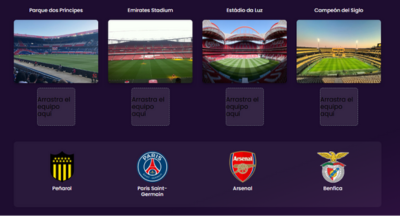
Your objective is to connect each football stadium with the team to which it belongs.





×
Games



Your objective is to connect each football stadium with the team to which it belongs.
Football Stadiums is an interactive puzzle that tests your knowledge of the most famous football grounds around the world. Your objective is to correctly match each football club with its corresponding home stadium.
On your screen, you'll see a list of stadiums and a set of team crests. Your task is to drag and drop each team's badge onto the stadium you believe is their home. The game features scenarios ranging from football’s most iconic and legendary venues to modern architectural marvels, putting both your memory and precision to the test.
You can rearrange the badges as many times as you need. Nothing is final until you are completely sure of your answers. Once you're ready, press the SUBMIT button to evaluate your choices.
When you submit your selection, the game will give you immediate feedback: correctly matched stadiums will be marked in green, and incorrect ones in red. This allows you to see exactly what you got right and what you need to improve.
There’s no limit to the number of attempts you can make, but the challenge is to achieve a perfect score by successfully matching all teams with their respective stadiums without a single error. At the end of the game, you’ll see your total score. Can you get them all right on your first try?
Good Luck!
The largest football stadium in the world is not in Europe or South America, but in North Korea. The Rungrado 1st of May Stadium in Pyongyang has an official seating capacity of 114,000 spectators.
Stadium naming rights have become a massive source of income for clubs. Arsenal’s transition from Highbury to the Emirates Stadium in 2006 was one of the first major naming-rights deals in European football, completely changing the financial landscape of the Premier League.
Many classic stadiums are famous for their unique architecture or atmosphere. Boca Juniors' 'La Bombonera' (The Chocolate Box) is famous for its steep stands and intense acoustics, to the point where opponents claim the stadium actually 'beats' and shakes when the fans jump.
The Maracanã Stadium in Rio de Janeiro holds the record for the highest attendance ever recorded at a football match. During the 1950 World Cup Final between Brazil and Uruguay (the famous 'Maracanazo'), an estimated 199,854 people packed into the stadium.