





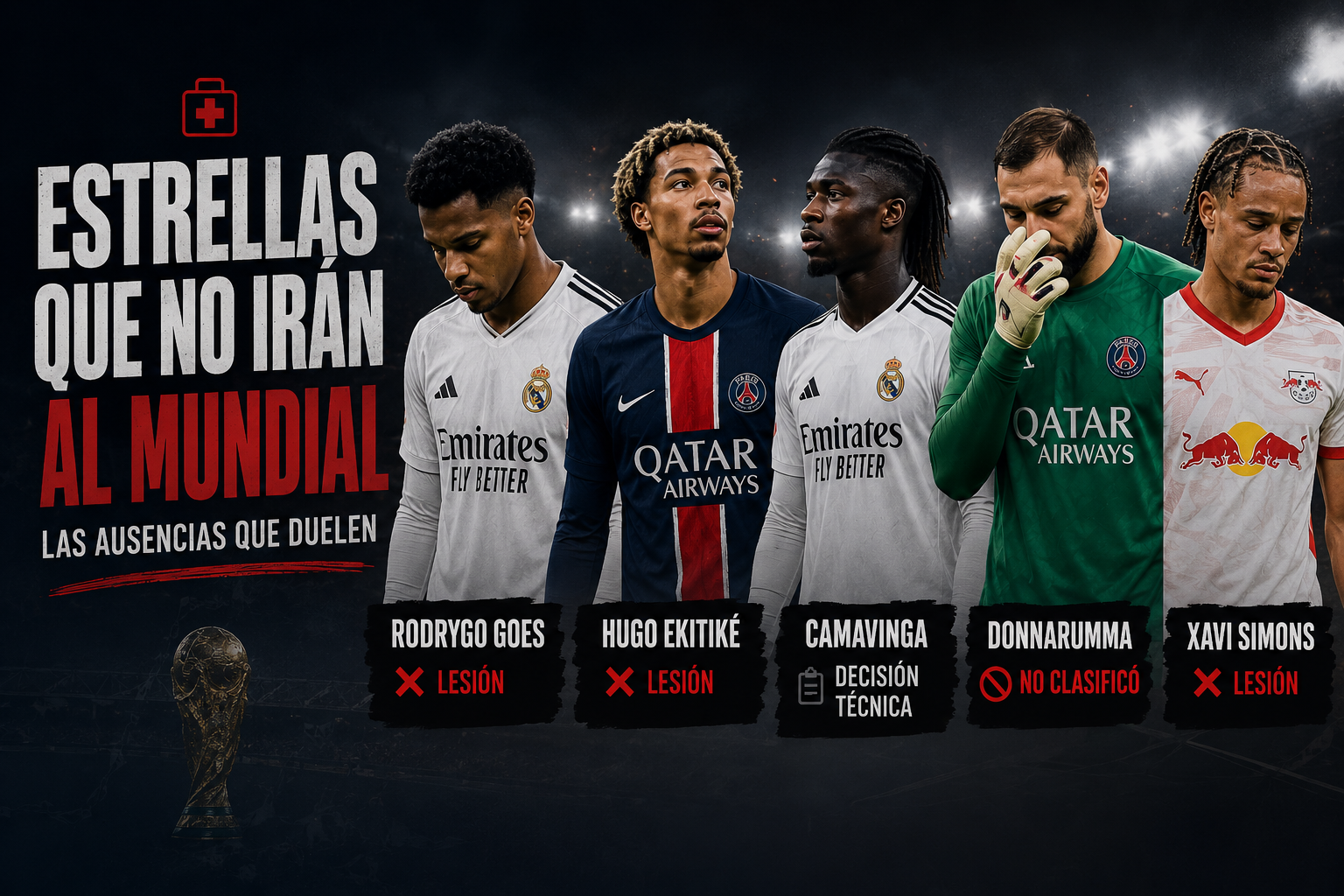
Every time a World Cup approaches, the debate on the benches and in the stands doesn’t solely revolve around who will lift the trophy. There’s also a heartbreaking void left by the absentees: those players who fall by the wayside due to an injury, a cruel qualifying elimination, or an incomprehensible managerial decision.
In 2026, with the newly expanded 48-team format, one might have assumed we’d see nearly all of the planet’s greats out on the pitch. However, fate, the grueling demands of the calendar, and the unpredictability of the qualifiers have handed down a very different sentence.
The casualty list is so staggering that, if we were to gather all the discarded players, we’d have a serious contender to lift the cup. Here at 11Inicial, we’ve evaluated the footballing weight, market value, and tactical impact of every absence to put together this analysis, updated with the latest information available following the release of the final official squad lists.
📋 Table of Contents
- The Ideal XI of the Great Absentees
- Top 11: The Most Painful Losses of the 2026 World Cup
- Detailed Analysis of Every Absence
- Comparative Table: Value and Cause of Absences
- The Killer Calendar: Why Modern Football is Breaking its Stars
- Conclusion: A World Cup of Collective Tactics
⚽ The Ideal XI of the Great Absentees
If all these players could participate, they would form a team with overwhelming offensive potential (though clearly unbalanced defensively, given that injuries have primarily struck attackers). Here is the stellar lineup missing out on the 2026 World Cup:
- Goalkeeper: Gianluigi Donnarumma (Italy)
- Defense: Éder Militão (Brazil) anchoring a backline short on reinforcements.
- Midfield: Eduardo Camavinga (France), Renato Sanches (Portugal), and Xavi Simons (Netherlands) running the creative engine.
- Wingers: Serge Gnabry (Germany), Roony Bardghji (Sweden), and Estêvão Willian (Brazil) providing width and flair on the flanks.
- Attack: Rodrygo Goes (Brazil), Hugo Ekitike (France), and Roberto Firmino (Brazil) completing a dream forward line.
It’s a team with a combined market value exceeding €600 million that will be watching the tournament from the couch. The reflection left by that hypothetical formation is harsher than any World Cup scoreline.
🌟 Top 11: The Most Painful Losses of the 2026 World Cup
Before diving into the individual analysis, here is the complete ranking of the superstars who will be watching the World Cup on television:
| # | Player | National Team | Reason |
|---|---|---|---|
| 1 | Rodrygo Goes | 🇧🇷 Brazil | Injury (ACL and meniscus) |
| 2 | Gianluigi Donnarumma | 🇮🇹 Italy | Failed to qualify |
| 3 | Eduardo Camavinga | 🇫🇷 France | Tactical decision |
| 4 | Xavi Simons | 🇳🇱 Netherlands | Injury (Cruciate ligament) |
| 5 | Estêvão Willian | 🇧🇷 Brazil | Grade 4 injury (Hamstring) |
| 6 | Hugo Ekitike | 🇫🇷 France | Achilles tendon rupture |
| 7 | Serge Gnabry | 🇩🇪 Germany | Adductor rupture |
| 8 | Roony Bardghji | 🇸🇪 Sweden | Tactical decision |
| 9 | Éder Militão | 🇧🇷 Brazil | Recurring muscle injury |
| 10 | Roberto Firmino | 🇧🇷 Brazil | Not called up (Tactical decision) |
| 11 | Renato Sanches | 🇵🇹 Portugal | Recurring knee injury |
💡 Did you know…? Brazil is the most heavily impacted national team on this ranking, with 4 confirmed absences. The Seleção approaches the tournament with its defensive and offensive lines significantly diminished, though they offset some of the psychological blow with Neymar’s return to the squad after a nearly three-year absence.
🔍 Detailed Analysis of Every Absence
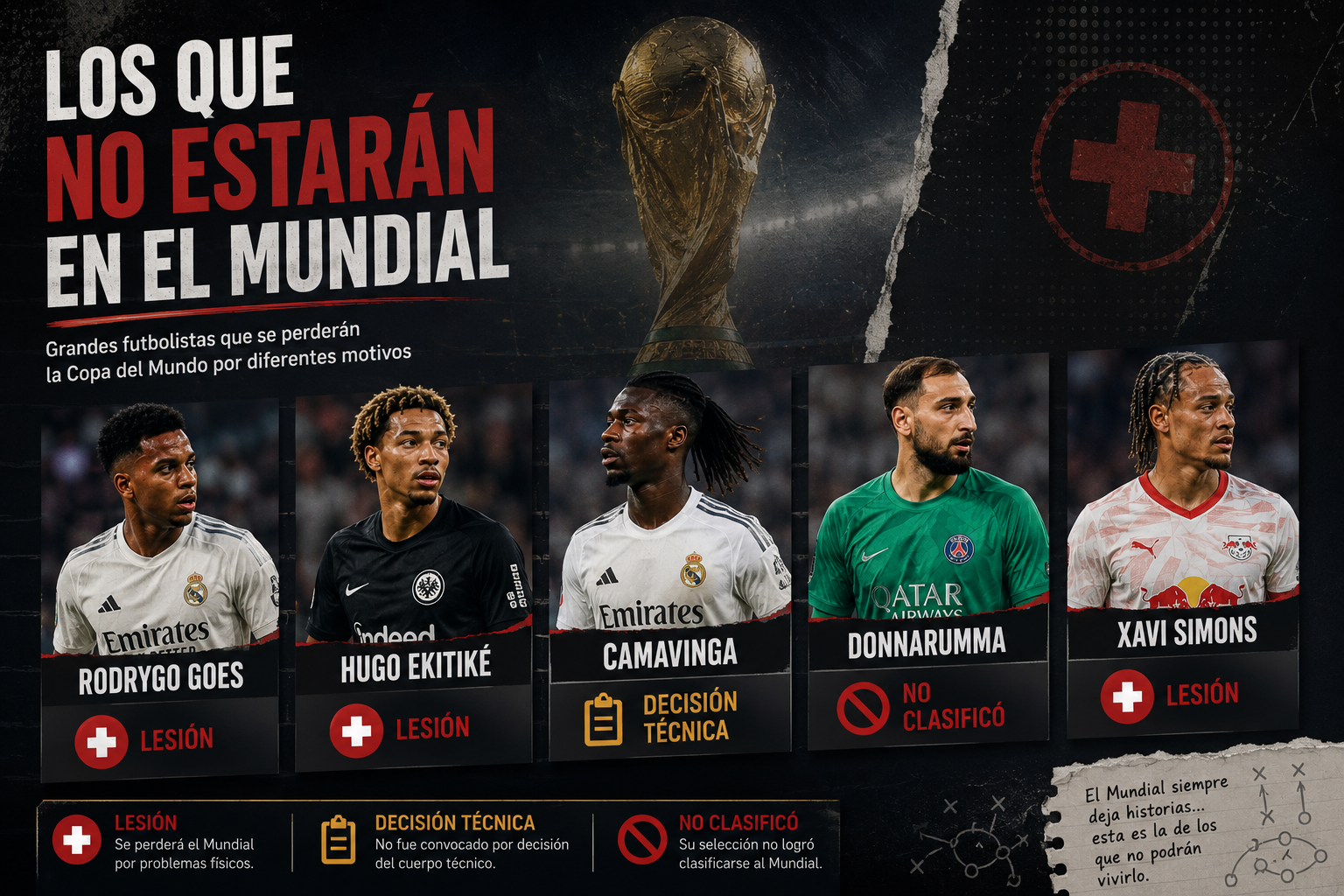
The major stars who will miss out on the 2026 World Cup.
1. Rodrygo Goes (Brazil) — The Ultimate Blow to the Seleção
Club: Real Madrid | Market Value: €110 million | Reason: Torn anterior cruciate ligament and lateral meniscus
Of all the blows Brazil has suffered during their World Cup preparations, losing Rodrygo Goes is by far the most devastating. The Brazilian winger was slated to be the leader of the attacking front during his period of peak footballing maturity: bringing speed, dribbling, goals, and an ability to operate in various attacking positions that made him indispensable on the tactical board.
On March 2, during a LaLiga match against Getafe at the Bernabéu, Rodrygo suffered a tear of his anterior cruciate ligament and lateral meniscus in his right knee after attempting a dribble. The medical verdict was final: surgery and six to eight months off the pitch, a timeline that mathematically ruled him out of the World Cup.
His absence forced a complete restructuring of the Seleção’s right flank and attacking midfield, stripping a massive amount of penetration from the Brazilian squad right when he was emerging as one of the undeniable fixtures of the starting lineup. In terms of tactical impact, it is the costliest loss of the tournament.
- ⚡ The most electric one-on-one attacker in the yellow-and-green squad
- 🎯 A player capable of featuring as a right winger, left winger, or attacking midfielder
- 🧠 Wealth of experience in major tournaments and high-pressure matches
2. Gianluigi Donnarumma (Italy) — The Azzurra’s Curse Continues
Club: Manchester City | Market Value: €80 million | Reason: Italy failed to qualify
It’s the sporting tragedy of the season. Following an agonizing European playoff decided by a penalty shootout against Bosnia and Herzegovina, the Azzurra were left out of the World Cup for the third consecutive time—an unprecedented streak for a four-time world champion nation. Donnarumma delivered notable individual performances throughout the qualifiers, but he was unable to single-handedly avert his national team’s collective collapse.
The World Cup subsequently loses one of the most dominant goalkeepers on the global stage, right at a time when the Manchester City shot-stopper was proving to be in peak competitive form. The elimination triggered an institutional crisis within the Italian Federation, ultimately resulting in the resignation of its president and several members of the coaching staff.
The tragedy by the numbers:
- 3 consecutive Italian eliminations in World Cup qualifying stages (2018, 2022, and 2026)
- Donnarumma has now been Italy’s undisputed number 1 for 8 years without ever playing in a World Cup final stage
3. Eduardo Camavinga (France) — The Snub That Shocked Europe
Club: Real Madrid | Market Value: €90 million | Reason: Tactical decision
One of the biggest surprises across all the European squad announcements. Despite his elite-level versatility—capable of performing as a defensive midfielder, box-to-box midfielder, or left-back—Didier Deschamps opted to leave him out of his 26-man roster. The manager himself explained the reasoning: the midfielder went through a season plagued by injuries and lacked consistency at Real Madrid, a factor that weighed more heavily on the final decision than his individual talent. Camavinga had also drawn criticism following a red card in the second leg of the Champions League quarterfinals against Bayern Munich.
The decision sparked fierce media debate in France, where many struggled to comprehend how one of the most well-rounded midfielders in Europe could be left out due to physical and performance concerns rather than strictly tactical ones. Deschamps, who is managing France for the final time in this tournament, publicly acknowledged that he “could imagine the player’s disappointment.”
What France loses without Camavinga:
- 🔄 A unique dynamic presence capable of operating in three different positions
- 🏃 The ability to break lines by carrying the ball in the final stretches of matches
- 💪 A physical profile distinct from the rest of the midfielders in the French squad
4. Xavi Simons (Netherlands) — A Knee Injury Stalls the Oranje’s Engine
Club: Tottenham Hotspur | Market Value: €85 million | Reason: Torn cruciate ligament
He was enjoying a breakout season in the Premier League, establishing himself as one of the most dynamic creative midfielders in Europe. The connection between the midfield and the forward line for the Netherlands relied heavily on his ability to carry the ball forward and trigger rapid link-up play in the final third.
On April 25, during Tottenham’s victory over Wolverhampton, Simons suffered a tear of the anterior cruciate ligament in his right knee. The player himself confirmed the end of his World Cup dream on social media: “Representing my country this summer… it’s gone,” he wrote. Without him, the Netherlands lose their primary link between midfield and attack—an absence that complicates the Oranje’s buildup play heading into the knockout stages.
5. Estêvão Willian (Brazil) — Youthful Talent Robbed of a Dream Debut
Club: Chelsea FC | Market Value: €60 million | Reason: Grade 4 hamstring tear
His explosive arrival in English football had positioned him as one of the tournament’s most highly anticipated young attractions. The 19-year-old Chelsea winger promised to be one of the great breakout names of the World Cup, having strung together five goals in his last six matches with the Brazilian national team. A grade 4 tear in his right hamstring, suffered on April 18 against Manchester United, prevented him from recovering in time despite attempting a conservative treatment plan to avoid surgery.
The Seleção loses one of its most promising gems at the worst possible moment—a blow that arrived just weeks after Rodrygo’s injury and definitively crippled the Brazilian attacking front.
6. Hugo Ekitike (France) — A Severe Injury Cuts Short His Prime
Club: Liverpool FC | Market Value: €35 million | Reason: Achilles tendon rupture
His stellar goalscoring form during his debut Premier League season with Liverpool had guaranteed him a firm spot in the Les Bleus forward line. On April 14, during the second leg of the Champions League quarterfinals against PSG at Anfield, Ekitike suffered a non-contact fall that was later confirmed to be a rupture of his right Achilles tendon—one of the most severe injuries with the longest recovery periods in professional football, estimated at around nine months.
The injury robbed the striker, who had recently scored against Brazil in a friendly, of his massive World Cup opportunity right at the absolute peak of his career. In his place, Deschamps called up Jean-Philippe Mateta for the final roster.
7. Serge Gnabry (Germany) — The Bavarian Infirmary Takes Its Toll
Club: Bayern Munich | Market Value: €40 million | Reason: Adductor rupture
The German winger suffered a severe rupture of the adductor muscles in his right thigh during a penalty shootout training session on April 18—an injury that ruled him out of both Bayern’s season finale and Germany’s final squad. Julian Nagelsmann was banking on his ability to crash the box from deep as a game-changing weapon for the Mannschaft, but the severity of the diagnosis made a timely recovery impossible.
Gnabry himself confirmed the news on social media: “As for the dream of playing the World Cup with the national team, I have to say that unfortunately, it’s over.”
8. Roony Bardghji (Sweden) — The Snub That Sparked Controversy
Club: FC Barcelona | Market Value: €25 million | Reason: Tactical decision
Although Sweden successfully qualified, manager Graham Potter shocked many by leaving the young Barcelona winger—widely considered one of the brightest prospects in Scandinavian football—out of the final squad. Potter explained that these were “incredibly difficult decisions” based on internal squad competition and managing the 26-player group that would travel to the tournament.
The decision ignited a media firestorm in Sweden. The Swedish sporting press believed Bardghji deserved a chance, not just because of his recent performances for Barça, but because his mid-to-long-range shooting and his ability to beat players out wide represent a unique profile that the Swedish national team lacks in other positions. The general feeling is that the call-up might have come slightly too soon for Bardghji—but also that the manager could have backed him right now to begin building the next generation of the Blågult.
9. Éder Militão (Brazil) — The Defensive Wall That Couldn’t Arrive in Time
Club: Real Madrid | Market Value: €70 million | Reason: Recurring muscle injury
Just like his club teammate Rodrygo, physical issues have shown no mercy to the Canarinha center-back. On April 21, playing against Deportivo Alavés, Militão suffered a relapse in his left biceps femoris over the scar tissue of a previous injury, forcing him to undergo another surgery and sideline him for four to five months. The Brazilian defense thus loses one of its fastest center-backs in open space, which will force the manager to rely on far more positional profiles that will likely be more vulnerable to counterattacks from the tournament’s quickest teams.
10. Roberto Firmino (Brazil) — The Silent Farewell of a Legend
Club: Al Qadsiah | Market Value: €12 million | Reason: Not called up (Tactical decision)
The case of Roberto Firmino differs from the rest: there is no injury, and there is no qualifying defeat. It is simply the end of a cycle. At 34 years old, the former Liverpool striker—who moved to Saudi football before retiring—was no longer in the Brazilian manager’s plans. His exclusion went almost unnoticed amidst so many injury-related absences, but for many Seleção fans, it represents the definitive end of an era.
Firmino will not play in a World Cup following 2018, where he was a crucial piece of Tite’s team. His unique style as a “false 9”—the best of his generation in that specific role—is left entirely unrepresented in Brazil’s 2026 squad.
11. Renato Sanches (Portugal) — The Cursed Midfielder
Club: PSG | Market Value: €15 million | Reason: Recurring knee injury
Few careers in modern football have combined so much talent with such dreadful physical luck as that of Renato Sanches. The Portuguese midfielder, who debuted at Euro 2016 as the tournament’s young player of the tournament at just 18 years old, has spent nearly a decade battling injuries that have prevented him from reaching the ceiling everyone expected of him.
During the 2025-26 season, another relapse involving his left knee ruled him out for the remainder of the club season and Roberto Martínez’s World Cup squad. For Portugal, his absence means losing an intense, box-to-box midfield profile that the rest of the Portuguese roster doesn’t naturally replicate. For Sanches, it may signal the definitive end of his chances to play in a major tournament with the national team.
📊 Comparative Table: Value and Cause of the Great Absences
To put the loss of talent into perspective, we’ve organized the key data for each absence, featuring reference market values from Transfermarkt for the 2025/26 season:
| Player | National Team | Club | Value | Reason | Attribute Lost |
|---|---|---|---|---|---|
| Rodrygo Goes | Brazil | Real Madrid | €110M | Injury (ACL and meniscus) | Dribbling and attacking versatility |
| Eduardo Camavinga | France | Real Madrid | €90M | Tactical decision | Versatility and physical range |
| Xavi Simons | Netherlands | Tottenham | €85M | Injury (Cruciate ligament) | Progressive ball carrying and key passes |
| Gianluigi Donnarumma | Italy | Manchester City | €80M | Failed to qualify | Shot-stopping security and leadership |
| Éder Militão | Brazil | Real Madrid | €70M | Recurring injury | Anticipation and recovery speed |
| Estêvão Willian | Brazil | Chelsea | €60M | Grade 4 injury (Hamstring) | Audacity in one-on-ones |
| Serge Gnabry | Germany | Bayern Munich | €40M | Adductor rupture | Late runs into the box |
| Hugo Ekitike | France | Liverpool | €35M | Achilles tendon rupture | Hold-up play and first-time finishing |
| Roony Bardghji | Sweden | FC Barcelona | €25M | Tactical decision | Long-range shooting and dribbling |
| Renato Sanches | Portugal | PSG | €15M | Knee injury | Intensity and box-to-box presence |
| Roberto Firmino | Brazil | Al Qadsiah | €12M | Tactical decision | False 9 and attacking pressing |
📌 Editorial Note: This list reflects the state of the squads following the official roster deadlines. Some situations remained uncertain until just weeks before the start of the tournament.
Total market value of the absentees: over €640 million. A figure that perfectly puts the magnitude of the losses into perspective.
⏰ The Killer Calendar: Why Modern Football is Breaking its Stars
The most striking aspect of this absentee list isn’t any specific name—it’s the temporal pattern of the injuries. Rodrygo on March 2. Simons on April 25. Ekitike on April 14. Gnabry on April 18. Militão on April 21. Estêvão on April 18.
All of them occurring in the final stretch of the season. It’s no coincidence: it is the direct consequence of a sporting calendar that continues to expand while players’ bodies lack sufficient time to recover between competitions. The Champions League, domestic leagues, European playoffs, and international breaks are all piled into a segment of the season where footballers are already carrying months of accumulated physical load.
The debate surrounding the restructuring of the international football calendar has been sitting on the desks of FIFA, UEFA, and players’ unions for years. The list of absentees for the 2026 World Cup is, in and of itself, the most powerful argument that exists for moving that debate from the realm of theory into concrete reforms.
🏁 Conclusion: A World Cup of Collective Tactics
The absences plaguing this 2026 World Cup sharply remind us of the cruelty of elite football. Severe injuries—like those suffered by Rodrygo, Xavi Simons, or Ekitike—and recurring ones—such as those of Gnabry, Militão, or Renato Sanches—once again bring the eternal debate over the overloaded international calendar to the forefront, with almost all of these setbacks occurring during the final and most demanding stretch of the European season.
However, this also opens a fascinating window of opportunity for managers: lacking stellar individualities, the tournament forces teams to maximize collective functionality and tactical structure. In such a scenario, any national team operating as a cohesive, compact unit has the potential to shock opponents boasting far more talent on paper.
The three key takeaways from this landscape of absences:
- 🇧🇷 Brazil is the biggest victim: featuring four players from this ranking sidelined, heavily impacting their defense (Militão), attack (Rodrygo, Estêvão), and their false nine profile (Firmino), although Neymar’s return to the squad softened the blow slightly.
- 🇫🇷 France suffers a double blow: Camavinga omitted by tactical choice and Ekitike sidelined by a severe injury leave both the midfield and the forward line with fewer options than anticipated.
- 📅 The calendar continues claiming victims: every single injury occurred in the final stretch of the league and European campaigns—a structural problem that elite football still hasn’t resolved.