





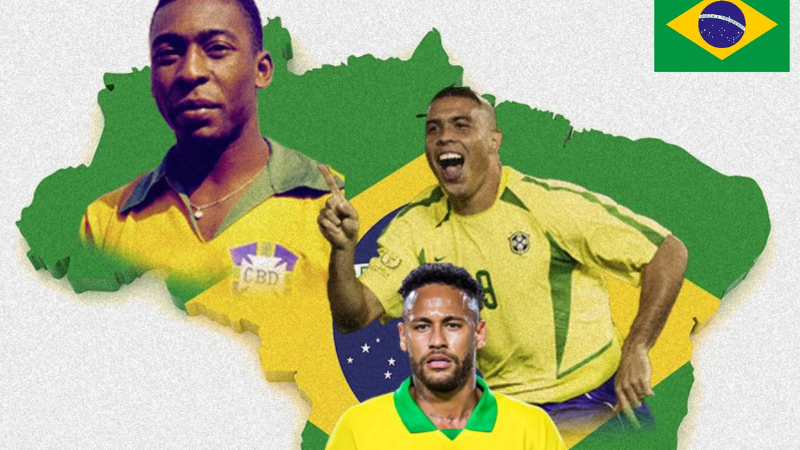
There are national football teams, and then there is Brazil. The land of carnival and samba is also the country that has won more World Cups than any other, produced some of the most brilliant footballers the world has ever seen, and given its name to a way of playing that transcends the sport: jogo bonito, the beautiful game.
The Brazilian National Team, known worldwide as the Canarinha due to the yellow color of its iconic shirt, has participated in every single World Cup in history since 1930—a record unmatched by any other nation. Five titles, generations of legends, moments of absolute glory, and also episodes of almost indescribable national sorrow make up a story that is, in many ways, the history of football itself.
In this article, we review the Canarinha’s legacy from start to finish: its origins, its golden eras, the idols who defined it, and the records that place Brazil in a category of its own in world football.
📋 Table of Contents
- Introduction
- The Origins of a Legend
- The Golden Decades of “Jogo Bonito”
- The Modern Rebirth
- Records Defining Their Greatness
- Idols and Golden Generations
- The Style That Conquered the World
- The Wounds That Also Forged the Legend
- Trivia Few Remember
- Conclusion
Introduction
The Brazil National Team is not simply a country’s football squad: it is a cultural symbol transcending borders and generations. From its origins in the early 20th century to becoming the most decorated nation in the history of world football, the Canarinha has built a legacy combining exceptional talent, a distinct playing philosophy, and a unique capacity to generate idols capable of making the entire planet fall in love.
There is no corner of the world where Brazil’s yellow jersey isn’t recognized. There is no football fan, of any age or culture, who doesn’t have in their memory an image of Pelé, Ronaldo, Ronaldinho, or Neymar doing something seemingly impossible with a ball. That universality of Brazilian football is, perhaps, its greatest achievement: not only did it win five World Cups, but it convinced the planet that playing beautifully and winning could be the exact same thing.
In this article, we review their complete history: the triumphs that made them legends, the failures that made them more human, and the players who shaped decades of jogo bonito.
The Origins of a Legend
The history of the Brazilian National Team officially begins in 1914, when they played their first international match against Argentina in a 3-3 draw. In those years, football was still an elite sport in Brazil, introduced by Englishmen working for the country’s railway and port companies. Charles Miller, a young Brazilian of Scottish descent who returned from studying in England with two footballs and a rulebook tucked under his arm, is considered the father of Brazilian football.
What happened in the ensuing decades was a democratization as rapid as it was fascinating: football left the elite clubs and reached the humblest neighborhoods, where underprivileged kids learned to master the ball on dirt pitches or straight on the streets. That blend of cultural influences—African, European, and Latin American—was what forged a playing style unlike anything the world had ever seen.
Early World Cups and the Global Awakening
Brazil debuted in the 1930 World Cup in Uruguay, where they were eliminated in the first round. The thirties and forties were years of building: the talent was there, but the organization and winning mentality were still developing.
The big leap came with the 1958 World Cup in Sweden. An extraordinary squad, which included a 17-year-old teenager named Pelé and the incomparable Garrincha, steamrolled every European team on their own continent and lifted Brazil’s first-ever world title. Pelé, who had arrived at the tournament with a knee injury and whose participation was in doubt, scored six goals in four matches, becoming the most famous player on the planet overnight. In the final against hosts Sweden, the score was 5-2: a statement of intent for world football.
The Golden Decades of “Jogo Bonito”
The sixties and seventies represented the absolute zenith of Brazilian football. Never before or since has a team dominated world football with such consistency and with such an irresistible style.
In 1962 in Chile, Brazil successfully defended their world title without Pelé, who got injured in the second match and couldn’t play again. The big star was Garrincha, the bow-legged right winger with impossible dribbling skills, considered by many to be the second-greatest player in Brazil’s history. The team demonstrated unusual squad depth: when their best player falls, another rises to fill the void. Brazil won the tournament with authority, becoming back-to-back world champions.
But the most glorious generation, the one still studied today in football academies around the world, was that of the 1970 World Cup in Mexico. That team, managed by Mário Zagallo and featuring Pelé at the absolute peak of his footballing maturity, combined technique, imagination, speed, and efficiency in a way football had never seen before. The squad lined up with Tostão as a second striker, Jairzinho as a right winger who ended up scoring in every single match of the tournament, Rivelino with his brutal left-footed shot, and Pelé as the hub of an attack that seemed capable of creating a goal out of nothing at any moment.
The final against Italy ended 4-1, and the goal where Pelé headed in the 1-0—jumping practically over the Italian defender—is considered by many to be one of the most beautiful moments in football history. By winning their third title, Brazil permanently kept the Jules Rimet Trophy. That 1970 team didn’t just win a World Cup: it set a standard of footballing beauty against which all subsequent generations have been compared, and none have surpassed.
The Modern Rebirth
After the glories of the seventies, Brazil experienced over two decades of high-level play without the definitive title validating their status as the world’s best team. The eighties produced brilliant squads—the generation of Zico, Sócrates, and Falcão is considered one of the most talented in history never to win a World Cup—but the trophy continued to elude them in crucial moments.
The return to the summit arrived in 1994 in the United States. That was not a team of dazzling aesthetics: it was a pragmatic, physical, and highly organized side under the management of Carlos Alberto Parreira. The duo formed by Romário and Bebeto was devastating, and the image of the two celebrating Bebeto’s goal against the Netherlands together—rocking an imaginary baby, referencing the son Bebeto had just had—became one of the most iconic celebrations in World Cup history. The final against Italy was decided on penalties following a 0-0 draw after 120 minutes: Roberto Baggio missed the final penalty, and Brazil lifted their fourth World Cup.
The fifth title came in 2002 in South Korea and Japan, and it was perhaps the most dramatic in terms of expectations and resolution. Ronaldo Nazário, who had arrived at the tournament with a career marked by severe physical problems and a highly questioned performance in the 1998 final—where he suffered a convulsive episode hours before the match—redeemed his career in the best possible way: he scored two goals in the final against Germany and finished as the tournament’s top scorer. Alongside Ronaldinho and Rivaldo, he formed a trident that was practically unstoppable throughout the entire championship.
Since 2002, Brazil hasn’t won another World Cup, although they have maintained their status as perennial candidates, winning several Copas América and a FIFA Confederations Cup as hosts in 2013.
Records Defining Their Greatness
Brazil’s numbers in international football are, quite simply, unique:
| Achievement | Detail |
|---|---|
| 🏆 World Cups Won | 5 (1958, 1962, 1970, 1994, and 2002) — absolute record |
| 🏅 Copa América | 9 titles |
| 🌍 Confederations Cup | 4 titles |
| ⚽ All-Time Top Scorer | Neymar Jr., with over 79 goals up to 2025 |
| 👕 Most Capped Player | Cafú, with 142 official appearances |
| 📅 Only Country | To have participated in every World Cup since 1930 |
These numbers are not just statistics: they reflect a national team that has found a way, generation after generation, to produce top-tier talent. No other country has managed to win five world titles. None has played in 22 consecutive World Cups. They are records reflecting not just talent, but a footballing culture sustained over time in a way the rest of the world hasn’t been able to replicate.
Idols and Golden Generations
Legendary Goalkeepers
Gilmar dos Santos Neves, known simply as Gilmar, was the goalkeeper for the 1958 and 1962 World Cups. His calmness between the posts and his leadership in the box were essential for that generation to play with such offensive freedom: when the team knew Gilmar was behind them, they could attack without the fear of leaving themselves exposed.
Cláudio Taffarel was the goalkeeper who starred in perhaps the most decisive moment in the Canarinha’s recent history: he saved Daniele Massaro’s penalty in the 1994 final and watched Baggio miss the last one, sealing Brazil’s fourth world title. For over a decade, he was the undisputed starting goalkeeper and one of the best in Europe with Italian side Parma.
Immortal Defenders
Cafú, the team captain in 2002, was the best right-back in the world for over a decade. His ability to join the attack without neglecting his defensive duties, combined with extraordinary physical stamina, made him an immovable pillar. He reached three consecutive World Cup finals (1994, 1998, and 2002), winning two of them—a record no other defender in football history has matched.
Roberto Carlos redefined the left-back position with an approach that seemed impossible at the time: a defender who pushed forward, attacked, crossed, and shot with such power that his free-kicks became a phenomenon of their own. His free-kick goal against France in 1997, curving in a way that defied the laws of physics and left the goalkeeper rooted to the spot, remains one of the most replayed wonder goals in football history.
Djalma Santos was the benchmark for Brazilian defensive football in the fifties and sixties, taking part in the first two world titles. His elegance in marking and his tactical reading earned him a place among the greatest defenders in history.
Midfield Magicians
Zico, nicknamed the “White Pelé,” was the most decisive footballer of the generation that didn’t win the World Cup in the eighties, speaking volumes to both his talent and the cruelty of football. With technique bordering on art and an exceptional shot, Zico averaged over a goal per game throughout his national team career, starring in some of the greatest footballing moments of that era.
Sócrates was something different: a doctor who decided to play professional football and built a life philosophy around the sport. His way of viewing football—as a collective game where individual freedom and tactical intelligence had to coexist—was as brilliant as it was unusual for his time.
Rivaldo was the best player in the world in 1999, the year he won the Ballon d’Or. His left foot was a precision weapon, his ability to step up in decisive moments was extraordinary, and his role in the 2002 World Cup was vital to Brazil securing the title.
Eternal Goalscorers
Pelé is, for many, the greatest footballer of all time. Three World Cups, over 1,000 goals in his entire career—though official FIFA records count 77 for the national team—titles at every level of football, and an innovative capacity on the pitch matched by no one. He was the first to prove that a footballer could be technical, physical, a goalscorer, and a playmaker all rolled into one.
Ronaldo Nazário, “O Fenômeno,” was perhaps the most complete striker in modern football history. Devastating speed, dribbling in tight spaces, and surgical finishing: qualities that usually exist separately in other players coexisted naturally in him. His 15 World Cup goals, spanning from 1994 to 2006, rank him among the top scorers in tournament history.
Romário was the killer of the 1994 World Cup: cold, intelligent, and decisive in the box. He didn’t need many touches or much space; he only needed a split second to find the exact angle and moment. Neymar Jr. is the national team’s all-time top scorer with over 79 goals, and although he hasn’t yet secured the World Cup that would complete his legacy, his influence on the Canarinha’s recent history is undeniable.
The Style That Conquered the World
Jogo bonito is not a tactical system: it is a philosophy. The idea that football must be, above all, a spectacle; that dribbling holds intrinsic value as an artistic expression; that creativity and improvisation are just as important as tactical discipline.
This philosophy was born in the humble neighborhoods of Rio de Janeiro and São Paulo, where underprivileged children learned to play on uneven surfaces with deflated balls and without coaches telling them exactly what to do. What emerged from that freedom was an instinctive, dynamic brand of football capable of solving situations no manual could predict.
Over time, that improvised foundation was combined with tactical organization—Brazil has used the 4-2-4, the 4-3-3, and multiple modern variations depending on the era—without losing its hallmark identity. Even in the team’s most pragmatic years, like the 1994 World Cup, there are plays of pure instinct and creativity serving as a reminder of where it all comes from.
What distinguishes Brazilian football from that of any other nation isn’t the titles or the statistical records. It’s the feeling it generates when playing at its best: the feeling of watching something that transcends the sport itself.
The Wounds That Also Forged the Legend
Every legend has its dark moments, and Brazil’s history is no exception. Two defeats in particular have left wounds stretching far beyond football, forming an essential part of the Canarinha’s narrative.
The Maracanazo (1950) is probably the most painful defeat in football history. Brazil hosted the first post-war World Cup, built the largest stadium in the world—the Maracanã, with a capacity of nearly 200,000—and reached the final matchday of the final round needing only a draw to become champions. Uruguay needed to win. In front of a crowd already celebrating before kickoff, Uruguay won 2-1 with an Alcides Ghiggia goal in the 79th minute. The stadium fell silent. Brazil went into days of national mourning. Goalkeeper Barbosa carried the blame for that defeat for the rest of his life, a story that speaks volumes about how ruthless football can be to those who play it.
The Mineirazo (2014) was a more recent wound and, in many ways, just as deep. Brazil hosted the World Cup and reached the semifinals with the pressure of winning at home. The opponent was Germany. What happened at the Mineirão Stadium in Belo Horizonte during the first 30 minutes of the match was simply devastating: four German goals between the 11th and 25th minutes, six before halftime, seven by the end. Brazil lost 7-1 in a match that paralyzed the country. Images of Brazilian fans crying in the stands circulated the globe. The result was so unexpected and so disproportionate that the event dubbed the Mineirazo—in a direct nod to the 1950 Maracanazo—now occupies a permanent place in world football history.
These defeats, far from diminishing Brazil’s legacy, add a human dimension that makes its history even grander. The Canarinha has known both the summit and the abyss, and in both places, it has remained a symbol.
Trivia Few Remember
-
Brazil is the only national team in the world to have participated in every World Cup since the very first one in 1930. 22 editions, 22 appearances: a record of consistency that no other nation has matched or even come close to.
-
The yellow jersey wasn’t always the original. Until the 1950 World Cup, Brazil played in white. After the Maracanazo, the color became so strongly associated with defeat that a magazine held a contest to design a new kit. The winner proposed the yellow and green recognized across the planet today.
-
Pelé is the only player in football history to have won three World Cups: in 1958, 1962, and 1970. He also participated in 1966, but Brazil was eliminated in the first round.
-
Garrincha never lost a match with Brazil in the games he played. Throughout his international career, the Brazilian national team won or drew every match where he was available and part of the squad.
-
The nickname “Canarinha” is a direct reference to the yellow color of the jersey, reminiscent of a canary’s plumage, a bird highly present in Brazilian popular culture. It is a nickname proudly used both inside and outside the country for decades.
Conclusion
The history of the Brazil National Team is, in the truest sense of the phrase, the history of modern football. No other nation has produced so many players capable of redefining their position, inventing a goal where there was no space, and turning 90 minutes of a match into a spectacle people wanted to watch over and over again.
Five world titles, uninterrupted participation in every edition of the planet’s most important tournament, generations of idols who have enchanted fans from entirely different cultures, and a playing style studied, copied, and attempted worldwide for decades: that is the legacy of the Canarinha.
But perhaps the most important thing isn’t the numbers or the titles. The most important thing is the emotion it generates. The first time someone sees Pelé heading in the 1-0 in the 1970 final, or Ronaldinho nutmegging an opponent in the World Cup, or Ronaldo celebrating his two goals in the 2002 final, they immediately understand why Brazil is something different. Something that goes far beyond football.
“Football was invented in England, but perfected in Brazil.” — Popular saying among world football fans.