





The Biggest Robberies and Corruption Cases in Football History
Football is the most followed sport on the planet and, like any industry moving billions of dollars, it has been exposed to its darkest side: refereeing decisions sparking international controversies, corruption plots organized from the very offices of federations, and cases where organized crime brushed against the pitch.
Some of these episodes remained in the collective memory as unjustifiable “robberies”. Others uncovered corruption structures that had been operating in the shadows for decades. All of them left a deep mark on football history and on how fans understand the sport they love.
This article reviews the most significant cases, from the 1966 World Cup final to the institutional earthquake of the 2015 FIFAGate.
Table of Contents
- The “Wembley Robbery” (England - Germany, 1966)
- South Korea at the 2002 World Cup
- The Calciopoli Scandal (Italy, 2006)
- Brazil – Norway at the 1998 World Cup
- The Escobar Case in Colombia
- FIFAGate (2015)
- Other Remembered Robberies
- Trivia and Controversies
- Conclusion
The “Wembley Robbery” (England - Germany, 1966)
The 1966 World Cup final between England and West Germany ended 4-2 and made the English world champions for the first and only time in their history. But Geoff Hurst’s third goal—the one making it 3-2 in extra time and deciding the match—has been the subject of debate for six decades.
The shot hit the crossbar and bounced in an area close to the goal line. Swiss referee Gottfried Dienst consulted with Soviet linesman Tofiq Bahramov and validated the goal. Images from the time were ambiguous, but studies using modern technology—including photogrammetric analyses—have overwhelmingly concluded the ball did not completely cross the line.
For Germany and much of the world, that goal was the first of the great robberies in World Cup history. For England, it remains simply the moment they won the World Cup.
South Korea at the 2002 World Cup
The 2002 Korea-Japan World Cup left two of the most questioned refereeing performances in the competition’s history in the memories of millions of fans. The South Korean hosts reached the semifinals in a run generating enormous international controversy.
In the round of 16, Korea eliminated Italy with a 2-1 result. During the match, Ecuadorian referee Byron Moreno disallowed a legitimate goal for the Italians, sent off Francesco Totti with a debatable second yellow card, and allowed the home team’s winning goal in extra time in an action the Italians considered offside. The Italian national team, one of the title favorites, was eliminated amidst general outrage.
In the quarterfinals, Spain faced Korea. The referee disallowed two Spanish goals that subsequent images showed to be perfectly valid. Spain fell in a penalty shootout. The Spanish Federation filed a formal complaint with FIFA, which did not prosper.
Byron Moreno, the referee of the match against Italy, was convicted years later in the United States for heroin trafficking, a fact adding an extra layer of shadow over that entire tournament.
The Calciopoli Scandal (Italy, 2006)
In the spring of 2006, just weeks before Italy traveled to Germany to play the World Cup they would end up winning, Italian football experienced one of the biggest scandals in its history. The judicial investigation known as Calciopoli revealed executives from several clubs—with Juventus as the main protagonist—maintained regular contacts with referee designators to influence the assignment of favorable referees to their teams.
Telephone conversations recorded by the Italian justice system proved Luciano Moggi, Juventus’ general director, was part of a network of influence affecting Serie A results. The consequences were immediate and severe: Juventus lost their 2005 and 2006 league titles, were relegated to the Second Division, and several of their executives were sanctioned. Other clubs such as AC Milan, Fiorentina, and Lazio also received lesser penalties.
The historical irony of Calciopoli is that Italy, with several Juventus players in its ranks, won the 2006 World Cup in Germany just weeks after the scandal broke.
Brazil – Norway at the 1998 World Cup
This episode is less known than others on this list, but no less controversial. In the group stage of the 1998 World Cup in France, Norway beat Brazil 2-1 thanks to an 89th-minute penalty called on Tore André Flo that television replays showed to be non-existent. There was no contact between the Brazilian defender and the Norwegian striker, but the referee pointed to the penalty spot and Norway scored the winning goal.
Brazil, arriving at the tournament as top favorites and eventually reaching the final, suffered an unexpected defeat that could have had consequences in the knockout draw. The match was archived for years by Brazilian fans as just another inexplicable refereeing decision in modern football.
The Escobar Case in Colombia
The murder of footballer Andrés Escobar on July 2, 1994, was one of the darkest moments in world football history. Days earlier, Colombia had been eliminated from the World Cup in the United States in the group stage after losing 2-1 to the hosts themselves. Escobar had scored an own goal in that match proving decisive for the elimination.
Ten days after that match, he was shot dead in Medellín. Investigations indicated the crime was related to drug trafficking mafias who had bet large sums of money on a Colombian victory and lost their bets due to the own goal.
The Escobar case brutally exposed the extent to which Colombian football at the time was infiltrated by organized crime, leaving a wound in the sport’s memory that remains difficult to process today.
FIFAGate (2015)
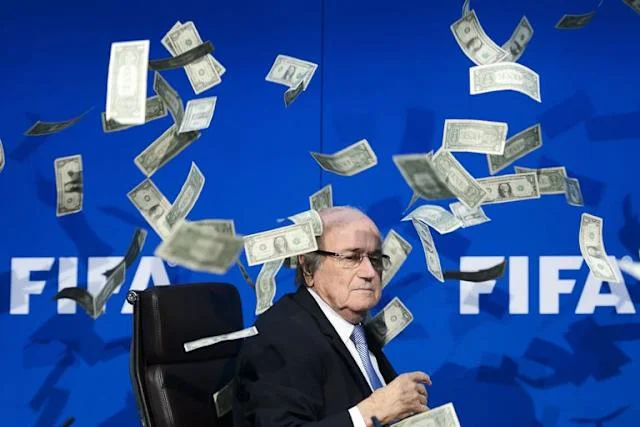
On May 27, 2015, Swiss police arrested seven top FIFA officials at a Zurich hotel at the request of the United States Department of Justice. It was the beginning of the biggest corruption scandal in football history.
An FBI investigation uncovered a multi-million dollar bribery network that had been operating for decades within the very organization governing world football. Television rights, sponsorship contracts, and host selections for international tournaments had been systematically manipulated in exchange for payments that, in some cases, exceeded ten million dollars per vote.
Joseph Blatter, FIFA president since 1998, announced his resignation just four days after being re-elected for a fifth term. The investigations also reached the host selection processes for the 2018 World Cup in Russia and the 2022 World Cup in Qatar, although neither tournament was reassigned.
FIFAGate forced a profound reform of FIFA’s statutes and governance processes, forever changing the public perception of the institution governing football globally.
Other Remembered Robberies
Football has a long list of episodes fans do not forget. Some of the most cited are the following.
In the 2009 Champions League, Chelsea were eliminated by Barcelona in the semifinals in a match where Norwegian referee Tom Henning Øvrebø ignored at least three situations subsequent analysts considered clear penalties in favor of the English team. Chelsea manager Guus Hiddink and several players received sanctions for their protests at the end of the match.
The so-called “Disgrace of Gijón” in 1982 is another widely remembered episode. On the final matchday of Group 2, West Germany needed to beat Austria by a one-goal margin for both teams to advance at Algeria’s expense. The match ended 1-0 in a game where, following the opening goal, both teams played without any apparent intensity. FIFA amended the rules so the final matches in each group are played simultaneously.
In 2018, Real Madrid eliminated Juventus in the Champions League quarterfinals thanks to a stoppage-time penalty dividing public opinion and awarded by match referee Michael Oliver in an action the Italians still consider non-existent.
Trivia and Controversies
Referee Byron Moreno, protagonist of the 2002 World Cup, was arrested at JFK airport in New York in 2010 with several kilos of heroin hidden in his body. He was sentenced to prison in the United States, an outcome adding a sinister dimension to memories of that tournament.
In FIFAGate, it was documented that some votes to elect World Cup hosts were negotiated through intermediaries with commissions divided among several officials. The system operated uninterrupted for at least two decades without any regulatory body detecting it.
In Calciopoli, transcripts of Moggi’s phone calls were made public and showed a level of detail in manipulation exceeding the worst expectations of the investigators themselves: not only was the designation of referees influenced, but also that of assistants and how designators gave them instructions before matches.
Conclusion
The episodes gathered in this article are very different from each other: there are questionable refereeing decisions, institutional corruption plots, and cases where organized crime penetrated directly into the football world. But they all share the same effect: they erode fans’ trust in a sport that should be, above all, fair.
Many of these cases have driven real reforms. FIFAGate changed the governance of the international federation. Calciopoli transformed referee designation systems in Italy. The Disgrace of Gijón modified tournament rules. In that sense, scandals have also had their usefulness: they have forced football to look in the mirror and take measures that, although belated, proved necessary.
Football remains passion and entertainment, but these episodes remind us that the match doesn’t always end when the final whistle blows.