





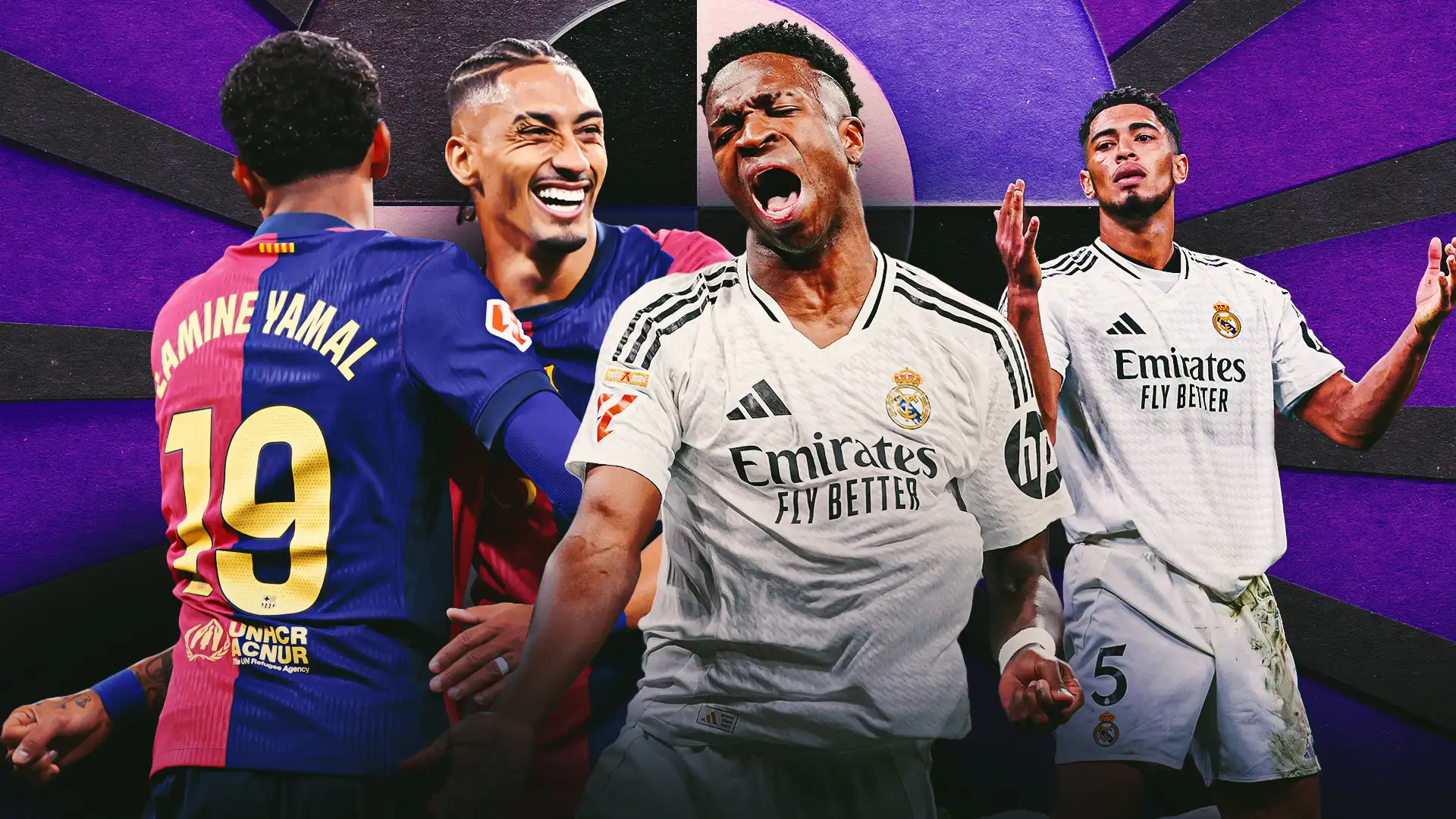
Twice a year, approximately, Spanish football stops being just Spanish football and becomes something greater. The stadiums of Barcelona and Madrid fill up. Bars in Buenos Aires, Mexico City, Lagos, and Jakarta turn on their screens. Social networks collapse before the opening whistle. And the whole world revolves, for 90 minutes, around a match between FC Barcelona and Real Madrid.
El Clásico is the most-watched sporting rivalry on the planet. Not because it is the oldest, nor because the two teams are the absolute greatest in purely sporting terms, but because it concentrates decades of history, two worldviews that rarely coincide, and the highest technical level club football can offer into a single match. When Messi and Ronaldo faced off in this duel for nearly a decade, El Clásico reached audience heights no other club match had ever achieved.
But the history of this clash begins long before Messi and Ronaldo, carrying political, cultural, and social layers that make it unlike any other duel in world football. In this article, we review everything you need to know about the most important match in Spain.
📋 Table of Contents
- Origins of El Clásico
- Meaning and Evolution
- Historical Statistics (up to 2025)
- El Clásico All-Time Top Scorers
- Players with the Most Clásico Appearances
- Legends Who Wore Both Shirts
- Unforgettable Clásicos
- Historic Managers
- Competitions Where They Meet
- Global and Economic Impact
- Trivia
- Conclusion
Origins of El Clásico
FC Barcelona was founded in 1899 by Swiss native Joan Gamper, along with a group of largely foreign players who found the Catalan city the ideal place to practice the football they had known in Europe. Real Madrid was born a couple of years later, in 1902, driven by a group of enthusiasts seeking to create the football club of the Spanish capital. Two distinct origins, two cities with their own identities, and, almost from the beginning, the perception that these two clubs represented something more than just themselves.
The first official clash between the two teams took place in 1916 during the Copa del Rey, a series that ended with heavy scorelines in both directions across several stages. Since then, the matchup has continuously grown in significance.
What makes El Clásico unique, even within world football, is the political dimension it acquired during the 20th century. During the years of Franco’s dictatorship (1939-1975), Real Madrid was perceived by many Catalans as the club of the regime, representing a centralism that had suppressed the Catalan language and identity. Barça, in that context, became “more than a club” (més que un club—the official motto of FC Barcelona) because it represented the cultural resistance of an entire region. For decades, Camp Nou was the only place where the senyera, the Catalan flag, could be displayed without immediate risk.
That historical weight hasn’t completely vanished, though with the passage of time and Spain’s democratization, El Clásico has evolved into a more sporting than political rivalry, without entirely losing the intensity its original dimension gave it.
Meaning and Evolution
Throughout over a hundred years of history, El Clásico has absorbed the tensions of each era and expressed them on the pitch with a symbolic power few other rivalries can match.
During the sixties and seventies, the duel reflected the rivalry between Madrid’s economic and institutional might—backed by a relationship with the regime that provided influence over signings and federation decisions—and Barça’s distinct cultural identity, which built its image of resistance on sporting results themselves. Every Barcelona victory was celebrated in Catalonia with a dimension going far beyond football.
In the nineties, El Clásico experienced one of its most brilliant eras with the clash between Johan Cruyff’s Dream Team—the most dominant Culé side in history up to that point—and the Galácticos of Madrid, which gathered the world’s most expensive stars in a team seeking the continental title that had eluded them. This rivalry of projects, styles, and footballing philosophies added another layer of depth to the encounter.
The Messi-Ronaldo era (2009-2018) took El Clásico to its moment of highest global visibility. With the two best players in the world facing off on the same pitch, the match became the most-followed sporting event on the planet. TV ratings shattered all previous records, and El Clásico was broadcast live in over 180 countries with viewership figures exceeding 650 million per edition.
Historical Statistics (up to 2025)
The all-time record between the two teams is one of the closest in any long-standing sporting rivalry:
| Statistic | Total |
|---|---|
| Total Official Matches | 255 |
| Real Madrid Wins | 104 |
| FC Barcelona Wins | 101 |
| Draws | 50 |
| Real Madrid Goals | 426 |
| FC Barcelona Goals | 414 |
Three victories’ difference in over a century of clashes. Twelve goals of advantage in goals scored. It is difficult to find another rivalry in world sports yielding such a balanced record over so long, making every match another page in a story that remains undecided.
El Clásico All-Time Top Scorers
| Player | Club | Goals |
|---|---|---|
| Lionel Messi | FC Barcelona | 26 |
| Alfredo Di Stéfano | Real Madrid | 18 |
| Cristiano Ronaldo | Real Madrid | 18 |
| Karim Benzema | Real Madrid | 16 |
| Raúl | Real Madrid | 15 |
Lionel Messi’s lead on this list, with 26 goals, is one of the most extraordinary records in Clásico history. Eight goals more than the runner-up, in a match played against the best team in Spain, is a figure reflecting the magnitude of his individual impact on this duel. Alfredo Di Stéfano and Cristiano Ronaldo share second place with 18 goals each, separated by six decades of history.
Players with the Most Clásico Appearances
| Player | Club | Matches |
|---|---|---|
| Sergio Busquets | FC Barcelona | 48 |
| Sergio Ramos | Real Madrid | 45 |
| Lionel Messi | FC Barcelona | 45 |
| Karim Benzema | Real Madrid | 43 |
| Xavi Hernández | FC Barcelona | 42 |
These numbers aren’t just statistics: they reflect a generation that lived El Clásico as the central axis of their careers. Both Sergio Busquets and Sergio Ramos are emblems of clubs that dominated European football for a decade, and their number of Clásicos played speaks of longevity and a sustained level of performance very few players in history could maintain.
Legends Who Wore Both Shirts
In El Clásico, there is a special category of players who, at some point in their careers, defended the colors of both rivals. In a rivalry of this intensity, such transfers are never easy.
Luis Figo starred in the most controversial transfer in Clásico history when he left Barça to sign for Real Madrid in the year 2000. The reunion at Camp Nou was one of the tensest moments in the stadium’s history: the Culé fans welcomed him with a shower of objects, including a pig’s head that landed in the corner where the Portuguese went to take a corner kick. Over two decades later, that day remains an unavoidable reference whenever transfers between the two clubs are discussed.
Ronaldo Nazário played for Barcelona in his debut professional season in Spain (1996-97) before leaving for Inter Milan, and returned to Spanish football years later to become Real Madrid’s great goalscorer between 2002 and 2007. His case didn’t generate the same animosity as Figo’s because his stint at Barça was brief, but his name appears in the records of Spain’s two biggest clubs.
Luis Enrique took the opposite route to most: he began his career at Real Madrid, where he was an international and captained the team on several occasions, and then left for Barcelona, where he played for years before becoming one of the club’s most successful managers. Samuel Eto’o was trained in Madrid’s youth academy, though he never debuted for the first team, before becoming one of the great stars in Barcelona’s history.
Unforgettable Clásicos
5-0 (1994) — Cruyff’s Dream Team at Its Best
Barça’s biggest victory over Madrid in the modern era came in January 1994, with the Culé side at the peak of its dominance under Johan Cruyff. The result was so heavy and the gap in class so evident that this 5-0 remains the obligatory reference when discussing the most humiliating nights in Real Madrid’s history. Romário was the main protagonist with two goals that left the white defense completely overwhelmed.
0-3 (2005) — Ronaldinho and the Bernabéu Ovation
One of the most extraordinary moments in Clásico history was not a goal or a comeback: it was an ovation from Real Madrid fans for a Barcelona player. After scoring two stunning goals at the Bernabéu and handing Madrid a 0-3 defeat, Ronaldinho received a standing ovation from the home crowd upon being substituted. That gesture, unprecedented in Clásico history, speaks to the level the Brazilian had taken his game to at that moment and what his football could generate even in rival fans.
2-6 (2009) — Guardiola’s Barça and the False 9
In May 2009, Pep Guardiola’s first year at Barcelona, El Clásico at the Bernabéu ended with a scoreline that is still hard to believe today: 2-6. The Barcelona of Xavi, Iniesta, Henry, and a Messi playing as a false 9 for the first time in his career gave a footballing lesson to Juande Ramos’s Madrid. It was the night the world understood Guardiola was building something different, and it was also the night confirming Messi as the best player in the world.
3-4 (2014) — Messi’s Hat-Trick at the Bernabéu
April 2014. Barça arrives at the Bernabéu needing a result to stay in the title race. Messi, experiencing one of his best moments, scored a hat-trick in the rival stadium, leading a 3-4 victory that paralyzed Spain. The image of Messi pointing upwards after his third goal, receiving applause from a section of the Bernabéu that could no longer help but surrender to what they were witnessing, is one of the most iconic in Clásico history.
4-0 (2015) — Luis Enrique’s Thrashing
The Clásico of November 2015, featuring the MSN trio—Messi, Suárez, and Neymar—at their collective peak, ended in a 4-0 thrashing leaving Madrid completely outplayed the entire match. It was a demonstration of Luis Enrique’s Barça’s superiority during that era and one of the heaviest results in recent Clásico history.
Historic Managers
FC Barcelona
Johan Cruyff transformed Barcelona into more than just a football club: he gave it a philosophical and tactical identity remaining valid decades after his last season in the dugout. “Positional play,” organized pressing, using high pressure as an offensive weapon, and betting on La Masia’s talent are direct legacies of Cruyff that the club has tried to maintain and recover in every cycle.
Pep Guardiola took that philosophy to its absolute maximum between 2008 and 2012, building one of the most dominant teams in modern football history. Four leagues, two Champions Leagues, and multiple domestic titles in four seasons, playing football the entire world still studies. Luis Enrique led them to the treble in 2015 with the MSN, and Xavi Hernández, as manager, tried to recover Barça’s essence during a complicated institutional transition.
Real Madrid
Miguel Muñoz built the Madrid of the sixties that dominated Europe and LaLiga with a consistency not repeated for decades. Vicente del Bosque was the architect of the Galácticos and the first manager to make a team with so many individual egos function as a collective unit. José Mourinho intensified the rivalry with Barça, turning it into a clash of civilizations on the pitch, racking up red cards, controversies, and matches of unprecedented tactical aggression. Carlo Ancelotti, meanwhile, has proven in his second spell at the club that calmness, man-management, and the ability to win in crucial moments can be just as valuable as any tactical system.
Competitions Where They Meet
- LaLiga: The main stage for El Clásico, where most of the championships won by either club in the modern era have been defined. Many leagues have been decided directly in the two regular-season encounters.
- Copa del Rey: Cup Clásicos always carry particular tension, especially in knockout ties, where the first leg’s result can completely condition the atmosphere of the second leg.
- Supercopa de España: In its revamped format as a four-team tournament held in Saudi Arabia, direct encounters between Barça and Madrid have become more frequent, generating highly charged matches.
- UEFA Champions League: Although both teams have dominated European competition for decades, their direct meetings in the Champions League have been less frequent than expected. They met in the 1960 and 2002 semifinals, and produced one of the tournament’s most epic moments in the 2011 semifinals, with Barça eliminating Madrid in a two-legged tie of extraordinary tension. They also met in the 2022 quarterfinals.
Global and Economic Impact
El Clásico is not just Spain’s most important match: it is one of the world’s most valuable sporting products. Its impact goes far beyond the result on the pitch.
In terms of viewership, each edition of El Clásico is followed by over 650 million viewers globally, broadcast live in over 180 countries. No other club match consistently generates comparable figures, and only certain matches in major international tournaments—World Cup or Champions League finals—approach those records.
Economically, El Clásico multiplies LaLiga’s television broadcasting revenues, boosts tourism in the host cities in the days leading up to the match, and generates tens of millions of euros in advertising and brand activations capitalizing on the event’s visibility. The combined brand value of Real Madrid and FC Barcelona, two of the world’s most valuable clubs according to major sports financial indices, is consolidated partly thanks to the global interest this clash generates.
Trivia
-
Lionel Messi is the all-time top scorer and also the all-time top assist provider in Clásico history, a combination of records reflecting his role not just as a finisher but as a playmaker in matches against Madrid.
-
Luis Figo was greeted with a shower of objects—and a pig’s head still mentioned today in any conversation about controversial transfers—when he returned to Camp Nou as a Real Madrid player in October 2002.
-
In some historic editions of El Clásico, the match coincided with moments of political tension in Catalonia. Pro-independence demonstrations and symbolic gestures inside the stadium have formed part of the context in certain recent editions.
-
El Clásico has survived a civil war, four decades of dictatorship, pandemics, and institutional crises at both clubs, always maintaining its ability to command a level of attention no other club rivalry can match.
-
There is a phrase accurately summarizing the meaning of this match: in Spain, before finding out if someone is from Madrid or Barcelona, the first question asked is which club they support. The answer to that question defines many other things.
Conclusion
El Clásico between Real Madrid and FC Barcelona has been the most important match in Spanish football and one of the most followed in the world for over a hundred years. What began as a sporting duel between two clubs from two different cities became, throughout the 20th century, a clash loaded with political, cultural, and identity significance, elevating it above any other club rivalry.
The idols who have defined this duel—Di Stéfano, Cruyff, Ronaldo, Messi, Ramos, Iniesta—are not just great footballers: they are figures who have embodied entire eras of football history, giving El Clásico an almost mythological dimension. When Messi scored 26 goals in this fixture, or when Ronaldinho received a standing ovation at the Bernabéu, or when Figo returned to Camp Nou in the white shirt, El Clásico proved it can generate moments transcending the result and enduring in the collective memory for decades.
Football will keep changing, budgets will keep growing, and the European football landscape will continue to transform. But as long as FC Barcelona and Real Madrid exist, El Clásico will remain the most anticipated, most watched, and most debated match of all. And that, in itself, is already a record no other duel in world football can take away.