





If forwards are the ones who provide the spectacle and defenders are the ones who save matches, midfielders are the ones who truly win them. They are the beating heart of any team, the bridge between defensive chaos and attacking creativity. The best midfielder on the pitch does not always appear in the goalscoring statistics, but their presence—or absence—defines whether a team functions or collapses.
Throughout football history, some players in this position have gone far beyond their technical duties: they have redefined the entire role, invented ways of playing that took their contemporaries a decade to imitate, and won trophies that a single elite performance at the exact right moment can decide forever. Zidane at the Bernabéu in 2002. Iniesta in Johannesburg in 2010. Redondo’s backheel against United. Cruyff changing the paradigm of world football from Ajax’s attacking midfield.
In this article, we don’t present technical sheets: we present stories. Those of the 10 greatest midfielders football has ever produced, explaining not just what they did, but why what they did was unrepeatable.
📋 Table of Contents
- 🧠 Zinedine Zidane
- 🎯 Xavi Hernández
- 🦁 Johan Cruyff
- ✨ Andrés Iniesta
- 🎨 Michel Platini
- ⚙️ Lothar Matthäus
- 🪄 Luka Modrić
- 🧩 Sergio Busquets
- 💪 Ruud Gullit
- 🎩 Fernando Redondo
- Why These 10 and Not Others?
- Conclusion
1. Zinedine Zidane 🇫🇷
Clubs: Cannes, Bordeaux, Juventus, Real Madrid | Titles: 1998 World Cup, Euro 2000, 2002 Champions League
There are players who win trophies and there are players who define eras. Zinedine Zidane did both at the same time and with an elegance that was almost insulting to his rivals. The son of Algerian immigrants in Marseille, Zidane arrived in elite football without the privileged physique of a Ronaldo or the speed of a Thierry Henry. What he had was different: ball control that seemed to violate the laws of physics, an ability to turn in impossible spaces, and a vision of the game allowing him to see the pass before the pass existed.
His volleyed goal in the 2002 Champions League final in Glasgow—receiving a cross from Roberto Carlos with the inside of his left foot and striking a perfect volley flying into the top corner—is considered by many the greatest goal in the competition’s history. But more impressive than that goal was what he did in the 1998 World Cup in France: in a final against Brazil, he scored two headers in the first half and orchestrated from midfield the most important victory in French football history.
2. Xavi Hernández 🇪🇸
Club: FC Barcelona | Titles: 3 Champions Leagues (2006, 2009, 2011), 2010 World Cup, Euros 2008 and 2012
If modern football had an architect, his name would be Xavi Hernández. In a position that for decades had rewarded physical power and pressing intensity, Xavi proved that mastery of the short pass, positional precision, and tactical intelligence could be just as devastating as any burst of speed.
In Guardiola’s Barcelona, Xavi was not simply the playmaker: he was the metronome. Every team movement passed through his feet. In the 2010 World Cup, when Spain conquered their first title, Xavi was chosen as the player of the tournament with passing figures that remain a benchmark: over 91% effectiveness throughout the competition. It was almost like cheating to see how a man with his apparent simplicity made it impossible for rivals to win the ball back. He didn’t chase it: he simply never lost it.
3. Johan Cruyff 🇳🇱
Clubs: Ajax, FC Barcelona | Titles: 3 European Cups (Ajax), 1 Spanish LaLiga (Barcelona), 1974 World Cup finalist
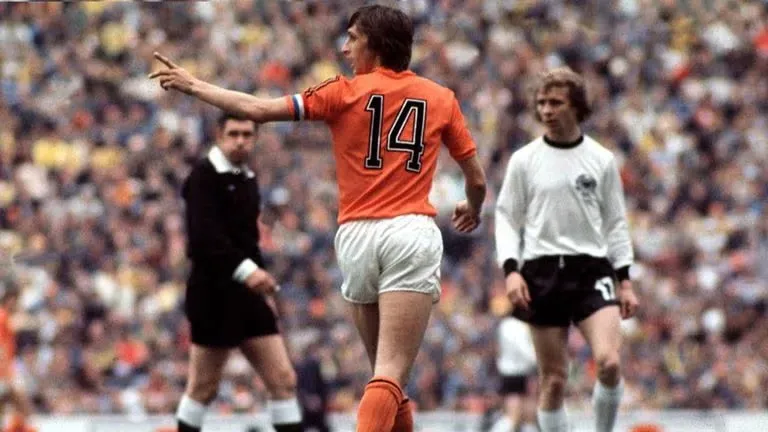
Johan Cruyff was not simply a great player: he was the first player to make visible that football was, above all, a game of spatial intelligence. Nominally a right winger converted into a total playmaker, Cruyff could appear in any area of the pitch, unbalance with his characteristic change of pace—the famous “Cruyff Turn”—and make decisions his own teammates took seconds to understand.
With Rinus Michels’ Ajax, Cruyff was the engine of “Total Football”: a system where everyone attacked and everyone defended, where positions were references and not limits. Three consecutive European Cups (1971, 1972, 1973) are the result. With the Dutch national team, he reached the 1974 World Cup final, where the Netherlands, despite losing to West Germany, presented the world with a footballing philosophy that seventy countries are still trying to imitate. His greatest legacy, however, was as an ideologue: the Barcelona dominating world football since the 1990s is, in essence, the continuation of his ideas.
4. Andrés Iniesta 🇪🇸
Clubs: FC Barcelona, Vissel Kobe | Titles: 4 Champions Leagues, 2010 World Cup, Euros 2008 and 2012
There is a goal defining entire careers. The goal Andrés Iniesta scored in the 116th minute of the 2010 South Africa World Cup final against the Netherlands is, for many Spanish fans and for football itself, that type of goal. At the exact moment Spain needed a hero, Iniesta—a player who never sought the spotlight—appeared in the area, controlled the ball with his left, and struck it cleanly into the back of the net.
What makes Iniesta extraordinary is not that goal, but everything making it possible: years of performances in impossible spaces, turning between three rivals without losing the ball, smoothly driving the team from the Barcelona midfield without anyone being able to explain exactly how he did it. A generational teammate of Xavi’s at Barcelona and the Spanish national team, together they formed the most dominant midfield of the last twenty years.
5. Michel Platini 🇫🇷
Clubs: Nancy, Saint-Étienne, Juventus | Titles: Euro 1984, 1985 European Cup, multiple Scudettos
In 1980s France, Michel Platini was not a footballer: he was an institution. Three consecutive Ballon d’Or awards (1983, 1984, and 1985) is the figure, but numbers do not fully capture what Platini did on the pitch. He was an attacking midfielder with a striker’s instinct: he scored more than 300 goals in his professional career, including 9 in a single European Championship (1984), a record standing for decades.
In the 1984 European Championship held in France, Platini was simply untouchable. He scored in every match but one, led France to their first major international title, and proved a midfielder could be the tournament’s most lethal player. At Juventus, he won the 1985 European Cup (predecessor to the Champions League) and dominated Italian calcio with the same authority with which he would dominate the UEFA boardroom a decade later.
6. Lothar Matthäus 🇩🇪
Clubs: Borussia Mönchengladbach, Bayern Munich, Inter Milan | Titles: 1990 World Cup, Euro 1980, multiple Bundesligas and the Scudetto
If one had to define the German competitive mentality in a single player, that player would be Lothar Matthäus. With 25 matches in World Cups (between 1982 and 2002), he is the player with the most appearances in the tournament in history. But his longevity statistics are not the most impressive thing: the most impressive thing is that for most of those two decades, he was one of the best midfielders in the world.
Matthäus won the Ballon d’Or in 1990, the year he also lifted the World Cup as captain of West Germany in Italy. His combination of physical power, vocational leadership, and technical ability allowed him to play as a creative central midfielder in his prime years and later convert into a sweeper when his legs no longer had the speed of yesteryear. That intelligent adaptation to the changes of his own body is, in itself, a lesson in footballing intelligence.
7. Luka Modrić 🇭🇷
Clubs: Dinamo Zagreb, Tottenham, Real Madrid | Titles: 6 Champions Leagues, 2018 Ballon d’Or, 2018 World Cup finalist
In 2018, Luka Modrić did something seemingly impossible in year 11 of the Messi-Cristiano duopoly: he won the Ballon d’Or. He didn’t win it through inertia or voter sympathy, but because he was objectively the best player that year—the engine of a Croatia team reaching the World Cup final in Russia and the central midfielder of a Real Madrid winning their third consecutive Champions League.
Modrić’s story is, above all, a story of resilience. When he arrived at Tottenham from Dinamo Zagreb, many questioned whether he had the physique for English football. When he signed for Real Madrid, some Los Blancos executives tried to veto him for being “too small.” Modrić responded with hard work, tactical intelligence, and an ability to maintain an elite level for consecutive seasons that very few players have matched in the club’s history.
8. Sergio Busquets 🇪🇸
Club: FC Barcelona | Titles: 3 Champions Leagues, 2010 World Cup, Euros 2008 and 2012, 9 Spanish LaLigas
There is a phrase Pep Guardiola frequently repeats when asked about the best midfielder he has managed: “If you don’t watch Busquets, you don’t understand football.” It is the best possible description of a player who will never be the flashiest, but who makes everything else work.
Sergio Busquets redefined the role of the modern defensive midfielder. While other interpreters of that position were defined by tackles and ball recoveries, Busquets was defined by not-doing: knowing when not to press, when to let the play pass to cut out the next pass, how to generate numerical superiorities simply with his body position before receiving the ball. He was the player making the possession system of Barça and Spain indestructible.
9. Ruud Gullit 🇳🇱
Clubs: Feyenoord, PSV, AC Milan, Sampdoria, Chelsea | Titles: Euro 1988, 2 European Cups, multiple Scudettos
Ruud Gullit had something no other player of his generation combined in the same way: the physical power of an elite athlete, the refined technique of a Southern European player, and the tactical ability of a complete midfielder. In Arrigo Sacchi’s AC Milan, alongside Van Basten and Rijkaard, he formed the most feared attacking trident in European football in the late 80s.
His 1988 European Championship with the Netherlands—where he scored in the final against the USSR and was named tournament MVP—was the culmination of a career beginning in Suriname (his family’s country of origin), crossing the neighborhoods of Amsterdam, and ending up redefining what a physical midfielder could be in European football. He won the Ballon d’Or in 1987, the year his AC Milan started building the most dominant dynasty of the late 80s.
10. Fernando Redondo 🇦🇷
Clubs: Argentinos Juniors, Tenerife, Real Madrid, AC Milan | Titles: 2 Champions Leagues, multiple Spanish LaLigas
Fernando Redondo is the best-kept secret of 1990s Argentine football. A defensive midfielder of such unusual elegance that many fans remember him not as a “destroyer” but as an artist. His ball recoveries were silent, surgical: he didn’t need the aggressive tackle because his reading of the game allowed him to appear exactly where the ball was going to arrive.
His most memorable moment is absolutely engraved on the retinas of Madridistas and football fans in general: in the second leg of the 2000 Champions League quarterfinals against Manchester United at the Bernabéu, Redondo received a ball with his back to goal, let the ball pass between his legs with an impossible backheel, left the defender behind, and delivered a cross to the far post that the referee didn’t call—but history did. It was, technically, one of the most difficult plays ever executed in a match of maximum tension.
Why These 10 and Not Others?
Every list of ten is an incomplete list, and the list of the best midfielders in history is no exception. There are names deserving to be in any serious debate about this position:
Andrea Pirlo redefined the modern regista with his vision and long passing at AC Milan and Juventus. Ronaldinho, although categorized as a winger or attacking midfielder, operated for several years as the most unbalancing midfielder in the world. Patrick Vieira was the personification of physical intensity combined with leadership in the 2003-04 invincible Arsenal.
Kevin De Bruyne, active to this day, is building a legacy that in ten years many will place above several of the names on this list. And Sócrates—the Brazilian doctor and philosopher who was also one of the best midfielders of the 1982 World Cup—represents a way of understanding football transcending any trophy cabinet.
If your favorite is not on this list, the discussion that generates is exactly what this sport deserves.
Conclusion
The ten midfielders on this list have something in common going beyond titles and Ballon d’Or awards: they all somehow changed the way we understand their position. Zidane proved elegance can be ruthless. Xavi proved the short pass could be football’s most lethal weapon. Busquets made the art of not touching the ball a superpower. Redondo turned a backheel at the Bernabéu into an imperishable work of art.
The midfield is the most complex position in football precisely because it has no single definition. It can be the silent destroyer, the dictator of tempo, the unexpected goalscorer, or the invisible creator connecting all systems. The best midfielders in history have been, each in their own way, all those things at the same time.
As football continues searching for the next great in this position—and with De Bruyne, Bellingham, and Pedri already active, the search is more alive than ever—the memory of these ten will remain the impossible standard to surpass.