





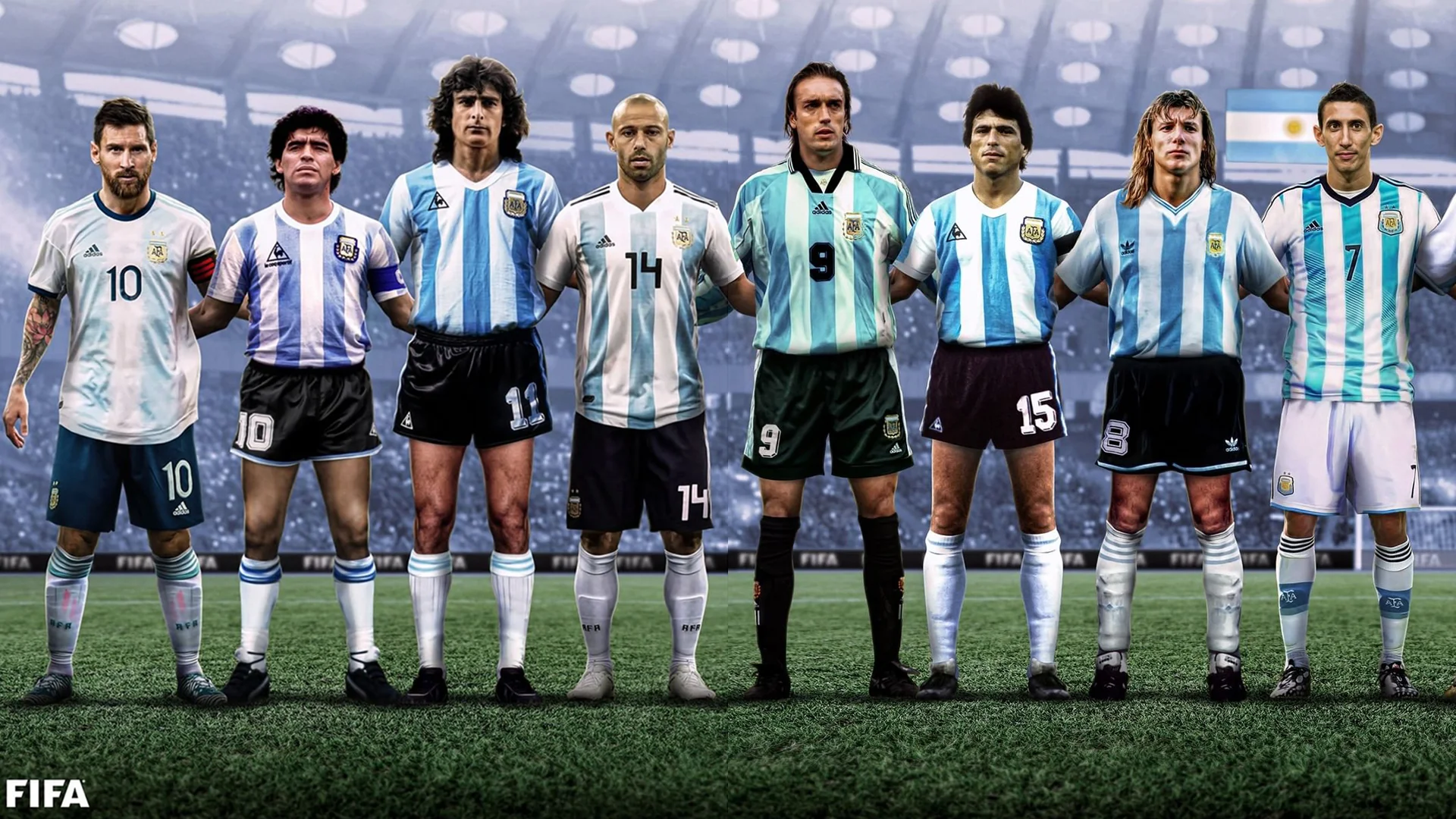
There are national teams that win matches. And there are national teams that spawn religions. The Albiceleste unquestionably belongs to the second category. From the very first matches against Uruguay in the early 20th century to the night in Lusail at Qatar 2022, Argentina has built one of the richest, most dramatic, and most passionate legacies in the history of world football.
It isn’t just a matter of titles, although three World Cups and fifteen Copas América certainly speak for themselves. It’s something much harder to quantify: the ability to generate moments that remain etched in history forever. The Hand of God. The Goal of the Century. Messi’s tears in 2014. The final in Lusail. Argentina doesn’t just play football; it turns it into a narrative, into Greek tragedy or Homeric epic, depending on the night.
This article traces the complete history of the Argentine National Team: its origins, its decades of glory and frustration, its most legendary players, its tactical identity, and the moments that have made it one of the most admired and feared national teams on the planet.
📋 Table of Contents
- 🇦🇷 The First Steps: Argentine Football Takes Shape
- 🏆 The Three World Cup Stars
- 😤 The Decades of Frustration (1990–2021)
- 🧤 Legendary Players by Position
- 🧠 The Argentine Style: Gambeta, Grit, and Tactics
- 📊 Historical Records
- 🧩 Trivia and History-Making Facts
- ❓ Frequently Asked Questions
- 💬 Conclusion
🇦🇷 The First Steps: Argentine Football Takes Shape {#primeros-pasos}
The Argentine Football Association (AFA) was founded in 1893, making it one of the oldest football federations in the world outside the British Isles. Football arrived in Argentina via British immigrants working on the railways and ports of the Río de la Plata, and within a few short decades, it transformed from an expatriate pastime into the national passion of an entire country.
The national team’s first international match was played in 1901 against Uruguay, igniting one of the longest and most passionate rivalries in world football. The so-called Clásico del Río de la Plata has pitted both nations against each other on more than 200 occasions, with every match carrying the heavy weight of a shared history and a competition that goes far beyond sport.
During the first decades of the 20th century, Argentina dominated the South American Championships—the direct predecessor to the Copa América—with a regularity that established the country as the continent’s premier power. The first title arrived in 1921, and the 1920s and 30s were an era of immense Rioplatense hegemony, where Argentina and Uruguay traded continental trophies with a frequency that deeply frustrated the rest of the South American nations.
The playing style that began to define itself during those years had very clear roots: the technical influence of Italian and Spanish immigrants, the culture of the potrero—improvised street football in the working-class neighborhoods of Buenos Aires—and a collective mentality that blended individual creativity with fierce competitiveness. The gambeta, the tight, continuous dribbling that utterly baffles opponents, became the tactical signature of Argentine football from those very first years.
Argentina reached the first-ever World Cup final in 1930, the inaugural tournament hosted by Uruguay. They fell 4-2 to the hosts in Montevideo but proved beyond doubt that Rioplatense football was fully capable of competing at the absolute highest international level.
🏆 The Three World Cup Stars {#tres-estrellas}
1978: The First Star at Home
The 1978 World Cup was held in Argentina under the dark shadow of the military dictatorship that had ruled the country since 1976. The junta, headed by Jorge Rafael Videla, used the tournament as an international showcase, adding a political and historical dimension that continues to generate fierce debate to this day. But on the pitch, the Argentines delivered a truly memorable tournament.
The team managed by César Luis Menotti—known as El Flaco—played an offensive and elegant brand of football that was the absolute antithesis of the era’s defensive pragmatism. Menotti was a left-leaning man deeply committed to the idea of football as popular art, and his team responded to that exact philosophy. The star was Mario Kempes, the Valencia CF striker who scored 6 goals in the tournament—making him the top scorer—including two crucial strikes in the final against the Netherlands.
The definitive match, played at the Estadio Monumental in front of more than 70,000 Argentines, ended 3-1 after extra time. Kempes opened the scoring, Johan Neeskens equalized, and an extraordinary second half by Kempes and Bertoni sealed Argentina’s first world title. The ticker tape raining down from the stands became the iconic image of that afternoon.
1986: The World at Maradona’s Feet
If 1978 was the victory of a collective team, 1986 was the absolute consecration of a single individual. Diego Armando Maradona turned the tournament in Mexico into his own personal kingdom, delivering the most absolute demonstration ever seen of what one single player can achieve when at the absolute peak of his powers.
The quarter-final match against England—just four years after the Falklands War, carrying all the immense emotional baggage that implied—produced the two most famous goals in football history within the space of just five minutes. The first was the Hand of God: Maradona scored with his left hand without the referee noticing, and his subsequent declaration that it was “a little with the head of Maradona and a little with the hand of God” instantly entered the annals of sports quotes. The second was The Goal of the Century: a sixty-meter diagonal sprint, bypassing five opponents and the goalkeeper before sliding the ball into the back of the net. FIFA voted it the greatest goal in football history in a public poll held in 2002.
Argentina won 2-1 and advanced to the final against West Germany. With Maradona orchestrating, the team led by Carlos Bilardo—a pragmatic manager who served as the philosophical polar opposite to Menotti—triumphed 3-2 in a match where Argentina threw away a 2-0 lead before Jorge Valdano and Jorge Burruchaga finally sealed the result. Maradona lifted the Cup at the Estadio Azteca and forever became the God of Argentine football.
2022: Messi’s Redemption and the Third Star
The 2022 World Cup in Qatar was the most highly anticipated closing of a circle in recent football history. Lionel Messi, who for years had carried the burden of unfair comparisons to Maradona and the immense pressure of needing to win a World Cup to justify his greatness, finally found ultimate vindication in Qatar.
The tournament began with a shocking defeat to Saudi Arabia—the biggest upset of the World Cup—but from that moment on, Argentina only grew stronger. The victories against Australia, the Netherlands, and Croatia in the knockout stages became increasingly convincing, with Messi racking up goals and assists in every single match. The final against France at the Lusail Stadium was, for many analysts, the greatest match in World Cup history: Argentina was winning 2-0 before Kylian Mbappé equalized in ten minutes with a brilliant brace to force extra time, where Messi scored again before Mbappé leveled once more with his hat-trick. Everything was decided on penalties, where Emiliano Martínez famously saved the shots of Coman and Tchouaméni.
Messi finally lifted the World Cup for the first time at the age of 35. The embrace with his family on the pitch at Lusail was the image that circled the globe. That night, the debate over whether Messi was better than Maradona was, for many, definitively settled forever.
😤 The Decades of Frustration (1990–2021) {#decadas-frustracion}
Between 1986 and 2021, Argentina failed to win a single major title. Thirty-five years of broken promises, sheer frustration, and lost finals fed the narrative of a team that had to suffer more than anyone else before finally tasting glory.
Italy 1990 was the tournament of Maradona’s last great campaign. Argentina reached the final without playing their best football, relying almost entirely on Diego’s sheer leadership as their primary argument. The final against West Germany was lost 1-0 courtesy of an Andreas Brehme penalty. It was a defeat that Maradona carried as an open wound for the rest of his life.
USA 1994 brought the greatest tragedy of Maradona’s international career: his expulsion from the tournament after testing positive in a doping control. Argentina crashed out in the quarter-finals against Romania. The generation led by Gabriel Batistuta—arguably the greatest center-forward the country has ever produced—never managed to conquer the World Cup despite featuring in three editions: 1994, 1998, and 2002.
Brazil 2014 was the wound that preceded the cure. Argentina reached the final with Messi as captain and undisputed star but fell 1-0 to Germany in extra time via a Mario Götze goal in the 113th minute. Messi won the tournament’s Ballon d’Or—a decision that sparked intense controversy—but he failed to lift the trophy he desired most.
Three lost Copa América finals (2007, 2015, and 2016) completed the grueling catalog of frustrations before the 2021 Copa América in Brazil finally broke the curse. Argentina won their first Copa América in 28 years by defeating Brazil at the Maracanã—the most symbolic stadium in South American football—with a goal from Ángel Di María. Messi, at long last, had his first senior title with the national team.
🧤 Legendary Players by Position {#jugadores-legendarios}
Goalkeepers
Ubaldo Fillol was the goalkeeper of the 1978 World Cup and is widely considered one of the greatest shot-stoppers in the history of Argentine football. His performances in the final stages of the tournament, especially against Peru and the Netherlands, were absolutely decisive for the title. Years later, Sergio Goycochea became a national hero at Italy 1990 with his penalty shootout saves that dragged Argentina to the final.
Emiliano “Dibu” Martínez is the modern goalkeeper of the championship cycle. His performance in the Qatar 2022 final—saving two penalties and displaying a psychological presence that visibly intimidated the French takers—made him a global star. His unique way of interacting with opponents before every penalty became one of the biggest talking points of the entire World Cup.
Defenders
Daniel Passarella was the captain of the 1978 championship team, a tough, goal-scoring center-back who defined an era of defenders who also consistently found the back of the net. Oscar Ruggeri formed alongside Passarella the most feared defensive pairing in Argentine football during the eighties, and was a fundamental piece in Bilardo’s 1986 squad.
Javier Zanetti is arguably the most complete full-back Argentina has ever produced: disciplined, incredibly consistent, and remarkably long-lasting, he spent fifteen years as the captain of Inter Milan and was one of the most widely respected players in European football. Cristian “Cuti” Romero, star of Tottenham and champion at Qatar 2022, represents the current projection of that legendary defensive tradition.
Midfielders
Diego Maradona is technically classified as an attacking midfielder, although his influence was so total that it defied any strict tactical categorization. He is the absolute reference point of Argentine football and one of the only two plausible candidates for the title of the greatest player in history.
Fernando Redondo was the elegant, highly technical midfielder that the Real Madrid of the late nineties—the team that won the Champions League in 1998 and 2000—turned into the absolute pillar of their game. His ability to distribute with pinpoint precision and shield the ball made him a role model for multiple generations.
Javier Mascherano embodied the exact opposite version: relentless work without the flash, constant pressing, and permanent dedication. He was the defensive wall that allowed Messi to fully deploy his game at Barcelona and the national team for over a decade.
Rodrigo De Paul is the absolute engine of Scaloni’s team: a box-to-box midfielder who runs, recovers, defends, and links up play with an intensity that perfectly embodies the true spirit of modern Argentine football.
Forwards
Lionel Messi is the national team’s all-time top scorer with over 106 international goals, the most-capped player, and the only Argentine to ever play in five World Cups. His eternal debate with Maradona over who is the greatest Argentine player of all time remains the most passionate argument in world football.
Gabriel Batistuta is the symbol of a generation that never managed to win a World Cup but utterly dominated South American football throughout the nineties. Pure and incredibly powerful, his strike was the most feared weapon in Argentina for years. Mario Kempes—the hero of 1978—and Ángel Di María—the author of the winning goal in the 2021 Copa América final and a provider in multiple key moments—complete the quartet of the most important forwards in Albiceleste history.
🧠 The Argentine Style: Gambeta, Grit, and Tactics {#estilo-argentino}
Argentine football possesses an identity that simply cannot be explained through tactical data alone. To truly understand it, you must understand the potrero: the hard dirt pitches of the working-class neighborhoods of Buenos Aires where generations of players learned to dribble in suffocatingly tight spaces, protect the ball with their bodies, and develop the picardía (street smarts) that characterizes the Argentine player whenever a match gets complicated.
From that potrero culture was born the gambeta—the tight, winding, continuous dribble that Maradona elevated to its absolute peak and that Messi inherited and perfected—along with a collective mentality that seamlessly blends brilliant individualism with fierce group solidarity when it’s time to defend.
On a tactical level, Argentina has gone through several highly distinct phases. César Menotti in the seventies championed an offensive and highly aesthetic style of football, based on a 4-3-3 and intricate link-up play between lines. Carlos Bilardo in the eighties broke entirely with that philosophy and bet everything on pragmatism: a 3-5-2 that prioritized defensive solidity and left Maradona as the sole creative outlet. The tension between the Menotti model and the Bilardo model—beauty versus pure efficiency—defined the tactical debate of Argentine football for decades.
Lionel Scaloni, the manager who unexpectedly took charge in 2018, finally found the perfect balance between both traditions. His Argentina combines intense high pressing, a rock-solid three-center-back defense, and a creative freedom for Messi and the attacking midfielders that has proven utterly devastating. The title at Qatar 2022 fully validated his vision.
📊 Historical Records {#records}
- World Cups: 3 (1978, 1986, 2022)
- Copa América: 16 titles (most recently in 2021, tied for the most all-time with Uruguay)
- All-time top scorer: Lionel Messi (over 106 goals)
- Most capped player: Lionel Messi (over 180 caps)
- Biggest victory: Argentina 12-0 Ecuador (1942)
- Longest unbeaten streak: 36 consecutive matches unbeaten (2019-2022), a world record at the time
🧩 Trivia and History-Making Facts {#curiosidades}
Argentina went over 36 matches unbeaten in the historic record they set between 2019 and 2022, surpassing the previous world record held by Italy. This streak began following their Round of 16 elimination at the 2018 World Cup in Russia and didn’t end until their shock defeat against Saudi Arabia at the start of Qatar 2022—though that stumble was ultimately totally eclipsed by their eventual championship title.
Diego Maradona was expelled from the 1994 World Cup after testing positive in a doping control for ephedrine, a substance that, according to his medical team, was present in an over-the-counter nutritional supplement. The image of Maradona weeping as he left the pitch after scoring against Nigeria—entirely unaware it would be the final goal of his World Cup career—remains one of the saddest in football history.
Messi played in five consecutive World Cups (2006, 2010, 2014, 2018, and 2022), a milestone achieved by only a tiny handful of players in the history of the sport. It wasn’t until his very last one that he finally found the reward his immense talent deserved.
The 2022 final against France is widely considered by many analysts as the greatest match in the history of the World Cup: four goals ruled out for offside, three dramatic equalizers, a breathtaking extra time, and a penalty shootout with the weight of the world hanging on every single strike.
Argentina is the country that has exported the most managers to the world. Argentine coaches have managed national teams and massive clubs across every single continent, spreading the tactical culture and sheer intensity of Rioplatense football to the most remote corners of the globe.
❓ Frequently Asked Questions about the Argentine National Team {#faq}
How many World Cups has Argentina won? Argentina has won three World Cups: in 1978 (at home, with Mario Kempes as the star), in 1986 (in Mexico, with Maradona), and in 2022 (in Qatar, with Messi).
Who is the all-time top scorer for the Argentine National Team? Lionel Messi is the all-time leading scorer for the Albiceleste, with over 106 international goals and more than 180 appearances—both absolute records for the team.
How many Copas América has Argentina won? Argentina has won 16 Copas América, making them, alongside Uruguay, the nations with the most titles in the history of the tournament. Their most recent triumph was in 2021, played in Brazil.
Who was Argentina’s manager during the 2022 World Cup? Lionel Scaloni, who took over as an interim manager in 2018 and ultimately ended up building the most successful cycle for the national team in decades.
What is the Clásico del Río de la Plata? It is the traditional name given to the clash between the national teams of Argentina and Uruguay, the oldest international football fixture in South America, first played back in 1901.
What was Argentina’s biggest ever victory? The largest margin of victory in the history of the Albiceleste was a massive 12-0 win against Ecuador in 1942, a record that has stood unbroken for over eight decades.
When is the next Copa América? The Copa América is typically held every four years. Argentina will defend their title in the upcoming edition scheduled by CONMEBOL. For exact dates and the updated calendar, it is highly recommended to check the official CONMEBOL website.
💬 Conclusion {#conclusion}
The history of the Argentine National Team is not a perfectly straight line of continuous glory. It is a story of deep, harrowing valleys and towering peaks, of frustrations that felt utterly eternal and redemptions that arrived precisely when they were least expected. That, to a large extent, is exactly what makes them so endlessly fascinating to the entire world.
From Kempes to Maradona, from Maradona to Batistuta, from Batistuta to Messi, every single generation has carried the crushing weight of history and found its own unique way to honor it. Argentine football has produced completely unique individual geniuses, but it has also proven—especially with Scaloni’s current team—that collective greatness can overcome even the most extraordinary individual talents.
With three World Cups in their trophy cabinet and Messi standing as the absolute reference for an entire generation, the Albiceleste arrives at the present day as one of the most complete and feared national teams on the planet. The next generation is already waiting in the potreros of Buenos Aires, learning how to gambetear, how to defend with pure grit, and daring to believe that they, too, can carry that light blue and white shirt all the way to the very top.