





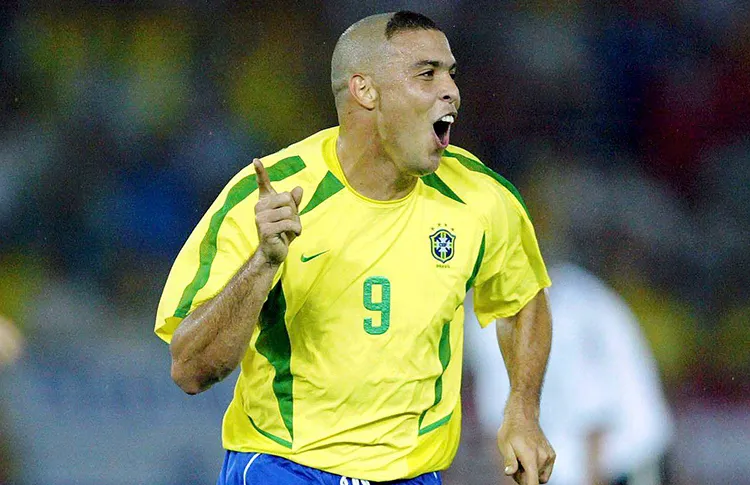
The forward is the player the crowd remembers most easily. Not because they are the most important player on the team—football is a collective sport and that debate is eternal—but because they are the one who puts their name on the scoreboard, the one who stars in the instant that paralyzes an entire stadium, the one who turns ninety minutes of tension into a shared roar.
But not all forwards are equal. Some are pure finishers who live for the goal and die by it. Others build the play just as much as they finish it. The greatest combine both: they don’t just score; they make football look different when they are on the pitch.
In this list, we have gathered ten forwards who weren’t just great goalscorers: they were players who redefined their position, who marked entire eras of football, and who, decades after their peak moments, remain unavoidable references when discussing the best in the history of the world’s most popular sport.
📋 Table of Contents
Introduction
Selecting the ten best forwards in the entire history of football is, inevitably, a subjective exercise. The eras are different, the level of the leagues has changed, tactical systems have evolved, and comparing Pelé with Messi or Gerd Müller with Cristiano Ronaldo implies assuming that the context in which they played is comparable when, in reality, it isn’t.
The criteria we have used for this selection are: impact on their era, titles won, accumulated statistics, influence on the tactical evolution of the position, and above all, the ability of each player to show up in the biggest moments and decide them. We aren’t just looking for goalscorers: we are looking for forwards who changed the way attacking is understood.
The 10 Forwards Who Shaped Football History
1. Lionel Messi (Argentina)
Clubs: FC Barcelona, Paris Saint-Germain, Inter Miami Honors: 2022 World Cup, 2021 Copa América, 4 Champions Leagues, 10 LaLiga titles, 8 Ballons d’Or
Lionel Messi arrived at FC Barcelona at the age of 13 with a contract signed on a napkin and became the greatest player in the history of the club—and, for many, of world football. His career defies any attempt at objective description because his numbers are so extraordinary they seem fictional: over 800 official goals, 8 Ballons d’Or, the all-time top scorer for LaLiga, Barcelona, and the Argentine national team.
What makes Messi truly unique, however, isn’t just the goals. It’s the combination of skills that no one else has possessed at the same level simultaneously: dribbling, vision, passing precision, speed over short distances, and an ability to appear in the biggest moments that seems supernatural. In his best version, between 2009 and 2012, Messi played at a level that even football analysts have difficulty describing using conventional categories.
The 2022 World Cup and the 2021 Copa América completed his legacy with the Argentine national team, answering the only question still asked of him: whether he could win the international titles that had eluded him for years.
2. Pelé (Brazil)
Clubs: Santos, New York Cosmos Honors: 3 World Cups (1958, 1962, 1970), over 1,000 goals throughout his career
There are players who have won more titles than Pelé, and players who have scored more goals in stricter statistical records than those of his era. But none has had the global impact that Edson Arantes do Nascimento had on 20th-century football. Pelé wasn’t just the best player of his generation: he was the ambassador of football at a time when the sport was becoming a global phenomenon.
He won his first World Cup at 17 years old, at Sweden 1958, becoming the youngest player to score in a final of such a tournament. He won the second at Chile 1962, though injuries limited his participation. And the third, at Mexico 1970, he won with one of the most perfect teams in football history: that Brazil side featuring Jairzinho, Tostão, and Rivelino, which won every single match playing a brand of football the world had never seen before.
Pelé was the first to demonstrate that a forward could be technically complete, physically powerful, and emotionally decisive all at the same time. Everything that came after bears a trace of his footprint.
3. Diego Armando Maradona (Argentina)
Clubs: Argentinos Juniors, Boca Juniors, FC Barcelona, Napoli, Sevilla, Newell’s Old Boys Honors: 1986 World Cup, 2 UEFA Cups with Napoli, 2 Scudettos with Napoli
Maradona wasn’t just a footballer: he was a cultural phenomenon. At Napoli in the eighties, he transformed a club from southern Italy—historically overshadowed by the northern giants—into the best team in the country for two consecutive years. For Neapolitans, Maradona is not just a sporting memory: he is part of the city’s identity.
But the moment defining his legacy is the 1986 World Cup in Mexico. In that tournament, Maradona was simply the best player in the history of a World Cup: he virtually decided an entire competition single-handedly, carrying Argentina on his shoulders from the group stage to the final. The quarterfinal match against England condenses the essence of his career into 90 minutes: the hand goal—the “Hand of God,” as he himself described it with a smile—and the “Goal of the Century,” considered by popular vote the greatest goal in World Cup history, both in the exact same match.
Maradona was, at his peak, the most difficult player to stop that football has ever produced. Not the fastest, not the strongest, but certainly the most unpredictable and the most capable of resolving situations that were impossible for any other player.
4. Ronaldo Nazário (Brazil)
Clubs: Cruzeiro, PSV Eindhoven, FC Barcelona, Inter Milan, Real Madrid, AC Milan, Corinthians Honors: 1994 and 2002 World Cups, 2 Ballons d’Or (1997 and 2002), Golden Boot at the 1998 and 2002 World Cups
Calling him “El Fenómeno” (The Phenomenon) isn’t an exaggeration: it is the most precise description for a player who, in his prime, did things with the ball no forward had ever done before, and which no one has reproduced with the same consistency since.
Ronaldo arrived at FC Barcelona in 1996 at just 19 years old and was immediately the best player in the world. His combination of devastating speed, dribbling at pace, physical power, and a finish combining coldness and precision made him practically unstoppable in one-on-one situations. In that first season in Spain, he scored 47 goals in all competitions and won the Ballon d’Or at only 20 years old.
Ronaldo’s story is also the story of a career marked by injuries. Two severe knee ligament tears raised doubts on several occasions as to whether he could ever return to being the player he once was. The answer arrived at the 2002 World Cup: Ronaldo scored 8 goals in the tournament, including two in the final against Germany, and won the Golden Boot while recovering the level injuries had stripped away from him. It was one of the greatest stories of resilience in sports history.
5. Cristiano Ronaldo (Portugal)
Clubs: Sporting CP, Manchester United, Real Madrid, Juventus, Al-Nassr Honors: Euro 2016, 5 Champions Leagues, 5 Ballons d’Or, all-time top scorer in international football
Cristiano Ronaldo is the most extreme example of what dedication, discipline, and continuous work can achieve in sports. He arrived at Manchester United at 18 as a skillful winger with a tendency for individual showboating, and what he built from there—through hours of training, an obsession with physical improvement, and a winning mentality accepting no half measures—is one of the most impressive legacies in modern football.
At Real Madrid, he won four Champions Leagues and achieved numbers seeming impossible: 450 goals in 438 matches in the white shirt, including at least one goal in 58 different Champions League knockout ties. His ability to show up in the biggest moments of the European competition makes him the greatest player in the tournament’s history, regardless of any Ballon d’Or debate.
With Portugal, he won Euro 2016 and is the all-time top scorer in national team football history, a record that keeps growing. His longevity of performance—remaining decisive well past 35 years old—makes him a case study in sporting professionalism.
6. Gerd Müller (Germany)
Clubs: Bayern Munich, Fort Lauderdale Strikers Honors: 1974 World Cup, Euro 1972, 3 Champions Leagues with Bayern, 1 Ballon d’Or (1970)
Gerd Müller was, for decades, the top scorer in World Cup history. He wasn’t surpassed until 2006, when Ronaldo Nazário equaled his mark of 15 goals. What distinguishes Müller from the rest is that he achieved that record with a relatively short international career compared to modern players: the so-called “Bomber of the Nation” concentrated a goalscoring density few forwards in football history have reached.
His style was the opposite of a spectacular player: Müller didn’t perform elaborate dribbles or arrive in the box from deep. He was simply always in the right place at the right time. His positional intelligence and coldness to finish from any position inside the box made him the most effective finisher of his generation and one of the most efficient football has ever known.
With Bayern Munich, he won four consecutive Bundesligas and three European Cups in a row (1974-1976), forming part of one of the most dominant teams in European football history.
7. Marco van Basten (Netherlands)
Clubs: Ajax, AC Milan Honors: Euro 1988, 3 Ballons d’Or (1988, 1989, 1992), Champions League 1989 and 1990
Marco van Basten’s career was as brilliant as it was cruelly cut short. The Dutchman won three Ballons d’Or in four years—a record only Messi and Ronaldo have equaled or surpassed in the modern era—with a brand of football combining technical elegance with a goalscoring efficiency few forwards in the history of the game have managed to replicate.
His goal in the Euro 1988 final against the USSR—a volley from an impossible angle that flew into the top corner before the Soviet goalkeeper could react—is considered one of the greatest goals in football history. It was the crowning moment of an individual performance in that tournament that many consider the best by a player in a European Championship to this day.
Van Basten retired at 28 years old due to an ankle injury doctors were unable to resolve. It is impossible to know what he would have achieved with ten more years of a career at the level he demonstrated, but what is clear is that in the time he had, he was one of the most complete and elegant forwards football has ever produced.
8. Luis Suárez (Uruguay)
Clubs: Nacional, Groningen, Ajax, Liverpool, FC Barcelona, Atlético Madrid, Grêmio, Inter Miami Honors: 2011 Copa América, 2015 Champions League, multiple leagues in various countries
Luis Suárez is the most complete forward of his generation in terms of his ability to contribute to his team’s play. He wasn’t just a goalscorer: he was a player who pressed, linked up, assisted, and finished with equal efficiency. Under Brendan Rodgers at Liverpool in the 2013-14 season, he had one of the most extraordinary years any forward has ever had in the Premier League: 31 goals in 33 league matches, a record that remains unsurpassed in the modern era of English football.
At Barcelona, he formed part of the MSN trident alongside Messi and Neymar, arguably the most lethal attack in the history of club football. In his first full season at Camp Nou, Suárez scored 59 goals across all competitions and won the Champions League. His ability to complement Messi’s play without being eclipsed—and vice versa—demonstrated a footballing intelligence rare in players of his profile.
He is also the all-time top scorer for the Uruguayan national team, a record speaking to his consistency over more than a decade representing his country at the highest level.
9. Robert Lewandowski (Poland)
Clubs: Lech Poznań, Borussia Dortmund, Bayern Munich, FC Barcelona Honors: 2020 Champions League, 8 Bundesligas, European Golden Shoe (2021 and 2022), The Best FIFA Men’s Player (2020 and 2021)
Robert Lewandowski is, statistically, one of the most productive forwards in European football history. During his time at Bayern Munich—stretching from 2014 to 2022—Lewandowski was the best forward in Europe beyond any reasonable debate: he scored over 300 goals for the Bavarian club, won eight consecutive Bundesligas, and led Bayern to the 2020 treble with an individual performance of extraordinary consistency.
His most significant record came in the 2020-21 season, when he scored 41 goals in 29 Bundesliga matches, surpassing Gerd Müller’s all-time record (40 goals in a season) that had stood for 49 years. Under normal circumstances, that kind of season would have won the Ballon d’Or; the cancellation of the award in 2020 due to the pandemic and its awarding to Messi in 2021 are the two episodes Lewandowski’s fans consider the great injustices in the award’s history.
At FC Barcelona, he rounded off his legacy with titles in Spain, proving his performance level remained elite even well into his thirties.
10. Neymar Jr. (Brazil)
Clubs: Santos, FC Barcelona, Paris Saint-Germain, Al-Hilal Honors: 2011 Copa Libertadores, 2015 Champions League, 2016 Olympic Games, 2013 Confederations Cup
Neymar Jr. is the most skillful forward of his generation and, probably, the player closest to Ronaldinho’s style that 21st-century football has produced. His dribbling, his creativity in tight spaces, and his ability to invent solutions no one else would see make every match where he is at his best a spectacle transcending the result.
At FC Barcelona, alongside Messi and Suárez, he formed part of the deadliest attack in club football between 2014 and 2017. His goal in the 2015 Champions League final against Juventus was decisive, and his performance in the 2017 “Remontada” against PSG—with two goals and an assist in the final minutes of a seemingly lost match—is one of the most extraordinary individual moments in recent European football history.
Neymar’s career has been marked by repeated injuries preventing his legacy from being as solid as his talent promised. However, his impact on modern football history—as part of the MSN, as a PSG figure, and as the ultimate exponent of the Brazilian style in his generation—is undeniable.
Conclusion
The ten forwards on this list share one thing going far beyond goals and titles: they all somehow changed the way their position is understood. Pelé proved a forward could be a complete player. Müller and Van Basten refined the art of finishing. Maradona and Messi turned it into something artistic. Ronaldo Nazário combined physicality and technique in a way nobody had ever seen. Cristiano Ronaldo proved that an obsession with improvement can compensate for any starting point. Suárez showed the modern 9 can be a total player. Lewandowski was the most consistent finisher of his era. And Neymar brought Brazilian creativity to European football in its most spectacular version.
Football continues to produce great forwards. Future generations will add new names to this debate. But what these figures did during their prime years—that ability to turn a match into a moment nobody forgets—is the standard by which all who come after must measure themselves.