





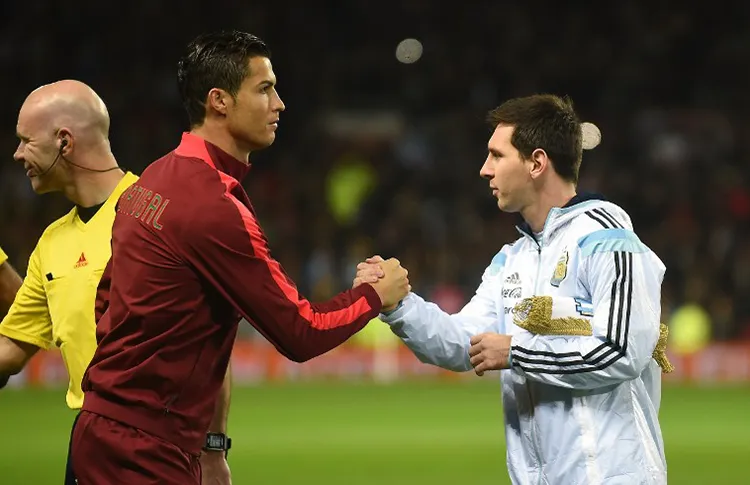
Throughout sports history, there have been legendary rivalries that have captured the public imagination: Ali vs. Frazier in boxing, Senna vs. Prost in Formula 1, Federer vs. Nadal in tennis. But none of them had the duration, the global media intensity, and the level of absolute dominance that the rivalry between Lionel Messi and Cristiano Ronaldo imposed on world football for over fifteen years.
Between 2008 and 2021, elite football seemed to have become a sport designed exclusively for the two of them. They shared the Ballon d’Or awards, shattered all goalscoring records that seemed unreachable, led the two biggest clubs in the world during the era of greatest television exposure in history, and divided the planet’s fans into two irreconcilable factions. Never before had two such dominant players coincided exactly in the same era, in the same league, and at the peak of their careers.
This is not just the story of two great footballers; it is the chronicle of an era that forever changed the standards of what it means to be the best in the world.
📋 Table of Contents
- Origins: The Beginning of the Golden Era
- The Peak: Real Madrid vs FC Barcelona
- Head-to-Head Duel: Statistics and Matchups
- Opposing Styles: Natural Talent vs. the Perfect Athlete
- The Dominance of Individual Awards
- The International Stage and the Final Legacy
- Conclusion
Origins: The Beginning of the Golden Era
The history of the rivalry began to take shape in the late 2000s. In 2007, the Brazilian Kaká won the Ballon d’Or after leading AC Milan to win the Champions League. He was accompanied on the podium by a 22-year-old Portuguese player dazzling at Manchester United and a 20-year-old Argentine who was already the star of FC Barcelona. That was the last time in a decade that anyone other than those two sat on the throne of world football.
The following year, in 2008, Cristiano Ronaldo won the Champions League with Manchester United and took his first Ballon d’Or. In 2009, it was the turn of Lionel Messi, who led Pep Guardiola’s Barcelona to the first treble in their history. Until that moment, they were simply the two best youngsters in the world playing in different leagues.
But in the summer of 2009, Real Madrid paid 94 million euros—the most expensive transfer in history at the time—to bring Cristiano Ronaldo to the Santiago Bernabéu. The objective was not just to sign the best available player, but to find the only piece capable of stopping the hegemony that Messi’s Barcelona was building. From that moment on, the rivalry ceased to be from a distance and became hand-to-hand combat.
The Peak: Real Madrid vs FC Barcelona
For nine seasons (2009-2018), Messi and Ronaldo competed in the same league, starring in the most-followed matchups in club football history: the Spanish Clásico.
Every time Barcelona and Real Madrid faced each other, the world stopped. It wasn’t just the LaLiga title or passage in the Champions League at stake, but individual supremacy. If Ronaldo scored a hat-trick on Saturday, Messi responded with another on Sunday. If Messi broke the record for goals in a calendar year (scoring an incredible 91 goals in 2012), Ronaldo pulverized the record for goals in a single edition of the Champions League (17 goals in the 2013-14 season).
The pressure they exerted on each other raised the level of both to stratospheric heights. Before their arrival, winning the top scorer trophy (the Pichichi) with 25 or 30 goals was considered an exceptional season. They took that standard to absurd figures, regularly exceeding 40 or even 50 goals in a single league campaign. They turned the extraordinary into the routine.
Head-to-Head Duel: Statistics and Matchups
If numbers are cold, in the case of Messi and Ronaldo, the statistics burn. Both accumulate figures that will hardly be surpassed in the coming decades.
Goals and Assists:
- Cristiano Ronaldo surpassed the mark of 900 official goals throughout his career, becoming the top scorer in history in official competitions recognized by FIFA. His lethality in the penalty area, his prodigious leap, and his shooting with both feet made him the ultimate goalscoring machine.
- Lionel Messi remains slightly below in the absolute total of goals, but with a slightly higher goalscoring average having played fewer matches. Furthermore, Messi overwhelmingly dominates in the assists department, surpassing 350 in his career, underlining his dual impact as a goalscorer and primary playmaker.
The Champions League: Europe’s premier competition was the favorite stage for the rivalry. Cristiano Ronaldo is “Mr. Champions”: he is the all-time top scorer of the competition (140 goals), has won the title five times, and holds the record for most goals in knockout rounds. Messi is the second all-time top scorer (129 goals), has won four titles, and has given us some of the most memorable individual performances in tournament history, such as his four goals against Arsenal or his goal after dribbling past half the Real Madrid team in the 2011 semifinals.
Head-to-Head Matchups: They faced each other in 36 official matches at the club and national team level. In these direct duels, the balance tilted in favor of Messi, with 16 victories for the Argentine, 11 for the Portuguese, and 9 draws. In those matches, Messi scored 22 goals compared to Cristiano’s 21, demonstrating the extreme equality that always existed when they shared the same pitch.
Opposing Styles: Natural Talent vs. the Perfect Athlete
Part of the rivalry’s magnetism lay in how different they were. They represented two philosophies, two physiques, and two almost opposite personalities, allowing fans to choose a side based on their own footballing values.
Lionel Messi represents the ideal of pure, natural talent. With a low center of gravity, the ball seemed glued to his left boot with Velcro. His playing style is one of close dribbling, panoramic vision of the pitch, and pinpoint precision. Messi is a player who, even when he doesn’t score, dominates the rhythm of the match because the entire attacking structure goes through him. He transmits the feeling that he plays football with almost magical ease, seeing spaces nobody else sees.
Cristiano Ronaldo is the definitive evolution of the modern athlete. While he began his career as a fast, skillful winger, he molded his body and his playing style through an obsessive work ethic until becoming the perfect center forward. Brute power, explosive speed, a gravity-defying leap, and ruthless finishing in front of goal. Ronaldo represents the triumph of willpower, hard work, and unbridled ambition; he is the demonstration that with absolute discipline, you can conquer the world.
Even in their body language, they were opposites: Messi, usually more reserved and introverted, celebrated by pointing to the sky; Ronaldo, exuberant and media-friendly, patented the jump and the shout of “Siuuu!” which became a global brand.
The Dominance of Individual Awards
The Ballon d’Or, the award recognizing the best player in the world, was hijacked by both of them for over a decade. Between 2008 and 2017, they shared five Ballon d’Or awards each, in a technical tie that seemed irresolvable.
However, in the final stretch of their careers, Messi managed to pull away in this section, reaching the record figure of 8 Ballon d’Or awards, adding the accolades achieved in his final stage at Barcelona, at PSG, and the definitive one achieved after the 2022 World Cup in Qatar. Ronaldo remained with 5 Ballon d’Or awards, a figure that alone would have been enough to consider him the best player in history had the Argentine not existed.
This monopoly was so suffocating that legendary players like Andrés Iniesta, Xavi Hernández, Franck Ribéry, Wesley Sneijder, or Neymar had to settle for watching the ceremony from the seats of honor, because first and second place already had permanent owners.
The International Stage and the Final Legacy
For years, the only argument leveled against both was that they had not achieved absolute success with their respective national teams, unlike legends such as Pelé or Maradona. They also took it upon themselves to destroy that narrative.
Ronaldo struck the first blow by leading Portugal to conquer Euro 2016, the first major international title in his country’s history, in addition to adding the first edition of the UEFA Nations League. Ronaldo also became the top scorer in the history of national team football, surpassing the mythical barrier of 120 international goals.
Messi, after losing three consecutive finals (2014 World Cup, 2015 and 2016 Copas América) and announcing a brief retirement from the national team out of frustration, returned to star in a redemption arc worthy of a movie. He won the 2021 Copa América at the Maracanã stadium and finally reached the absolute summit by being crowned champion of the World Cup in Qatar 2022, being the best player of the tournament at 35 years of age.
Today, with Messi shining in MLS with Inter Miami and Ronaldo breaking nets in the Saudi Arabian league with Al-Nassr, the direct rivalry has come to an end. At the 2024 Ballon d’Or gala, neither of the two appeared among the final nominees for the first time in two decades, officially certifying the change of era in world football.
Conclusion
“The rivalry is over. It was good, the spectators liked it. We changed the history of football and we are respected all over the world, which is the most important thing.” With these words, Cristiano Ronaldo summarized in 2023 the mutual feeling remaining between the two after years of fierce competition. And Messi, for his part, acknowledged: “It was a golden era for us and for football. We fed off each other.”
Trying to definitively answer the question of who was the best is failing to understand the true value of what they did. Messi showed us how beautiful football can be; Ronaldo showed us how unstoppable it can become. It didn’t matter whose side you were on: if you loved football during those fifteen years, you were a privileged spectator of the greatest sustained exhibition of excellence in sports history.
Football will continue to produce great players. Kylian Mbappé, Erling Haaland, Jude Bellingham, Lamine Yamal, and Vinícius Jr. will write their own stories. But many decades will pass before the world once again sees two titans collide with such force, for so long, and at the highest possible point. The era of Messi and Ronaldo is over, but the standard they set will be eternal.