





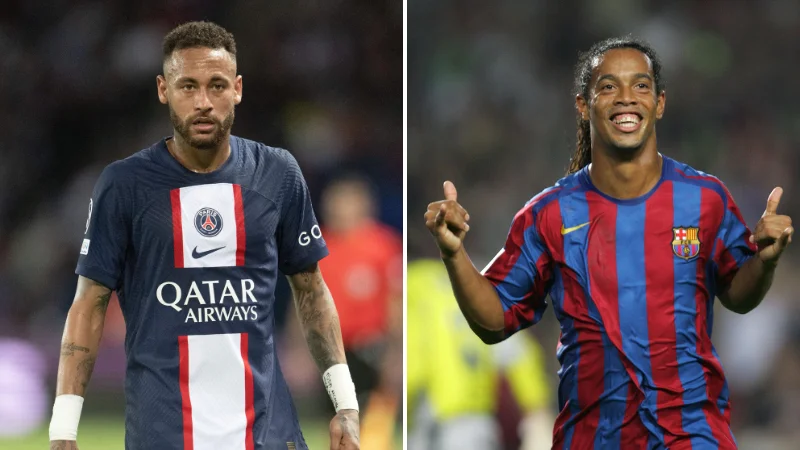
There are players who win matches, players who win titles, and players who change the way football looks and feels. Ronaldinho and Neymar belong to that last category, and both do so from the same footballing tradition: that of Brazilian football in its most creative, free, and spectacular expression.
The coincidence between the two is striking: Ronaldinho passed through Paris Saint-Germain before arriving at FC Barcelona, where he built his legend. Neymar took exactly the opposite path: he shone at Barcelona before leaving for PSG in the most expensive transfer in history. And both, at different times, were the central figure of the Brazil National Team with the responsibility of carrying on their shoulders the expectations of a country that lives football like no other in the world.
Comparing them is not just a comparison of statistics. It is the comparison of two different ways of being the best player in Brazil: one more artistic and unpredictable, the other more complete and consistent. In this article, we analyze their careers, their spells at the same clubs, and the legacy each has built in world football.
📋 Table of Contents
- Career and Origins
- Spell at Paris Saint-Germain (PSG)
- Spell at FC Barcelona
- Brazil National Team
- Honors and Statistics Compared
- Playing Styles and Legacy
- Trivia
- Conclusion
Career and Origins
Ronaldinho Gaúcho was born in Porto Alegre in 1980 and came through the ranks at Grêmio, his city’s club. He made his professional football debut in 1998, and from his very first seasons, it was clear he was a different player: his dribbling, improvisation, and ability to create dangerous situations from impossible positions distinguished him from all his contemporaries. His first big international leap came with Paris Saint-Germain in 2001, and from there his career kept rising until he became the best player in the world between 2004 and 2006.
Neymar Jr. was born in Mogi das Cruzes in 1992 and arrived at Santos at the age of 11, where he became one of the greatest prospects in Brazilian football memory. With Santos, he won the 2011 Copa Libertadores—the club’s first continental title in decades—and was repeatedly recognized as the best player in South America before turning 21. His signing for FC Barcelona in 2013 was one of the most anticipated in history and did not disappoint: Neymar became part of the most lethal trident club football has seen in a long time.
What unites both beyond the statistics is their style: both represent the best version of jogo bonito, that way of playing with joy and spectacular flair that Brazil has exported to the world as its most recognizable hallmark. But the way each expresses it is radically different.
Spell at Paris Saint-Germain (PSG)
Ronaldinho at PSG (2001-2003)
Ronaldinho arrived at Paris Saint-Germain at the age of 21 and at a time when the French club was a regional power but not yet the global ambition project it would become years later. His 77 matches and 25 goals in two seasons do not fully reflect his real impact: what Ronaldinho did at PSG was to show European football that someone had arrived who played in a way different from anything seen before.
His performances at the Parc des Princes and away in Ligue 1 quickly became a subject of debate: the elástico, the nutmeg, the feints making defenders look like they were playing another sport. PSG didn’t win major titles with Ronaldinho, but he used those two seasons as the school where he finished shaping himself for what would come next at Barcelona.
Neymar at PSG (2017-2023)
Neymar’s signing for PSG in August 2017 for 222 million euros was the most expensive in football history up to that point and remains so. The move was possible thanks to the release clause Barça had included in his contract, trusting that no club would dare pay it. They were wrong.
In his six seasons in Paris, Neymar accumulated 118 goals and 77 assists in 173 matches, in addition to 13 titles in the French league and cup competitions. But PSG’s great objective—and Neymar’s—was the Champions League, and that title did not arrive: the 2020 final against Bayern Munich, which Paris lost 1-0, was the closest and at the same time the most painful moment.
Injuries were another factor conditioning his time at the club. At several key moments of the season, Neymar suffered physical problems keeping him out of competition, generating criticism about his durability and commitment. His departure to Saudi Arabia’s Al-Hilal in 2023 meant the closure of a spell that was brilliant in numbers but incomplete in the objective taking him to the club.
Spell at FC Barcelona
Ronaldinho at Barcelona (2003-2008)
Ronaldinho’s spell at FC Barcelona is one of the most celebrated in the club’s history, even though the Brazilian arrived when the club was going through one of its worst recent moments. The 2003 Barcelona had gone years without winning LaLiga, without the Champions League, and with a playing identity unable to find its best expression. Ronaldinho changed that.
In his five seasons at Camp Nou, he won 2 LaLigas, 1 Champions League, and 2 Ballon d’Or awards (2004 and 2005), becoming the best player in the world at the peak of his career. His match at the Bernabéu in 2005, where Madrid gave him a standing ovation while he was substituted after scoring two spectacular goals, is one of the most extraordinary moments in football history: the rival team’s fans standing up to applaud a Barcelona player because it was impossible not to recognize they were witnessing something unique.
He was also the mentor and friend to a young Lionel Messi in his early years with the professional team. Both Messi and Guardiola have acknowledged in various interviews that Ronaldinho’s influence on the dressing room atmosphere and the confidence he transmitted to the young Messi was fundamental to the Argentine’s development.
Neymar at Barcelona (2013-2017)
Neymar arrived at Barcelona as the great promise of world football and left the club as one of the pieces of the most lethal attack in club football history. His 186 matches, 105 goals, and 76 assists in four seasons place him among the most effective forwards to have passed through Camp Nou.
The MSN trident—Messi, Suárez, and Neymar—won the treble in 2015 (LaLiga, Copa del Rey, and Champions League) with a demonstration of attacking superiority that few combinations in football history have equaled. Neymar scored two goals in the Champions League final against Juventus, being decisive in the most important match of the season.
His relationship with Messi and Suárez on the pitch was complementary in a way rarely occurring in teams with three top-tier stars: the three understood each other intuitively, passed the ball to each other at the right moments, and enhanced each other instead of competing against one another for the spotlight.
Brazil National Team
Ronaldinho with Brazil (1999-2013)
Ronaldinho featured at his absolute best in the 2002 Korea-Japan World Cup, where Brazil won the tournament with a team combining his magic with Ronaldo Nazário’s goalscoring efficiency. His free-kick goal against England in the quarterfinals—which caught goalkeeper David Seaman off guard with a shot going straight in without anyone touching the ball—is one of the most remembered goals in World Cup history.
He also won the 1999 Copa América and the 2005 Confederations Cup, where he was the main star. His performance in that tournament, which Brazil won against Argentina in the final, is considered by many fans as the greatest individual performance by a Brazilian in a national team competition after the 58-70 Pelé.
Neymar with Brazil (2010-present)
Neymar is the all-time top scorer for the Brazil National Team, having surpassed Pelé’s record in 2023. His 79 goals in 128 matches are a reflection of a goalscoring consistency with the national team no Brazilian had ever had before.
His most important titles with Brazil are the 2013 Confederations Cup—where he was the player of the tournament and scored four goals—and the Olympic gold medal at the 2016 Rio Games, where he converted the decisive penalty in the shootout against Germany before 80,000 fans at the Maracanã. The image of Neymar crying on his knees on the pitch after that penalty is one of the most emotional in Olympic football history.
What Neymar is still missing is a World Cup, the title giving him definitive recognition as the best player of his generation in Brazil. Injuries have kept him away from the biggest moments in several World Cups, which has been the great frustration of his international career.
Honors and Statistics Compared
| Category | Ronaldinho 🇧🇷 | Neymar 🇧🇷 |
|---|---|---|
| Official Titles | 19 | 29+ |
| Club Matches | 556 | 602+ |
| Club Goals | 230 | 405+ |
| Assists | 141 | 243+ |
| Matches with Brazil | 97 | 128+ |
| Goals with Brazil | 33 | 79+ |
| Ballon d'Ors | 2 (2004, 2005) | 0 |
| World Cups | 1 (2002) | 0 |
| Record Transfer (€M) | 30 | 222 |
The statistical difference in goals and titles clearly favors Neymar, who has played more matches over more years and in completely different economic football conditions. But Ronaldinho has the two Ballon d’Or awards and the World Cup, which are the two accolades Neymar has not achieved and which are the most valued in any debate about the best players in history.
Playing Styles and Legacy
The contrast between the two styles is what makes the comparison between Ronaldinho and Neymar so interesting.
Ronaldinho was the most unpredictable player of his generation. His technical arsenal—the elástico, the nutmeg, driving with both feet, the vision for the impossible pass—made him capable of solving any situation from any position. But what made him special was not just the technique: it was the joy with which he played. Ronaldinho smiled on the pitch, had fun with the ball, and transmitted that pleasure to the crowd. Football seemed more beautiful when he was on the pitch.
Neymar is a more modern and complete player in the traditional sense: more of a goalscorer, more of an assister, more consistent over many years and in many different contexts. His dribbling is as good as Ronaldinho’s, but he combines it with an efficiency in the finishing areas that the Brazilian of the previous generation didn’t have in the same way. Neymar is also a global media phenomenon on a scale Ronaldinho never had: social media, sponsorships, and commercial visibility making him one of the most recognized athletes in the world.
The legacy of both, however, is measured more in what they left in those who watched them play than in trophies. Ronaldinho changed the perception of what was possible on a football pitch. Neymar proved that Brazilian creativity can coexist with the statistical consistency of modern European football.
Trivia
-
Ronaldinho was Lionel Messi’s mentor in his early seasons with the FC Barcelona first team. Messi himself has acknowledged on several occasions that Ronaldinho’s influence on his development as a professional player was decisive, both on and off the pitch.
-
Neymar is the most expensive signing in football history, with the 222 million euros PSG paid Barcelona in 2017 for his release clause. The figure was more than double the second most expensive transfer at the time.
-
Together they total more than 48 official titles throughout their respective careers, with a marked imbalance in favor of Neymar in quantity but with Ronaldinho holding the advantage in titles of greater individual (Ballon d’Or) and collective (Champions League) prestige.
-
Neymar scored the decisive penalty in the shootout of the Rio 2016 Olympic final against Germany, with the Maracanã full of Brazilian fans. It was arguably the highest-pressure moment a Brazilian player had experienced since Pelé’s time, and he handled it with extraordinary coolness.
-
Ronaldinho received a standing ovation from the Real Madrid fans at the Bernabéu in November 2005 after scoring two spectacular goals in a 3-0 Barcelona victory. It is one of the few—perhaps the only—cases where a team’s fans give a standing ovation to an opposing player during the match itself.
Conclusion
Comparing Ronaldinho and Neymar is comparing two different versions of the same promise: Brazilian football in its most spectacular expression. One arrived at the Parc des Princes as an unknown youngster and left transformed into the most exciting player in the world. The other arrived at the same stadium as the most expensive player in history and left as his country’s all-time top scorer.
Statistically, Neymar is superior: more goals, more assists, more titles, more high-level matches over more years. But the cultural and emotional impact of Ronaldinho—the two Ballon d’Or awards, the World Cup, the ovation at the Bernabéu, the friendship with Messi helping to build a legend—has a dimension numbers do not capture.
The debate over who was better between the two has no objective answer. What they do have in common is that the football world was more beautiful thanks to both of them, and that the Brazilian style they both represented will continue to be the benchmark of what football can become when a player decides having fun is just as important as winning.