





Rules - Goal Radar
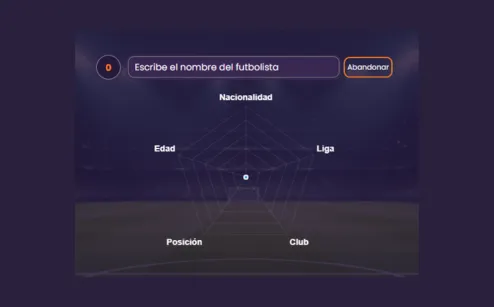
Guess who the mystery player is. You have 25 attempts and after each one the radar will tell you how close you are.


How to Play Goal Radar?
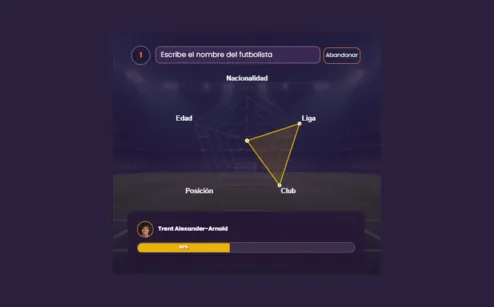
The challenge: identify the secret footballer in up to 25 attempts using the Goal Radar similarity score.
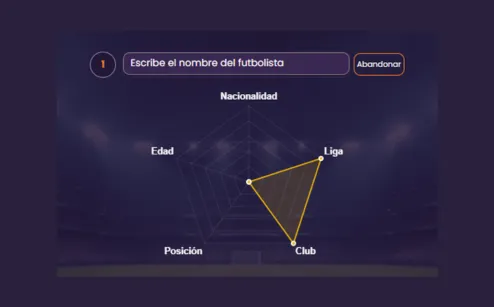
Every player you enter is compared to the hidden one across 5 criteria: Nationality, League, Club, Position and Age.
Nationality, League and Club are binary: 100% if they match, 0% if they don't.
Position gives you 100% for an exact match, 50% if they play in the same area of the pitch (e.g. both defenders), and 0% otherwise.
Age gives you 100% for the same age, dropping as the gap grows — hitting 0% at 5 years or more difference.
- Easy Mode: The hidden player always belongs to one of the top 5 clubs from Europe's major leagues. Great if you mainly know the superstars.
- Normal Mode: The hidden player can be from any club in Europe's top 5 leagues. For true football experts only.
A brand-new mystery player is revealed every day for each mode.
Good Luck!
🔍 Fun Facts
The origin of football radars: Radar charts (or spider charts) were popularised in football by data analytics companies like StatsBomb, letting scouts compare two players' statistical profiles at a glance.
Football's Moneyball: Clubs like Brentford (England) and FC Midtjylland (Denmark) base a large part of their signings on mathematical similarity models, prioritising data radars over traditional scouting.
Finding the next Messi: Modern scouting algorithms use 'cosine similarity' calculations to find statistically identical players, letting clubs search for exact replacements by filtering position, age, league and performance metrics.
Breaking the radar: When Pep Guardiola converted Philipp Lahm from right-back to central midfielder at Bayern Munich, his passing and recovery radar changed so drastically that the algorithms of the time classified him as two completely different players.
📚 You might also like...
- World Cup
Neymar Returns to the Seleção: Brazil Announces Squad for the 2026 World Cup
9 min read - Especiales
The 2026 World Cup Sticker Album Craze: The 48-Team Challenge and the Most Sought-After Stickers
12 min read - Historia
History of the Brazil National Team: The Canarinha and Its Legacy
14 min read